

Recommended Weekend Reads
China’s Quiet Quest to Expand Its Economic Reach in Latin America, An Update on USMCA Negotiations, The Pope’s AI Politics, and How Consumers View Government Debt
August 7 -9, 2026
Below are a number of reports and articles we read this past week and found particularly interesting. Hopefully, you will find them of interest and useful as well. Have a great weekend.
Latin America, China, and the Future of USMCA/CUSMA
China’s Quiet Quest to Dominate Latin America Natalia Cote-Muñoz/Foreign Affairs
For years, U.S. officials have fretted about Chinese megaprojects in Latin America. Successive administrations have, for example, sounded the alarm about Peru’s Chancay Port, which is controlled and operated by a Chinese shipping giant, and about the Chinese-built Coca Codo Sinclair Dam, in Ecuador. In response, Washington has issued diplomatic condemnations against Latin American officials, revoked visas, and even threatened to use force against the region’s governments. It is easy to see why the United States is so worried about major infrastructure being built and operated by China. In the eyes of many U.S. officials, these projects are a way for Beijing to accumulate leverage over Latin American governments… But Washington is stressing about yesterday’s challenge. Beijing is no longer betting on multibillion-dollar megaprojects to improve its position in the Western Hemisphere. Instead, it is embedding itself in the region by fostering smaller, quieter endeavors, often at the municipal or provincial level.
The Sheinbaum Administration’s Cautious Engagement with China. Expediente Arierto
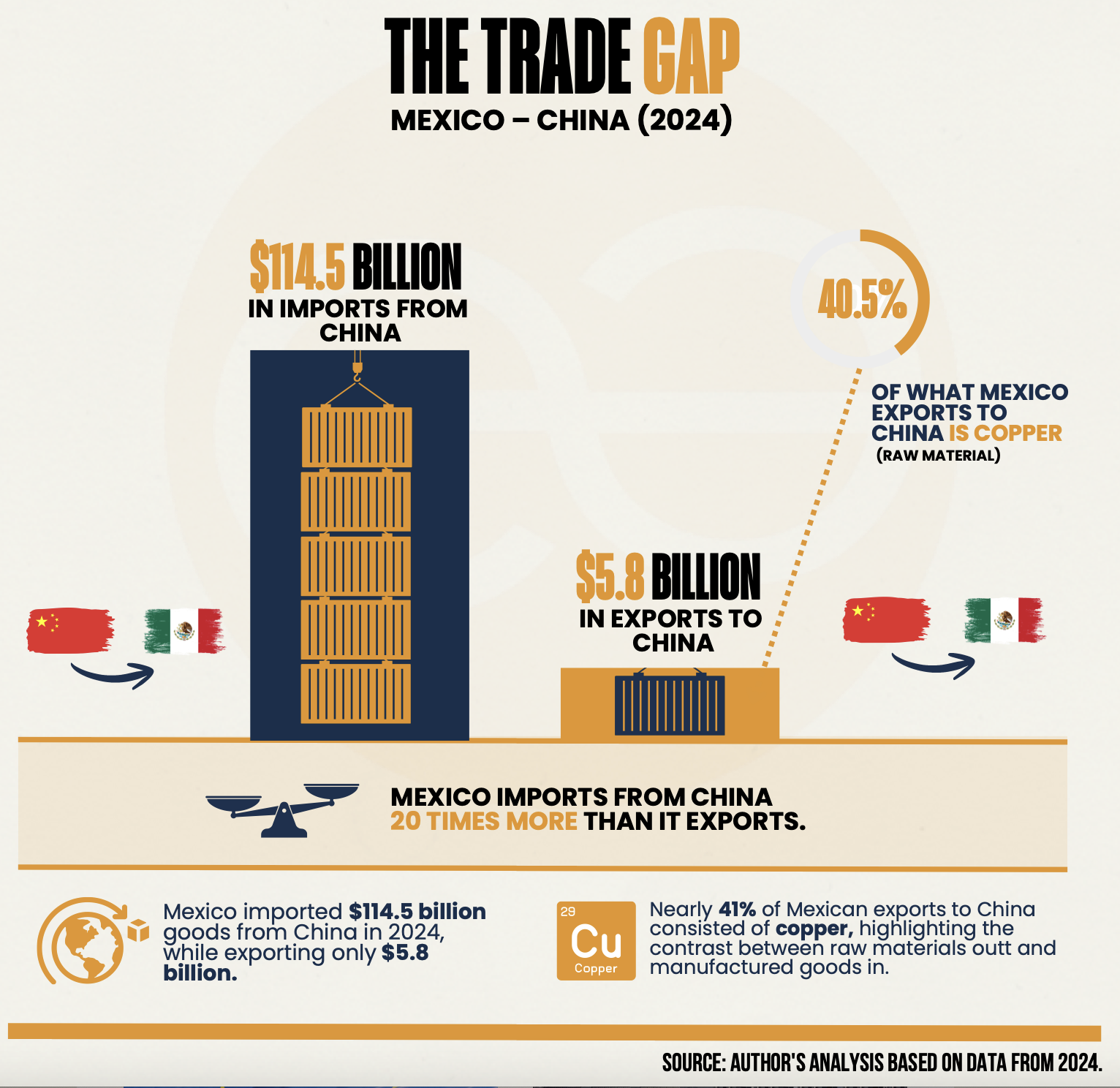
Claudia Sheinbaum’s government in Mexico has sought to navigate a delicate balance between cooperation with the United States, Mexico’s biggest export market, source of remittances and security partner, and the People’s Republic of China (PRC), an important potential source of investment and trade with Mexico, particularly as the trade and political relationship with the U.S. has become increasingly unpredictable and occasionally tense. In the context of preliminary negotiations with the Trump Administration over the future of the U.S.-Mexico-Canada Free Trade Agreement (USMCA), in December 2025, Mexico imposed significant new tariffs on a range of products from countries with which Mexico does not have a current Free Trade Agreement. These included a tariff of up to 50% on autos from the PRC. As an offset, however, Sheinbaum’s government also held high-level talks with her Chinese counterparts to explain Mexico’s action and announced that she will be attending the Asia Pacific Economic Cooperation (APEC) leaders’ summit in Beijing in November 2026, setting the stage for a bilateral summit between Sheinbaum and Xi from which deepened economic, political, and other cooperation could flow.
USMCA and the Politics of Permanent Leverage Americas Quarterly
Without much fanfare, U.S. and USMCA trade negotiators concluded a third round of bilateral USMCA talks in this city days ago. While progress was made on some issues, contentious topics such as auto industry rules of origin and nondiscriminatory access to Mexico’s electricity market are still sticking points that will be discussed in a new round scheduled for September in Washington. So, what is the ultimate goal of the new Washington? The objective is not simply to secure concessions. It is to preserve the leverage that makes future concessions easier to extract. And that distinction matters a lot.
New USMCA demands on USco: A breakdown Mexico Political Economist Substack
The third round’s the charm. This time, US-Mexico-Canada Agreement (USMCA) negotiations between Mexico and the US happened in Mexico City. US Trade Representative (USTR) Jamieson Greer and his team met with President Claudia Sheinbaum to discuss what a revamped regional trade acceptable to the Trump administration might look like. Here are the latest parameters of what the US is asking of Mexico.
The Ethics and Energy of AI and Data Centers
The Pope’s AI Politics Civitas Outlook/Civitas Institute at the University of Texas
Saint Augustine’s political analysis of the city of man and the city of God structures Pope Leo’s XIV’s first encyclical letter, Magnificia Humanitas. Surveying the times, On Safeguarding the Human Person in the Time of Artificial Intelligence sees personal liberty used by currents in geopolitics. Released in May, the encyclical received rave reviews on social media. This is curious given the document’s bleakness. It would be comforting to both enjoy the technology and side with the pope on the politics. However, Leo argues that the technology is as problematic as the politics. He cautions parents and educators “to protect our young people from the promise of the perfect machine.” Without legal and moral oversight, Leo is sure machine learning is not a continuation of Western humanism.
Data Center Electricity Use: Two Years After “Make or Buy?” Lynn Kiesling/Knowledge Problem Substack
Two years ago today, the author published “Data Center Electricity Use III: Make or Buy?,” applying transaction cost economics to a question then just emerging: how would data-center developers respond if electricity became more expensive, less reliable, or too slow to obtain through ordinary utility processes? AI and cloud computing were driving electricity-demand forecasts upward. Grid operators and utilities were warning of generation shortages, transmission constraints, and long interconnection queues. Data centers could keep buying electricity conventionally, or pursue alternatives: long-term contracts with individual generators, co-location with nuclear plants, or on-site generation of their own. The question was where firms would draw the boundary between purchasing electricity through markets and tariffs and exerting direct control over its production. The author’s conclusion was deliberately Coasean: “the answer to the make or buy question is ‘it depends.’” The choice would turn on price, but also on uncertainty, contracting costs, asset specificity, the value of reliability, and the managerial difficulty of producing power internally. But a great deal has happened since then. Microsoft has backed the restart of a retired nuclear plant. Meta has signed a twenty-year agreement to keep another running. Google and Amazon have become sponsors of advanced nuclear technology. Developers have proposed gigawatts of dedicated natural gas generation. Federal regulators have spent two years working out how data centers may connect directly to power plants without shifting costs unfairly onto other customers. The author argues the evidence supports her original hypothesis and refines it. Data centers are not simply choosing between buying from a utility and owning power plants. They are building a spectrum of organizational forms on a continuum between those poles. The decision may be better described as make, buy, or ally. The cost of electricity now includes the opportunity cost of waiting
Who Is Winning the AI Race? Dr. Alina Polyakova/Center for European Policy Analysis
From cyber “breakouts” to new Chinese AI models catching up and a fresh European AI regulation coming into force, the global AI race is accelerating. But who is winning? The author studies the state of AI advancement in the US, China, and Europe. Her analysis finds the US is still in the lead. On the heels of Anthropic’s and OpenAI’s disclosures that their models escaped their sandboxes to hack into companies, the White House once again gathered the leaders of America’s top AI labs to review a new framework for vetting frontier models before release. It is voluntary, for now. But with US public opinion on AI souring, the Administration and Congress are asking how much control can and should the government exert over these increasingly powerful capabilities.
The AGI Rideout Strategy for Reducing Strategic Risk and Promoting Stability in the Transition to Artificial General Intelligence The Rand Corporation
An all-out race toward artificial general intelligence (AGI), driven by expectations that the first state to achieve AGI will enjoy an overwhelming and enduring first-mover advantage over its geopolitical rivals, poses serious national security risks for the United States. Drawing inspiration from strategic developments that stabilized the superpower nuclear rivalry during the Cold War, the authors describe an AGI Rideout strategy that seeks to deter artificial intelligence (AI)–fueled conflict and avoid disrupting U.S. technological progress by increasing the resilience of the AI ecosystem and developing capabilities to counter rapidly evolving adversary AI-enabled military capabilities that could lead to aggression and escalation. AGI Rideout is not a strategy for winning the race to advanced AI or restricting the pace of progress toward it. Instead, the authors argue that the United States should prioritize measures to avoid strategic disaster on the path toward AGI, regardless of the course it takes, and maximize decisionmakers' long-term options in a world with advanced AI.
Geoeconomics
How do Consumers View Future Government Debt A Primer on Debt-Growth Expectations Federal Reserve Bank of Cleveland
Abstract: We analyze consumers’ expectations for growth in government debt before and after the COVID-19 pandemic, its breakdown by different income groups, and its relation to inflation expectations. We find that debt-growth expectations rose immediately during the pandemic recession and started to return to their pre-pandemic levels at the end of 2024. We also observe that consumers in the bottom 40 percent of the household-income distribution have higher debt-growth expectations than their counterparts in the middle 40 percent and top 20 percent of this distribution. A regression analysis indicates that government debt-growth expectations are positively correlated with inflation expectations in the post-pandemic recession period.