

The Financial Regulatory Week Ahead
August 10 - 14, 2026
The Senate Left for August, Hopes of Getting a Deal on the CLARITY Act Got Pushed Until September, And Otherwise, Washington is Collectively on Vacation
Nothing is going on this week. The Senate packed up and left for the rest of August (after shelving efforts to hammer out a deal on the ethics portion of the CLARITY Act until September, when they return). The House of Representatives has been gone for ten days already and will not be back until September, too. There are no major regulatory speeches, conferences, or other events of note this coming week.
We hope you are enjoying the quiet and are on vacation someplace fun. We have three recommended reads for you at the end – not exactly beach reading but pretty good, nonetheless.
Let us know if you have any questions.
U.S. Congressional Hearings
U.S. Senate
· The House is in August recess until September 7th.
House of Representatives
· The House is in August recess until September 7th.
Federal Department & Regulatory Agency Meetings & Events
The White House
· There are no significant events scheduled at this time.
Federal Reserve Board and Federal Reserve Banks
Speeches –
· There are no significant events scheduled at this time.
Conferences –
· There are no significant events scheduled at this time.
U.S. Treasury Department
· There are no significant events scheduled at this time.
Department of Commerce
· There are no significant events scheduled at this time.
Department of Housing and Urban Development
· There are no significant events scheduled at this time.
Securities and Exchange Commission
Thursday, August 6, 2:00 p.m. – The SEC holds a Closed Meeting.
Commodities Futures Trading Commission
· There are no significant events scheduled at this time.
Federal Deposit Insurance Corporation
· There are no significant events scheduled at this time.
Office of the Comptroller of the Currency
· Nothing significant to report.
The Consumer Financial Protection Bureau
· There are no significant events scheduled at this time.
FINRA
· There are no significant events scheduled at this time.
National Credit Union Administration
· There are no significant events scheduled at this time.
Federal Trade Commission & Department of Justice Antitrust Division
· Nothing significant to report.
Farm Credit Administration
· There are no significant events scheduled at this time.
Farm Credit System Insurance Corporation
· Nothing significant to report.
International Monetary Fund & World Bank
· Nothing significant to report.
North American Securities Administrators Association
· There are no significant events scheduled at this time.
Small Business Administration
· There are no significant events scheduled at this time.
Trade Associations & Think Tank Events
Trade Associations
· Tuesday & Wednesday, August 11 – 12 – SIFMA holds a virtual briefing for members on digital assets and asset management.
· Wednesday, September 9, 12:00 – 6:30 p.m. – The Institute for International Finance in conjunction with the Canadian Bankers Association holds the annual IIF-Canada Forum in Toronto.
Think Tanks and Other Events
· There are no significant events scheduled at this time.
Recommended Reads
The new era of finance needs innovation more than consensus CFTC Chair Michael Selig/The Economist
By invitation of The Economist, CFTC Chair Selig wrote an opinion piece on the future of derivative regulation. Selig writes: “For many years, international financial regulation has operated under an assumption that regulatory priorities would emerge through broad consensus among global institutions and regulators from different countries. Although international co-operation remains important, America is not in the business of importing regulatory trends designed by agencies that are considering yesterday’s markets built around limited trading hours, single exchanges and screen-based trading.”
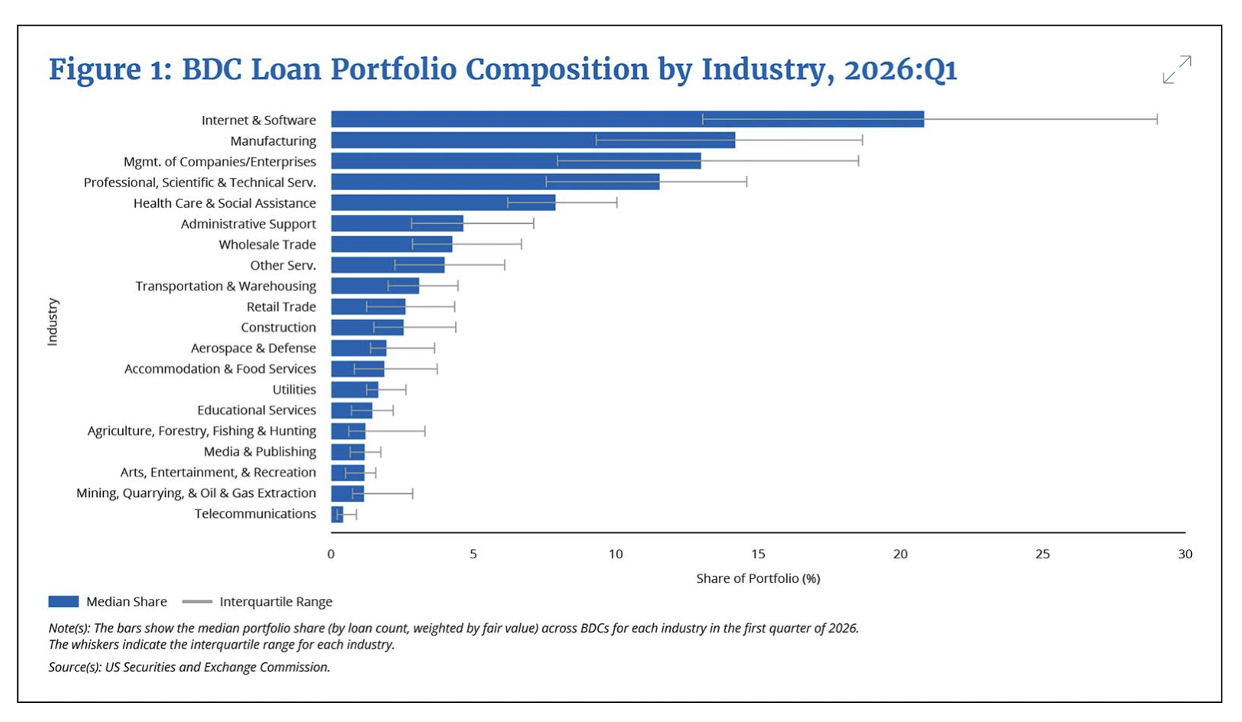
Early Warning Signals in Private Credit? What BDC Portfolios Reveal about Emerging Risks Federal Reserve Bank of Boston
Private credit—lending by nonbank financial institutions—has grown to over $1 trillion in the United States, yet most of it remains opaque to investors and policymakers because private credit funds are not required to publish their holdings. Business development companies (BDCs) are an exception and provide a window into this segment of the credit markets. All BDCs are publicly registered investment vehicles that must file periodic reports with the Securities and Exchange Commission, including quarterly and annual filings. We analyze these disclosures to detect trends in the pricing of BDC loans, borrowers’ creditworthiness, and the industry composition of BDC loan portfolios. The key Takeaways are:
The share of BDC loans with payment-in-kind usage—borrowers deferring cash interest payments—rose from 6 percent to 10 percent from 2022 to 2026; the sharpest increases were in construction, transportation and warehousing, and wholesale trade.
BDC portfolios tend to be concentrated in certain industries: Loans to internet and software companies account for just over 20% of the median portfolio, with wide variation across lenders.
BDC lending spreads average 4 to 5 percentage points over the secured overnight financing rate (SOFR) but have decreased by close to 1 percentage point over the past two years, even as borrowers’ creditworthiness appears to have deteriorated.
While BDCs use internal models to assign value to their portfolio companies, disclosed valuation metrics predict future BDC stock returns, suggesting that public markets incorporate information from those disclosures.
Financial and Production Integration in the Macroeconomy Federal Reserve Bank of Cleveland
Abstract: This paper studies how integration between the financial sector and production networks shapes business cycle transmission. We develop a dynamic model in which banks provide asset-based financing to firms embedded in supply chains. The model highlights two margins of bank–supply chain integration with opposite macroeconomic implications. Extensive-margin integration—captured by firms’ access to banks specializing in different supply chain segments—amplifies negative banking shocks. By contrast, intensive-margin integration—captured by the diffusion of factoring and invoice discounting—attenuates banking disruptions. The model reveals that the stabilizing effects of integration dominate when firm production linkages are tight. The predictions are consistent with matched bank–firm data from Italy.
Please let us know if you have any questions or would like to be added to our email distribution list.