

Recommended Weekend Reads
The National Security Implications of the US Industrial Base, China’s Ongoing Demographic Crisis, The US-Venezuelan Crisis and Bonds, and the Growing Global Debt Crisis
December 5 - 7, 2025
The US Industrial Base and National Security
Building Greater Resilience and Capacity in the US National Security Industrial Base Brookings Institution
In the current policy landscape, virtually every stakeholder—from federal agencies to industry groups—calls for classifying a widening swath of economic activity as “national security.” The impulse to broaden what counts as critical has gained momentum not only with each new global disruption, but also with each new report highlighting U.S. exposure to China in key sectors, making “national security” a catchall for fears that range from supply interruptions to cyber threats. While this instinct reflects real vulnerabilities, it leaves policymakers struggling to prioritize and risks making the label so expansive that it ceases to have sharp policy meaning. This paper cuts through that noise. We agree with the notion of expanding the concept of national security to include production supply chains, the interruption of which by a hostile foreign actor could directly imperil large numbers of American lives or the functioning of society. Our approach, however, is not simply whether to broaden the concept of national security, but how to realistically scope it—especially when it comes to supply chains.
The National Security Strategy of the United States of America 2025 The White House
On Friday, the White House released a report entitled “The National Security Strategy of the United States of America 2025.” In it, the report makes clear that securing access to critical supply chains and materials is of paramount importance to the Trump national security strategy, along with reindustrialization, balance of trade, and reviving the US’s Defense Industrial base.
Acquisition Reform vs. Congress: Who Will Win? War on the Rocks
Weeks ago, Secretary of Defense Pete Hegseth gave a speech announcing the Pentagon’s intentions to embrace more aggressive acquisition reforms. One of the most significant changes is to shift from a program focused acquisitions to portfolio concepts. According to Hegseth: “We will shift funding within portfolios’ authorized boundaries swiftly and decisively to maximize mission outcomes. If one program is faltering, funding will be shifted within the portfolio to accelerate or scale a higher priority. If a new or more promising technology emerges, we will seize the opportunity and not be held back by artificial constraints and funding boundaries that take months or even years to overcome.” But the biggest obstacle to shifting the Department of Defense to a portfolio management structure comes from congressional appropriators. Regardless of party affiliation, appropriators jealously guard their role as the arbiters of spending allocation in defense and other Federal roles. They have consistently opposed giving the Pentagon this degree of flexibility. A knock-down, drag-out fight between the Trump Administration and Congress now looms.
Latin America
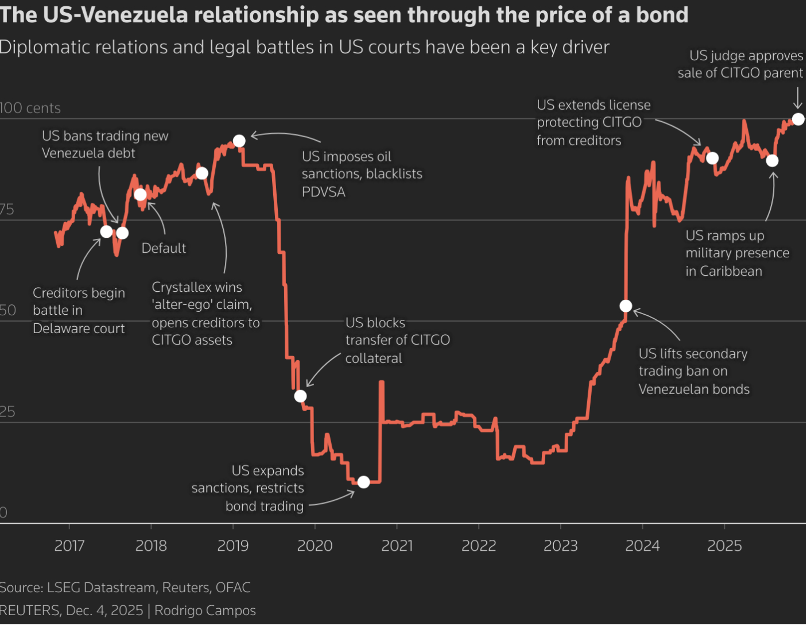
The US-Venezuela relationship as seen through the price of an oil-linked bond Reuters
The ramp-up of U.S. pressure on Venezuelan President Nicolas Maduro's government is bringing fresh attention to the nation's defaulted bonds, including those of the state oil company Petroleos de Venezuela, known as PDVSA. Venezuela defaulted on its debt in 2017 but PDVSA continued to pay holders of a specific bond maturing in 2020. It was issued in 2016 under a swap offer that replaced debt maturing the following year. This bond is secured with a pledge of 50.1% of refiner Citgo Holding through PDVSA’s wholly-owned subsidiary PDV Holding. But payments stopped after the opposition-led National Assembly declared the bond contract illegal in October 2019.
The Hidden Cost of Your Avocado Ioan Grillo/New York Times
In recent years, Mexico’s cartels have diversified from drug production to a portfolio of criminal rackets, from human smuggling to stealing crude oil — and, increasingly, extorting civilians. The shakedowns, known here as “cobros de piso,” rob workers, from mom-and-pop shop owners to farmers to truck drivers, of their earnings and force up the prices of goods in Mexico and abroad. One business association estimates that such protection rackets cost Mexican enterprises around $1.1 billion this year as of September.
China’s Demographic Challenge
China's Demographic Dilemma Pekingology Podcast: On Chinese Politics/Center for Strategic and International Studies
In this episode of Pekingology, CSIS Senior Fellow Henrietta Levin is joined by Philip O’Keefe, Professor of Practice at the University of New South Wales Centre of Excellence in Population Ageing Research and one of the world's leading experts on demographic trends in China and across Asia. They unpack the rapid aging of Chinese society, exploring the impact of a shrinking population on China's politics, economy, and innovation ecosystem, as well as its trade imbalances and Beijing's global ambitions.
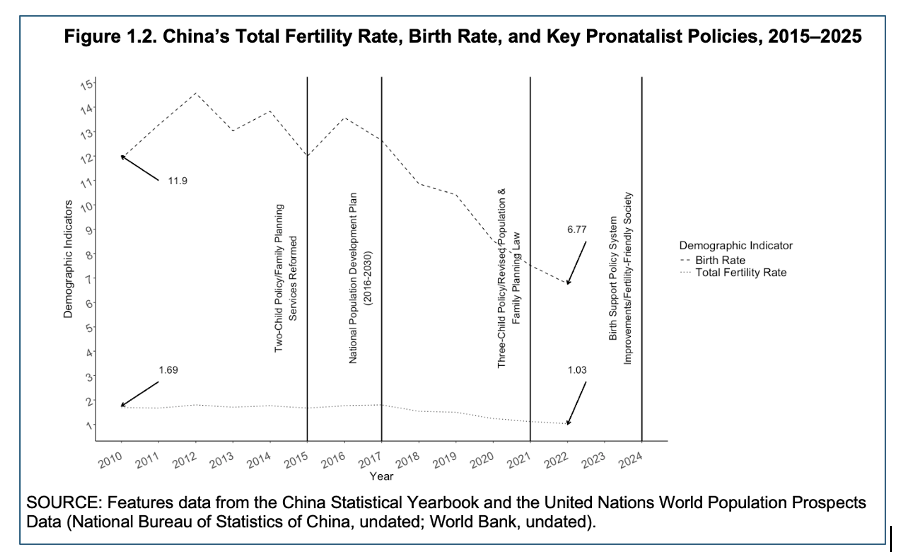
China Is Trying to Boost Fertility. It’s Not Working Rand Corporation
China's population is aging rapidly, and its birth rate is declining. These trends have resulted in a shrinking workforce and growing pressure on social services. In response, Beijing has rolled out a series of pronatalist policies. A new RAND study finds that these efforts have been unevenly implemented and largely ineffective. This shows the limits of government attempts to influence family decision-making. These findings have implications for the United States, where fertility rates are also declining. Rather than trying to increase the population's desire to have children, it may be more effective to help those who already want to grow their families. Such an approach might include removing structural barriers by improving access to affordable child care and housing. As the authors write, “The United States should learn from China’s failed pronatalist policy.”
Geoeconomics
The Global Debt Crisis Builds Robin Brooks Substack
Fed cuts aren’t pulling down long-term yields: if you look at the long end of the yield curve properly by stripping out front-end yields, things look very worrying. 10y10y and 10y20y forward yields are near their highs and the gap of both metrics with 10-year yield has grown. The buyers’ strike for longer-dated Treasury debt looks like it’s getting worse. There’s many idiosyncratic trouble spots: a key feature of the recent rise in long-term yields is that there’s many fiscally distressed countries that run into trouble at different points and for idiosyncratic reasons. Italy, France and the UK are all part of this dynamic and have very elevated 10y20y forward yields. Traditional safe havens are failing: in the past, Japan and Germany would have been safe harbors in this kind of environment, but these days they’re at the heart of the rise in long-term yields.

The State of Generative AI Adoption in 2025 Federal Reserve Bank of St. Louis “On the Economy” Blog
In September 2024, we presented results from the first nationally representative U.S. survey of generative AI adoption at work and nonwork settings, conducted in August 2024. Since then, we have conducted our survey—the Real-Time Population Survey—on a quarterly basis. In this blog post, we share an update on the state of generative AI adoption by U.S. workers and look for evidence of this technology’s impact in the broader economy.