

Recommended Weekend Reads
What Does Russia’s Inability to Support Its Allies Mean for Its Own Future?, The Massive Industrial Challenge To Modernize the U.S. Navy, Was Pandemic Fiscal Relief Effective Stimulus? And An Assessment of China’s Military Buildup
January 16 - 18, 2026
Below are a number of reports and articles we read this past week and found particularly interesting. Hopefully, you will find them interesting and useful as well. Have a great weekend.
The Future of Russia
Putin’s great-power project faces the ‘end of an era’ Politico EU
Moscow was also seemingly unable to protect its closest friend in South America earlier this month when the United States captured Venezuela’s Nicolás Maduro, a leader who had dutifully made the trip to Moscow for Putin’s Victory Day Parade in May last year. Embarrassingly, Moscow wasn’t even able to fend off the unprecedented U.S. seizure of an oil tanker flying a Russian flag. Just a year ago, Putin signed a 20-year strategic partnership agreement with Tehran. Now the regime — which supplied Russia with killer Shahed drones for its fight in Ukraine — is in danger of being toppled by protesters whom Trump has indicated he could intervene militarily to defend. Russians have taken notice. “An entire era is coming to an end,” wrote a pro-war military blogger under the pen name Maxim Kalashnikov on Sunday, reflecting growing criticism of the Russian leadership.
Russia Is the World’s Worst Patron Foreign Affairs
For the last 20 years, Moscow has demonstrated an ability to inject itself as a player in regions with strong anti-American sentiment. But the Kremlin’s costly adventures have yet to show any practical benefits for enhancing Russia’s genuine security interests or boosting its economic prosperity. Involvement in places such as Venezuela serves only Putin’s vanity, a few votes of solidarity with Moscow at the UN General Assembly, and money-making opportunities for corrupt Russian officials. The result has been that from Syria to Venezuela to Iran, Putin has overpromised and underdelivered.
Why Didn’t the Ukraine War Turn Russia’s Ruling Class Against Putin? Carnegie Politka
The answer is that Russia’s ruling class is disillusioned and fragmented. And, as the writer points out, the apparent suicide of the dismissed transport minister Roman Starovoit in 2025 was a reminder of the fragility of everyone’s position. For another, the idea that had brought together much of the establishment, “autocratic modernization”—that despite the authoritarian system, a rational state, capable of learning lessons and balancing interests, could still emerge in Russia—has obviously turned out to be a failure.
The Massive Challenge to Modernizing the U.S. Navy
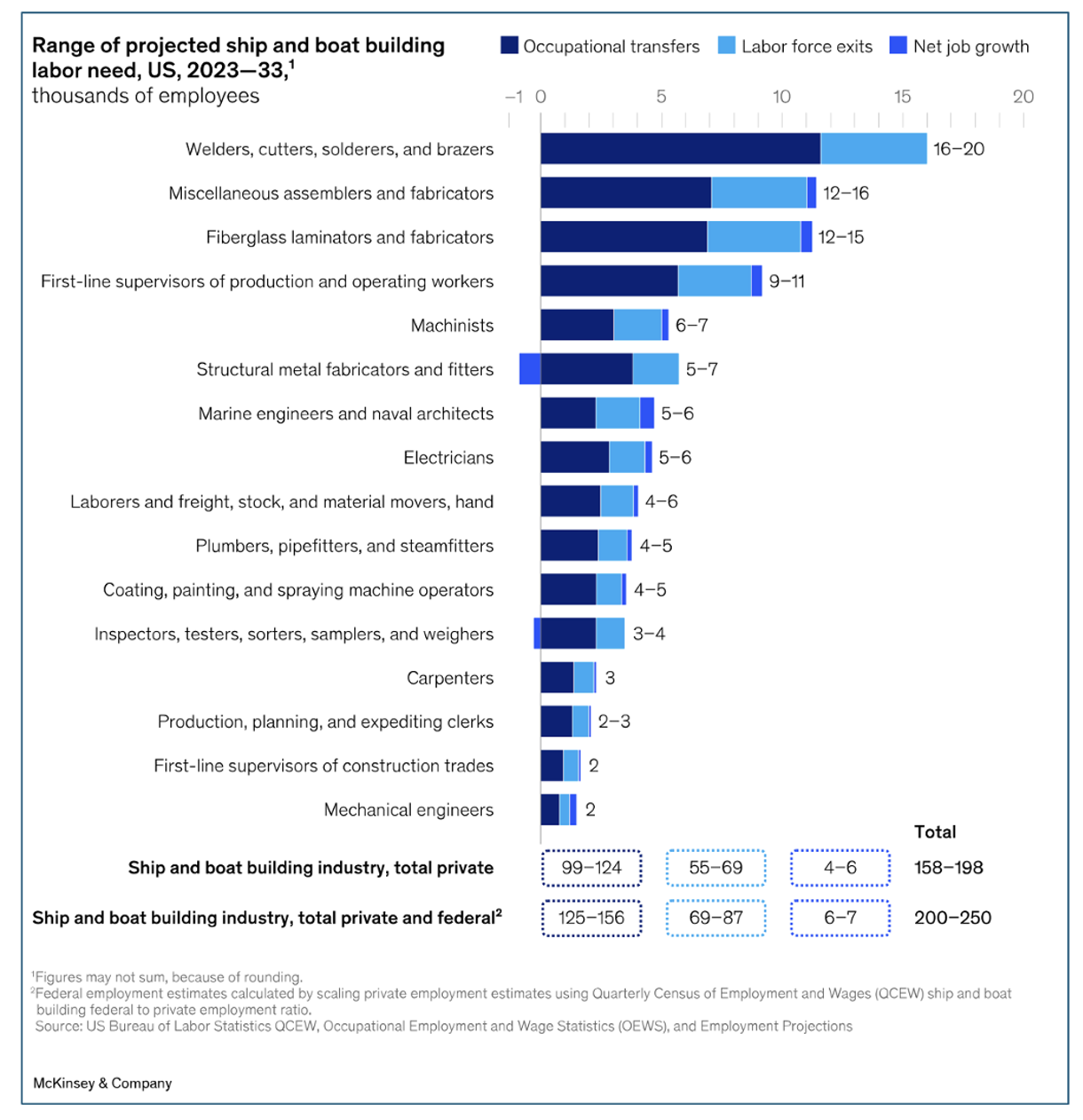
Helming A Sea Change: Building The Future Workforce For US Shipbuilding McKinsey & Company
According to the US Department of Labor, the shipbuilding industry may require about 200,000 to 250,000 additional maritime workers in critical occupations, such as welding, soldering, and front-line management, to satisfy demand over the next decade. If demand for ships increases, the labor gap will be even wider.
Outlining the Challenges to the U.S. Naval Shipbuilding Center for Strategic and International Studies
Growing the size of the Navy has been a bipartisan goal of successive administrations and Congress over the last decade. The service faces capacity limitations as it struggles to meet the demands of its current aggressive operational tempo with a fleet that is small by historical standards and faces delays in conducting maintenance. The demand to increase the Navy’s ship count has only grown as China’s navy has overtaken the U.S. fleet in terms of size, with the blistering rate of production of its own shipbuilding industry. Despite the Navy’s plans for growing the fleet and bipartisan efforts and funding from Congress, the U.S. shipbuilding enterprise—including the Navy, Department of Defense (DoD), Congress, and industry—has failed to consistently produce ships at the scale, speed, and cost demanded. These longstanding challenges stem from a series of interwoven, systemic issues within both the U.S. government and industry, as well as broader socioeconomic trends. This report outlines the challenges facing the U.S. naval shipbuilding enterprise, their underlying drivers, and some efforts the government has taken to mitigate them.
Geoeconomics and Technology
Was Pandemic Fiscal Relief an Effective Fiscal Stimulus? Evidence from Aid to State and Local Governments Journal of Macroeconomics
Abstract: We use an instrumental-variables estimator reliant on variation in congressional representation to analyze the macroeconomic effects of federal aid to state and local governments during the COVID-19 pandemic. Through December 2022, we estimate statistically insignificant impacts of federal aid on employment. Our baseline point estimate suggests that $603,000 were allocated for each state or local government job-year preserved, and the bounds on our baseline confidence interval rule out estimates smaller than $220,400. Our estimates of effects on aggregate income and output are centered on zero and imply modest, if any, spillover effects onto the broader economy.
When Trade Compresses: The Impact of Liberalization on Wage Inequality Federal Reserve Bank of Cleveland
Abstract: We study the effects of trade liberalization on the full wage distribution, exploiting Spain's 1993 entry into the European Single Market. Using employer-employee data, we identify the causal effects of trade across the entire wage distribution, using a novel shift-share instrument embedded in an unconditional quantile regression. We find that the liberalization reduced wage inequality, leading to wage compression through earnings gains at the bottom of the distribution and wage losses at the top. We trace this compression to two asymmetric channels: import competition disproportionately harmed high earners, while export opportunities benefited low earners. The key mechanism is an import-driven “skill-downgrading.” A multi-region multi-sector model shows that the key insight for understanding these empirical results is that trade's distributional effects depend on the skill intensity of a country's tradable sector, and Spain's was relatively low-skill-intensive back then.
Foreign Affairs: The Myth of the AI Race Colin Kahl/ Foreign Affairs
In July, the Trump administration released an artificial intelligence action plan titled “Winning the AI Race,” which framed global competition over AI in stark terms: whichever country achieves dominance in the technology will reap overwhelming economic, military, and geopolitical advantages. As it did during the Cold War with the space race or the nuclear buildup, the U.S. government is now treating AI as a contest with a single finish line and a single victor. But that premise is misleading. The United States and China, the world’s two AI superpowers, are not converging on the same path to AI leadership, nor are they competing across a single dimension. Instead, the AI competition is fragmenting across many domains, including the development of the most advanced large language and multimodal models; control over computing infrastructure such as data centers and top-of-the-line chips used to train and run models; influence over which technologies and standards are used throughout the world; and integration of AI into physical systems such as robots, factories, vehicles, and military platforms. Having an edge in one area does not automatically translate into an advantage in the others. As a result, it is plausible that Washington and Beijing could each emerge as leaders in different parts of the AI ecosystem rather than one side decisively outpacing the other across the board.
China’s Military Capability
Annual Report to Congress: Military and Security Developments Involving the People’s Republic of China 2025 U.S. Department of Defense
Abstract: China’s historic military buildup has made the U.S. homeland increasingly vulnerable. China maintains a large and growing arsenal of nuclear, maritime, conventional long-range strike, cyber, and space capabilities able to directly threaten Americans’ security. In 2024, Chinese cyberespionage campaigns such as Volt Typhoon burrowed into U.S. critical infrastructure, demonstrating capabilities that could disrupt the U.S. military in a conflict and harm American interests. The PLA continues to make steady progress toward its 2027 goals, whereby the PLA must be able to achieve “strategic decisive victory” over Taiwan, “strategic counterbalance” against the United States in the nuclear and other strategic domains, and “strategic deterrence and control” against other regional countries. In other words, China expects to be able to fight and win a war on Taiwan by the end of 2027.
The World Economic Forum’s Global Risk Assessment
Global Risks Reports 2026 World Economic Forum
In advance of the World Economic Forum (WEF) meetings in Davos ,Switzerland this coming week, the WEF released their 21st edition Global Risks Report 2026. The report analyses global risks through three timeframes to support decision-makers in balancing current crises and longer-term priorities. Chapter 1 presents the findings of this year’s Global Risks Perception Survey (GRPS), which captures insights from over 1,300 experts worldwide. It explores risks in the current or immediate term (in 2026), the short-to-medium term (to 2028) and in the long term (to 2036). Chapter 2 explores the range of implications of these risks and their interconnections, through six in-depth analyses of selected themes. Below are the key findings of the report, in which we compare the risk outlooks across the three-time horizons.