Recommended Weekend Reads
June 5 - 7, 2026
Assessing U.S. Military Options Toward Cuba, Chile’s Investment Reset, China Considers the Challenge of Ruling Taiwan, and Is AI Creating Value?
Below are a number of reports and articles we read this past week and found particularly interesting. Hopefully, you will find them both interesting and useful. Have a great weekend.
Americas
The Next Caribbean Crisis? Assessing U.S. Military Options Toward Cuba Center for Strategic & International Studies
The United States has engaged in touch-and-go negotiations with various figures within the Cuban communist regime, while at the same time issuing an executive order to further increase economic pressure on the island. The United States has stepped up military surveillance overflights of Cuba, gathering intelligence on the capabilities and dispositions of the country’s Revolutionary Armed Forces (FAR). In late May, CIA Director John Ratcliffe met with Cuban leaders, bringing along a paramilitary officer who was involved in capturing Maduro and killing the Cuban military personnel who were guarding the Venezuelan leader. It was a sign of what could come if negotiations are unsuccessful. Although the crisis in the Persian Gulf continues to smolder, the United States has enough military assets to operate simultaneously in the Western Hemisphere. While the ultimate objective of U.S. Cuba policy remains unclear, the possibility of military action is present. Therefore, it is worthwhile to examine a range of possible scenarios involving the use of force against Cuba. This report examines five such scenarios, their relative likelihoods, and the risks involved.
Why Brazil–U.S. Relations Will Worsen Before They Improve Latin America Takeaways
Between new tariffs on Brazil and the recent announcement of new U.S. measures targeting Brazil criminal gangs— the designation of the PCC and Comando Vermelho as terrorist organizations and, more recently, the conclusion of the Section 301 investigation — domestic political analysis has focused more on the electoral implications of these developments than on their broader consequences for the overall trajectory of the bilateral relationship. As the Brazilian elections get closer, the U.S.-Brazil relationship is likely to worsen before getting better.
Kast and Chile’s Investment Reset Americas Quarterly
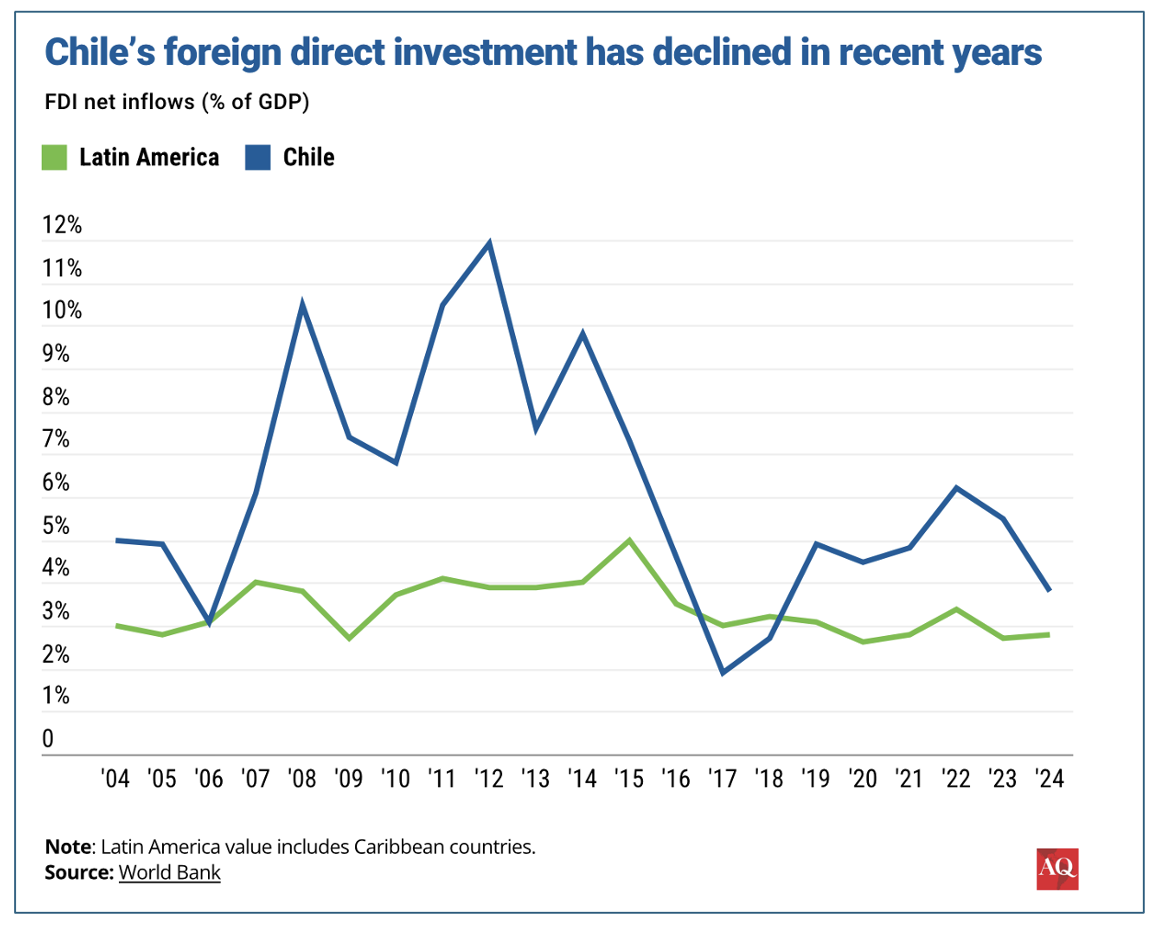
For decades, Chile stood out as Latin America’s most reliable destination for foreign direct investment (FDI), capturing as much as $192 billion between 2000 and 2014, or 7.4% of the region’s total net inflows. But since then, the country has endured a substantial erosion of its ability to attract international capital. That may be about to change. In April, President José Antonio Kast submitted an economic reform to Congress — the Reconstruction and Economic Development (RED) bill — that seeks to modernize the investment regime and encourage both international and local investment as the government aims to boost GDP growth to 4% annually by the end of his administration, double the average annual GDP growth rate reported since 2014. The goal is to reset the investment climate after years of lackluster performance, and the House already passed the proposal, which the Senate will begin discussing today. Kast defended the scope of the reform during his first annual address to the nation held at the National Congress in Valparaiso on Monday. Reviving the investment environment and redefining its institutional framework presents a challenge: how to rebuild economic dynamism without undermining the regulatory legitimacy gained through social and political reforms of the recent past. This is a political question, not only an economic dilemma.
U.S. Foreign Policy in the Western Hemisphere: Issues for Congress Congressional Research Service
The Congressional Research Service – the research arm of the U.S. Congress – recently prepared an updated brief for members of Congress on the region and official U.S. policy. It offers a good high-level overview of all that has changed in U.S. foreign policy for the region.
Delcy Rodríguez Tries to Show She Has a Debt Strategy Caracas Chronicles
In April 2026, the IMF and World Bank resumed dealings with Venezuela for the first time since 2019, opening the path to a formal economic assessment and potentially unlocking $4.9 billion in frozen special drawing rights. In May, the Delcy administration announced a “comprehensive restructuring of its sovereign debt” and PDVSA obligations, appointing Centerview Partners as financial adviser and pledging a macroeconomic framework by June. This did not include a request for a macroeconomic program established by the Fund, which distanced itself from Venezuela’s announcement shortly after. According to Reuters, Venezuela’s total liabilities could be above $150 billion. On June 2, Venezuela added Hogan Lovells as legal counsel for the restructuring under a dual mandate that also covers strategic lobbying for the Venezuelan embassy in Washington. The account is led by Norm Coleman, a former Republican senator with deep political connections in the capital. Neither selection has been free of political entanglement. Former Trump official Mauricio Claver-Carone, earmarked by The Washington Post as Venezuela’s unofficial viceroy, has vouched for Centerview. His business partner, Jessica Bedoya, was on the same chartered flight to Caracas as two Centerview executives on February 12, weeks before the firm finalized its contract (Centerview denied Bedoya played any role in their assignment).
The US plan for Venezuela won’t work without the rule of law. Here’s how to make progress Chatham House
Drawing on discussions with a group of experts including Venezuelan and international jurists, diplomats, scholars of democratic transitions and democratization, and representatives of the Venezuelan opposition, this policy paper sets out recommendations for incremental, integrated steps to achieving rule-of-law reform in post-Maduro Venezuela. The paper makes the case that a negotiation and monitoring process must be put in place without delay, with the committed involvement of the US, the interim Venezuelan government, multilateral organizations, diplomatic missions, investors, and local business and civil society. The framework for this process will need to identify priorities, benchmarks, and a timeline for institutional and legal reforms, and it should clearly articulate how judicial, commercial, legal, and human rights reforms relate to, and underpin, economic and political development.
Indo-Pacific
How China Misperceives Itself Foreign Affairs
Great powers rarely fail because they are unaware of their problems. More often, they fall apart because they misidentify or only partially identify the root of those problems. The ability to accurately diagnose weaknesses, to distinguish between temporary constraints and structural limits, and to generate the political will to fix deep-seated problems separates states that adapt and thrive from those that stagnate or crumble. China today faces an imposing list of challenges that it needs to assess and address. Economic growth is slowing, the population is aging, the financial system is under stress, and other countries have been tightening trade controls and scaling up their own industrial policies to compete. For many years, China’s economic expansion could mask the country’s underlying vulnerabilities. That era is now over. And in party documents and major speeches alike, leaders in Beijing admit these pressures and acknowledge the country’s weaknesses.
After the Invasion: China Considers the Problem of Ruling Taiwan War on the Rocks
In August 2024, scholars at a Xiamen-based think tank published a paper urging Beijing to immediately establish a shadow Taiwan government on the Chinese mainland in preparation for a full takeover of the island. “It is imperative to prepare a plan for the comprehensive takeover of Taiwan after unification,” they said. The scholars were writing at a fraught moment for Beijing. Only months earlier, the anti-China Democratic Progressive Party had taken office after a third consecutive presidential election win. Unusually for a Chinese publication on such a sensitive topic, the paper made several frank admissions: that opposition to unification within Taiwan had deepened rather than softened; that Hong Kong’s post-1997 governance model was ill-suited to Taiwan; and that many Chinese officials lacked even a basic understanding of political and social conditions on the island. The paper circulated briefly before disappearing from China’s internet, which underscored the sensitivity of the topic and the rarity of such candor.
The Iran Effect: Showing The Many Challenges to Crude Oil Processing
The global refining disorder: The political geography of crude processing Alexander Etkind, Georg-Kaup, Ayansina Ayanlade, Gustavo Andreao/Energy Research & Social Science
Abstract: Why are refineries where they are, and what forces explain their distribution across planetary space? This article develops the concept of the Global Refining Disorder (GRD) to analyze the political geography of crude oil processing. Departing from location theory, which privileges transport-cost minimization, we argue that refinery siting is determined by the interplay of national strategies, security regimes, postcolonial legacies, and economies of scale. We identify two ideal types of refining political economy — the mercantile pump, which concentrates processing capacity near centers of power and imports crude from peripheries, and the developmental syringe, which locates refining near extraction sites to stimulate peripheral growth. Working across five comparative cases – the United States, Russia, Saudi Arabia, Brazil, and Nigeria – we analyze the transportation triangles shaped by oil fields, refineries, and consumers of fuel. To operationalize these carbon flows, we calculate two derived measures — refining lag and the export-to-refining ratio. With the concept of securitization of scalability, we explain how economies of scale generate systemic vulnerability of refineries. Recent events in Ukraine and Iran empirically demonstrate that refineries constitute the most vulnerable component of the global energy system. Looking forward, we argue that the path from refining to circularity secures decentralization of energy supply, with political choice — rather than geological endowment or market signals — remaining the decisive variable in transition.
Is AI Creating Value?
Writing Code vs. Shipping Code: Productivity Effects Across Generations of AI Coding Tools Mert Demirer, Leon Musolff & Liyuan Yang/National Bureau of Economic Research
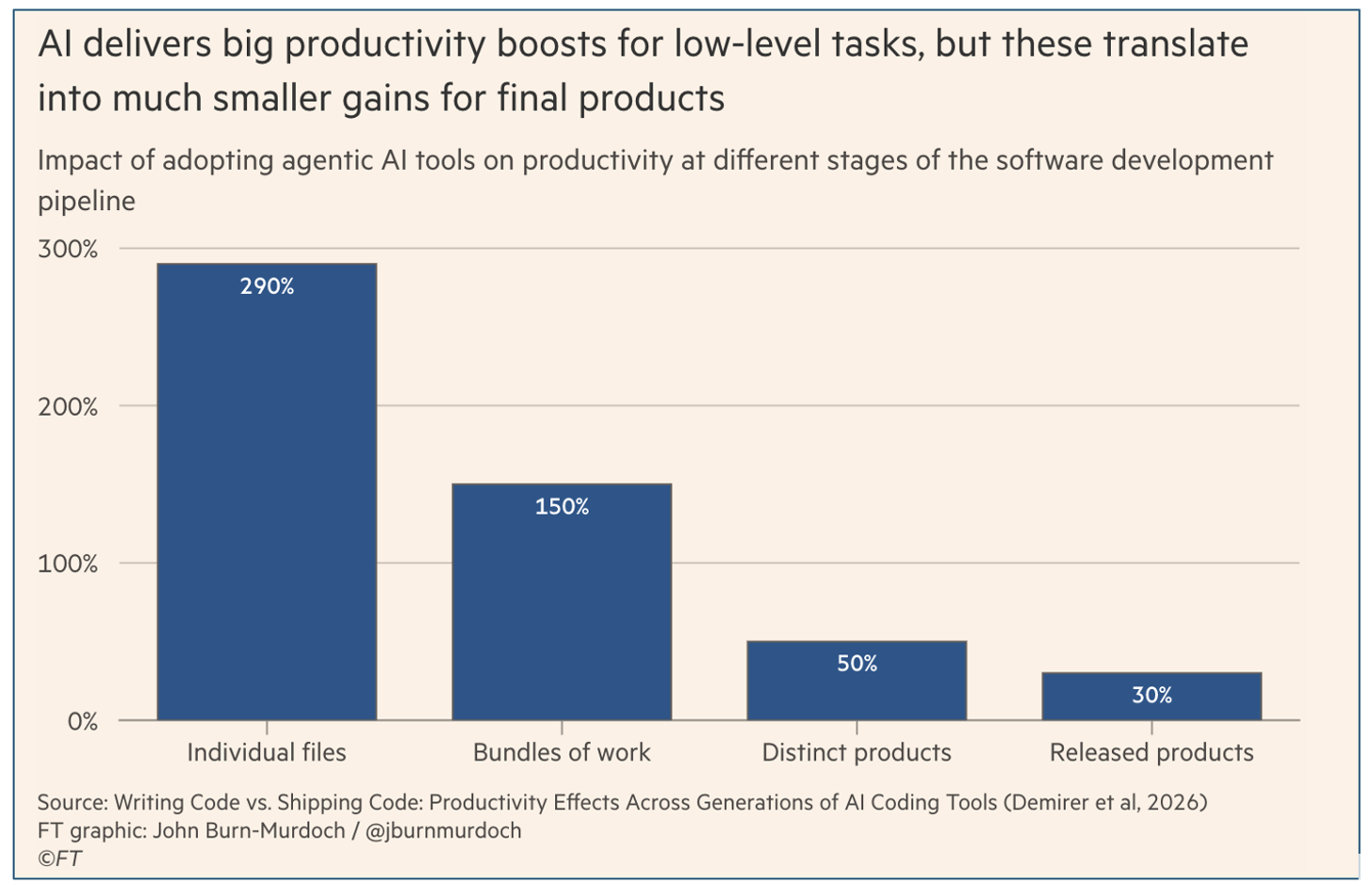
The Financial Times Data Points columnist John Burn-Murdoch wrote an intriguing piece asking if AI was really creating much value. Burn-Murdoch wrote, “One particular point of tension between AI’s boosters and detractors has been the disconnect between reported increases in coders’ output and the apparent lack of a corresponding boom in product or value creation. A new paper leaves both sides able to claim vindication. The study by MIT’s Mert Demirer and co-authors tracked software developers’ work before and after they adopted AI tools. Importantly, they measured this at several different levels, from the amount of code written, to the number of discrete files edited, to the number of projects or features worked on, to actual releases of new software. They found an explosive impact at the top of this funnel — coders created or edited almost 300 per cent more files — but that boost was halved to 150 per cent by the time they got to the number of discrete pieces of work submitted for review, and that in turn shrunk fivefold to a roughly 30 percent uplift in the number of full software releases. This is the study. And here is the abstract:
Abstract: How do the productivity effects of AI evolve across successive generations of tools, and to what extent do task-level gains ultimately translate into final output? We study these questions in the context of software development, using data on more than 100,000 GitHub developers combined with their AI usage telemetry. In a matched event study design, we find that autocomplete, interactive coding agents, and autonomous coding agents each significantly increase coding activity (“commits”), with respective cumulative effects of 40%, 140%, and 180%. These gains, however, attenuate sharply across the production hierarchy: the 180% cumulative effect falls to 50% for the number of projects, and to 30% for actual releases. This pattern is consistent with the weak-link hypothesis: the strong productivity gains from AI are attenuated by human bottlenecks in the production chain, with an estimated elasticity of substitution of 0.25 between AI and human effort, which indicates strong complementarities. We further confirm these results across four major app marketplaces, finding a moderate increase in the number of new apps but no increase in total usage. Large task-level AI productivity gains have therefore translated only partially into shipped and used software thus far.