Recommended Weekend Reads
June 12 - 14, 2026
The Battle Over Data Centers, Is the iPhone Birth Control?, Germany’s Evolving Defense Policy, and US Debt Levels Won’t Be Sustainable in 20 Years
Below are a number of studies, research reports, and news analyses we read this past week. We thought you might find them of interest and, hopefully, of use. Please let us know if you have any questions.
The Growth and Growing Battle Over Data Centers
Latin America’s Data Center Gold Rush: Myth and Reality Americas Quarterly
The numbers speak for themselves: Google is building an $850 million data center in Uruguay; Amazon committed $5 billion to a new cloud region in Mexico; and Microsoft is investing $2.7 billion in cloud and AI infrastructure in Brazil. From Montevideo to Querétaro, data center providers are expanding capacity, governments are rolling out tax incentives, and multilateral banks are publishing frameworks to help countries “capture the data center opportunity.” The opportunity is real. So is the risk of misreading it. Latin America and the Caribbean are emerging as credible destinations for digital infrastructure investment for reasons that go beyond hype. The region’s electricity matrix is a structural asset: Brazil generates nearly 90% of its electricity from renewables, and companies like Equinix, Ascenty and Scala have expanded aggressively in São Paulo for exactly that reason.
OpenAI’s Threat Report: “Data Center Bandwagon” The Special Competitive Studies Project
In this YouTube interview, OpenAI’s Ben Nimmo, who leads the company’s intelligence and investigations work, details a covert influence operation — likely out of China — that used ChatGPT to generate content posted by fake accounts posing as Americans, aimed at one surprising target: America’s own data centers. Ben connects it to a pattern that should worry anyone tracking the AI race, and answers the question— why reach for ChatGPT instead of China’s own DeepSeek?
America’s Data-Center Build-Out Is Falling Way Behind Schedule Wall Street Journal
Tech companies are earmarking unprecedented sums of money to finance the build-out of massive data centers, with a planned $85 billion equity-raise by Google being the latest example. But even as the piles of capital secured have grown ever larger, the ability to deploy it in the artificial-intelligence race has become less certain. Supply-chain backlogs, permitting fights and availability of power supplies are among the issues that have caused the construction of data centers to fall behind targeted timelines, with the gap growing wider in recent months: A JPMorgan analysis last month found that more than 60% of data-center capacity planned for completion in 2027 isn’t yet under construction, and another 7% is delayed. It is a seeming paradox: If hyperscalers can’t break ground on many of the projects they have already announced, what difference can hundreds of billions of dollars more make—however eager Wall Street may be to supply it?
Demographics
·Is the iPhone Birth Control? Causal Evidence from AT&T’s 2007–2011 Carrier Monopoly Caitlin Myers & Ezekiel Hooper/National Bureau of Economic Research
Abstract: The U.S. general fertility rate has fallen by 22% since 2007, a sustained decline not readily explained by economic conditions, contraceptive use, housing or childcare costs, or other commonly cited factors. We assess the potential role of a different shock: the diffusion of the smartphone. The U.S. rollout of the iPhone, the first modern smartphone, provides a natural experiment: from June 2007 through February 2011, the device was sold only on AT&T, allowing us to identify its effect from variation in AT&T’s mobile broadband coverage. Entropy-balanced Poisson and synthetic difference-in-differences event studies imply that access to the iPhone reduced births by 4.5–8.0% at ages 15–19 and 3.2–6.6% at ages 20–24, with statistically significant but smaller declines among older cohorts. Placebo analyses applied to Verizon and Sprint’s pre-2011 coverage footprint are null. Taken together, these cohort effects imply that the diffusion of the iPhone deepened the decline in births among women under 30 while suppressing the rise in births among older women. Overall, the diffusion of the iPhone explains 33–52% of the decline in the general fertility rate among women aged 15–44. National-survey evidence on time use and sexual behavior is consistent with the iPhone reducing in-person interactions, increasing pornography use, and reducing sexual frequency.
India’s population will soon be falling—probably quite fast The Economist
In 1950 India’s population was 360m. The average woman had six children—roughly the same as an American woman a century earlier. Today, with a population of 1.45bn, India accounts for a sixth of humanity. It surpassed China as the world’s most populous country in 2023 and has kept growing. But its total fertility rate (tfr), the number of births a typical woman has over her lifetime, has fallen to 1.9 (see chart 1), below the level needed to keep the population stable in the long run. Although the population will keep growing for a spell, as the generation that are currently children themselves become parents, a future contraction is inevitable unless the fertility rate rises back above 2.15. In practice, it is likely to keep falling, accelerating the impending shrinkage. In Delhi, for instance, the tfr is 1.2.
Declining Fertility Rates Across the World Federal Reserve Bank of St. Louis
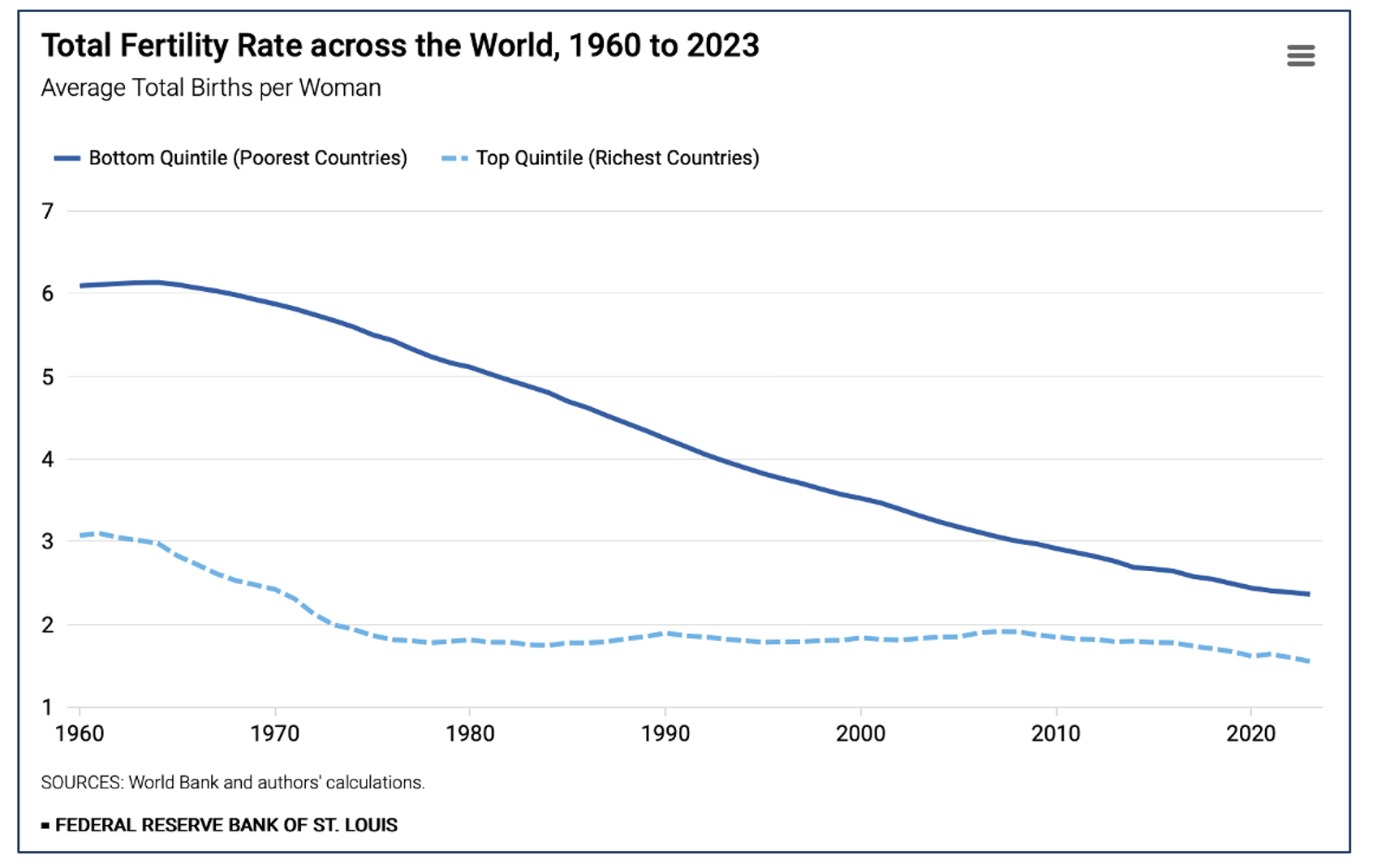
The total fertility rate (TFR), or the average number of births per woman over her entire reproductive life, is one factor affecting population growth. Trends in the TFR have implications for the world’s demography. Although poor countries have a higher TFR than rich countries, the rate has been declining in both for 60 years. This has narrowed the TFR gap between the poorest and richest countries from three children per woman to less than one child per woman. In rich countries, the TFR has been lower than the rate needed to maintain population levels for a few decades. But the TFR in low-income countries remains higher than the replacement rate.
Europe’s Evolving Defense Strategy: The German Perspective
Understanding Germany's Defense Strategy Chain Reaction Podcast/Foreign Policy Research Institute
The podcast features a conversation with FPRI President Aaron Stein and Roderich Kiesewetter, a Member of the German Bundestag (CDU/CSU) who has held various command and staff positions, including at the EU Council , NATO and the German Ministry of Defense. The two discuss the strategic framework of the recently released German defense policy, key reforms and capabilities, and what strength means in the new European security environment.
Making Defense European Again European Council on Foreign Relations
Between an expansionist Russia and a careless America, one thing is clear: Europeans must be prepared to defend themselves, and quickly. To do so, they need to adopt a distinctly European way of defense. They cannot hope to replicate America’s security approach, nor do they need a new institutional superstructure. Rather, they need to be pragmatic and resourceful by building on what exists. A European way of defense has three pillars. First, a layered decision-making architecture would draw on NATO’s command structure for military operations; on the EU for funding and pan-European solidarity; and on minilateral arrangements for fast adaptability. Second, Europeans would build up their military capabilities, capacity and readiness to deter and defend effectively with little to no American help. Third, all of this must rest on a coordinated European defense industry wherever possible and draw on capabilities from diversified, allied sources if needed. This model would set Europeans up to defend themselves with America where possible, with less America where necessary and without America if it comes to that.
The Overall Concept of Military Defense: Military Strategy and Plan for the Armed Forces German Federal Minister of Defense
The German Ministry of Defense recently published its first-ever integrated military strategy connecting threat assessment to force structure to capability investment over a defined timeline — the most serious attempt in the history of the Federal Republic to close the gap between strategic understanding and actual defense commitment. The plan runs in three phases: a rapid buildup through 2029, a capability-focused expansion through 2035, and a longer-term technology-driven phase through 2039 and beyond. Together with its allies, Germany aims to be ready to deploy at least 460,000 troops to deter potential aggression.
The U.S. Federal Debt
When Does Federal Debt Reach Unsustainable Levels? Spring 2026 – Onward Penn Wharton Budget Model
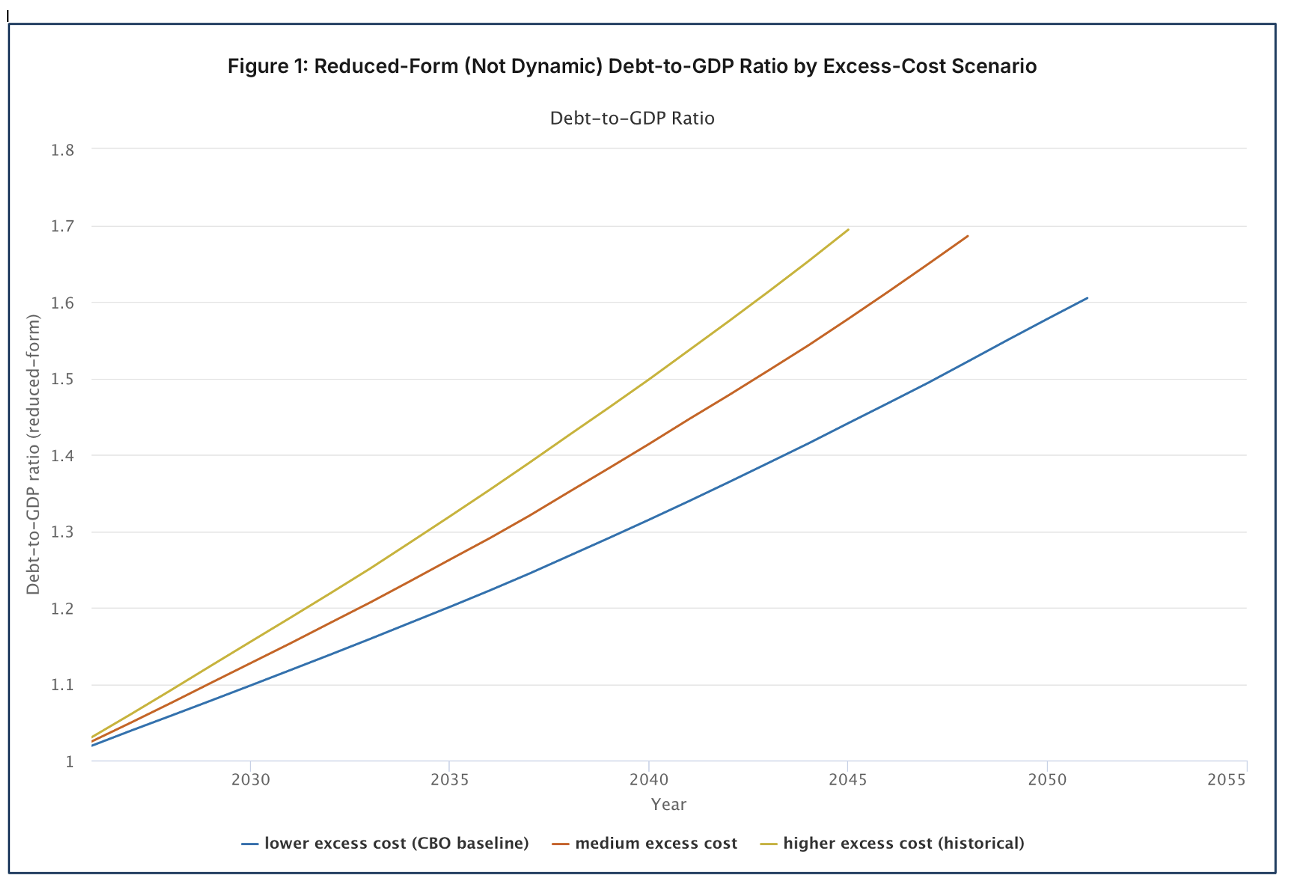
The Penn Wharton center estimates that the United States federal debt cannot rationally exceed roughly 210 percent of GDP as an outer limit. Under historical excess cost growth in healthcare, this outer limit is likely reached within 20 years; there is a 25% chance of reaching it in 14 years. Debt markets unravel earlier if beliefs about government repayment shift.