

Recommended Weekend Reads
Previewing the Trump – Xi Summit, Overcoming Latin America’s Stubborn Productivity Gap, Who Will Make Money on AI?, and How Americans Rarely Talk to Their Neighbors
May 8 - 10, 2026
The US and China in Advance of the Xi–Trump Summit
In What Ways Has U.S. Trade with China Changed? Hunter Clark and Gregory Simitian - Federal Reserve Bank of New York
In 2025, the US deficit with China in machinery and electrical goods fell ~$70 billion, while the US deficit with ASEAN in similar goods rose ~$80B, and China’s surplus with ASEAN increased ~$70 billion — reshuffling, not shrinking, trade imbalances.
What will happen when Trump meets Xi? Brookings Institution Expert Roundtable
President Donald Trump will travel to Beijing for meetings with President Xi Jinping on May 14-15, 2026. Nine Brookings experts weigh in below on how Trump and Xi’s interaction will impact their areas of expertise and how the summit’s success will be measured. But as Ryan Haas, Brookings Director of the John L. Thorton China Center, suggests, observers should have low expectations for the upcoming summit. While the relationship has stabilized since the two leaders met last November, Haas points, it remains fragile—defined more by an absence of friction than any affirmative agenda or deep dialogue on the substantial differences that bedevil the relationship. Many Chinese analysts expect a U.S. snap back to a more competitive China policy, either after the midterms or after Trump steps down in 2029. Beijing seems focused on using this interregnum to enhance its position vis-à-vis the United States. Likewise, many in the Trump administration and on Capitol Hill favor a return to sustained strategic competition.
Americans’ views of China have grown somewhat more positive in recent years Pew Research Center
For the better part of a decade, most Americans have had negative views of China. This is still the case, but the share with a favorable view has ticked up, according to a Pew Research Center survey conducted in March. Today, 27% of Americans have a positive opinion of China. That has risen 6 percentage points since last year and nearly doubled since 2023. And it’s part of a modest softening of Americans’ opinion of China on multiple fronts:
Confidence in Chinese President Xi Jinping to do the right thing regarding world affairs has gone up 4 points since last year and roughly doubled since 2023.
When asked whether China is a partner, enemy or competitor of the United States, fewer Americans call China an enemy now than in 2025. But most Americans still see it as a competitor.
Slightly fewer say now than last year that China is benefiting from trade at the expense of the U.S.
China’s Demographic Future Is Now The Rhodium Group
We estimate China will lose nearly 60 million people in the next decade, roughly equivalent to the population of France. The impact on household consumption is obvious, but the larger problem for Beijing may be the hit to social security funds. The headlines are bad, the regional breakdown is worse. The country’s most developed provinces are seeing falling populations, which will impact overall consumption and the future productivity of the labor force. The impact on household consumption is obvious, but the larger problem for Beijing may be the hit to social security funds. The fiscal subsidy to social security funds rose to a record 2.9 trillion yuan last year, or 10.1% of general budget spending, and appears set to rise in the future.
Latin America
A Bad USMCA Rewrite Will Cost Mexico More Than No Deal Juan Pablo Spinetto/Bloomberg
The USMCA free-trade pact is due for review on July 1, with negotiations likely to run past the deadline and potentially leading to annual reviews. Mexico has high stakes in the review, with an updated USMCA potentially lifting uncertainty and unlocking investments, but the country should resist sacrificing a good deal for a quick one. Mexico should secure explicit guarantees that US tariffs on certain goods will be lifted or reduced before making any announcements, and may be better off waiting for a shift in Washington’s stance if such guarantees are not provided.
Sinaloa Governor Indicted: USMCA, Cartels, and the Future of U.S.-Mexico Trade Center for Strategic and International Studies
On April 29, Sinaloa Governor Rubén Rocha Moya and nine other current and former Mexican officials were indicted by the U.S. Department of Justice on charges of conspiring to assist the Sinaloa Cartel in trafficking drugs into the United States in exchange for bribes and political support. The move was not a surprise, but a culmination. For 18 months, the White House had been turning the screws on the Sheinbaum administration, demanding deeper security cooperation and tangible outcomes, while holding a series of escalating threats in reserve, among them the specter of unilateral U.S. military action on Mexican soil. Mexico responded at nearly every turn—yet the goalposts moved. The indictment of sitting officials from Morena, Mexican President Claudia Sheinbaum’s party, represents one of the most consequential of those threats, one that the White House had kept in reserve but never fired. Its timing is not incidental. It comes at a moment of acute bilateral tension, and just weeks before the formal review of the United States–Mexico–Canada Agreement (USMCA), currently scheduled to launch, without Canada, on May 26.
Overcoming Latin America’s Stubborn Productivity Gap Americas Quarterly
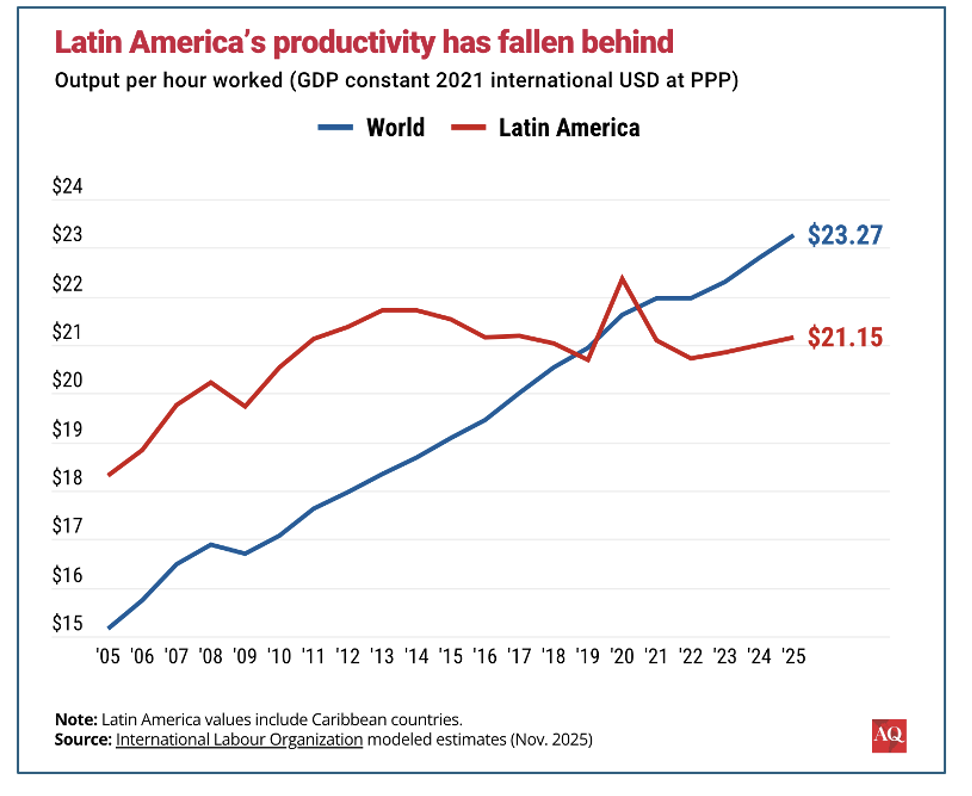
Call it Latin America’s perennial challenge: Low productivity. Measured as output per worker or per hour, productivity in most of the region remains a fraction of that in advanced economies and has hardly improved over the past 75 years. The result is a development constraint that scholars and observers use to explain why Latin America and the Caribbean are currently immersed in a “low growth trap” that limits wages and political stability alike. A growing body of research has identified the persistent culprits, but also the solutions that we urgently need. Low productivity limits the region’s ability to capitalize on new global opportunities—including those emerging from today’s rapidly shifting trade environment.
Geoeconomics, Statistics, and The Global Growth of AI
The Value of Reliable Statistics Nicholas Bloom/Erica Groshen/Duncan Hobbs/Michael Strain – NBER Working Paper Series
Abstract: On August 1, 2025, President Trump fired the head of the U.S. Bureau of Labor Statistics (BLS) and claimed that the agency’s data were “rigged.” In the aftermath, measures of economic policy uncertainty rose sharply, consistent with the idea that reduced trust in official data increases uncertainty for investors, businesses, and households. We use an event-study design to estimate the effect of the firing on policy uncertainty and then map that increase in uncertainty into implied macroeconomic outcomes. This yields a back-of-the-envelope estimate of the marginal value of public trust in official statistics. Our baseline estimate implies that preserving trust in the integrity and quality of official statistics generates economic benefits of about $25 for every $1 spent on the agency’s budget.
Who Will Make Money on AI? A Discussion Paper on Aligning Commercial Incentives with National Security Interests Geoffrey Gertz and Emily Kilcrease/Center for a New American Security
The private sector is playing a leading role in advancing the frontier of artificial intelligence (AI). As a result, commercial incentives are likely to have a significant impact on how AI capabilities develop and diffuse across markets. Firms’ commercial incentives will influence U.S. national security interests associated with the emergence of powerful AI systems. These interests include enabling beneficial uses of AI while limiting security risks associated with AI misuse, ensuring reliable and controllable AI system behavior in deployment, and maintaining strategic geopolitical advantage in the development and global diffusion of AI. Yet to date, stakeholders focused on AI national security interests have paid only limited attention to AI companies’ commercialization strategies and market dynamics across the AI stack. This paper seeks to bridge this gap, identifying potential scenarios for the future shape of AI markets and exploring the implications of these scenarios for U.S. national security. Rather than attempting to resolve core debates on the commercialization of AI, the paper seeks to prompt consideration in both the private and public sectors, and among economics and national security expert communities, of how commercial incentives can better align with U.S. national security interests.
The Sovereign AI Index – Tracking the Global Push for AI Self-Reliance Center for a New American Security
CNAS is running an interactive, regularly updated site tracking the explosive growth of AI globally. As they point out, The United States and China control 90 percent of the computing power needed to develop and deploy frontier AI. They own all 50 of the top-ranked AI foundation models. Concerned about this concentration of AI power, governments worldwide have responded with initiatives to strengthen their AI capabilities under the banner of “sovereign AI.” Although a consensus definition of sovereign AI remains elusive, this index defines a sovereign AI project as a government-backed AI initiative tied explicitly to national strategic interests and backed by material public investment in domestic compute, models, or data ecosystems. The drivers of sovereign AI vary widely. For some countries, the imperative is security: protecting sensitive data and ensuring access to advanced capabilities for defense and intelligence. For others, it is the economy: leveraging AI to spur AI-related local investment, jobs, productivity, and long-term value. Culture is another driver, with nations seeking AI systems that better reflect local languages and norms. Autonomy also motivates countries that see danger in growing AI dependence on the United States or China. These drivers often overlap. The result is a surge in sovereign AI activity across the globe.
An American industrial revolution is brewing. I saw it in Pittsburgh. David Ignatius/Washington Post
Columnist and former Business Editor Ignatius went to Pittsburgh to witness first-hand an extraordinary change taking place. Watching a nimble robot check for flaws along the side of a massive steel tube crafted to simulate the reactor of a nuclear submarine, you see a snapshot of the revolution in manufacturing and maintenance that could transform the gritty, routine tasks of the defense industry — and perhaps American manufacturing, as well.
How Students and Recent Grads are Responding to the Rise of AI Sarah Eckhardt and Nathan Goldschlag/Agglomerations
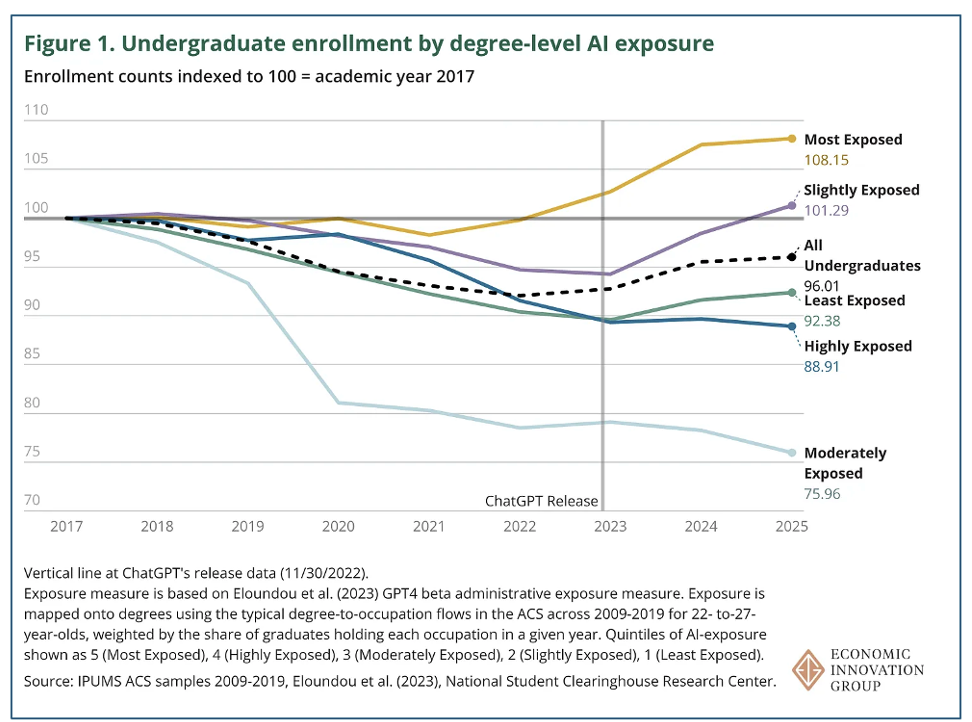
Far from shying away from AI, American undergraduates “are flocking towards the most-AI-exposed degrees,” with enrollment in these majors up 8% last year compared to 2017. Are students shying away from fields that have more exposure to AI, perhaps worried that AI will shrink the number of jobs available to them? Or are students shifting towards those fields, preparing for a future in which they will have to be comfortable using AI? To find out, we can check enrollment for groups of degrees based on the AI exposure of the jobs that students with those degrees are likely to take, as shown in Figure 1. As is clear, undergraduates are flocking towards the most-AI-exposed degrees, with enrollment in those degrees up 8% last year compared to 2017. This trend holds despite a notable decline in Computer Science degrees, one of the most-AI-exposed degrees, but whose decline is more than offset by increases in other exposed degrees like Engineering.
Societal Challenges in America
Strangers Next Door Daniel Cox, Jae Grace, and Avery Shields/American Enterprise Institute
In 2012, 51% of Americans aged 18–29 and 59% of all Americans spoke to their neighbors “at least a few times per week.” By 2025, only 25% of 18–29 year olds did relative to 40% of Americans overall. The effect was less pronounced for college grads.
Is America Financially Illiterate? The Numbers Are Alarming The Tax Foundation
In this podcast, Most Americans don’t understand how the tax code works, and it’s costing them. In this episode of The Deduction, host Kyle Hulehan sits down with Zoe Callaway, VP of Education at Tax Foundation, to talk about tax and financial literacy in America. They dig into the results of Tax Foundation’s national survey on tax literacy, the most stubborn misconceptions people have about taxes (including one that nearly made a teacher turn down her own promotion), and what’s happening in high school classrooms across the country. They also connect everyday tax confusion to bigger policy questions, from tariffs to tax refunds.