
Recommended Weekend Reads
Putin and Russia Are Facing Rough Waters, How Mexico Benefits From the US – China Trade War, Will Raising Taxes Solve the US Debt Problem? And How America is Experiencing a Productivity Miracle
May 15 - 17, 2026
Below are a number of reports and articles we read this past week and found particularly interesting. Hopefully, you will find them of interest and useful as well. Have a great weekend.
Russia
Putin Is Losing His Grip on Russia The World Unpacked Podcast
Russia’s surprising recent Internet shutdown did more than disrupt daily life: it also crippled the regime’s own communications and propaganda. It’s one of a series of strange events—from a diminished Victory Day parade to crackdowns on businesspeople and celebrities—that suggest growing disorder and confusion within the Russian state. Alexandra Prokopenko, a former Moscow insider who quit over the Ukraine War, says that Vladimir Putin has lost focus on running the country. She joins Jon Bateman on The World Unpacked to explain the erosion of Russia’s social contract and share stories from her new book, From Sovereigns to Servants: How the War Against Ukraine Reshaped Russia’s Elite.
In Russia, the Public Mood Is Souring Carnegie Russia Eurasia Center
Something in the air has changed in Russia. Now even loyalists complain about the mounting restrictions and repression, and once-upbeat businesspeople are now despondent. What we are witnessing is three related processes. First, attitudes toward President Vladimir Putin are changing. Second, economic optimism and the associated everyday patriotism, which celebrates survival rather than development (people are simply grateful to be alive) are fading. And finally, Russian people are realizing the impossibility of winning a war that has minimized their country’s advantages.
The Russia-Ukraine War Report Card, May 13, 2026 Russia Matters
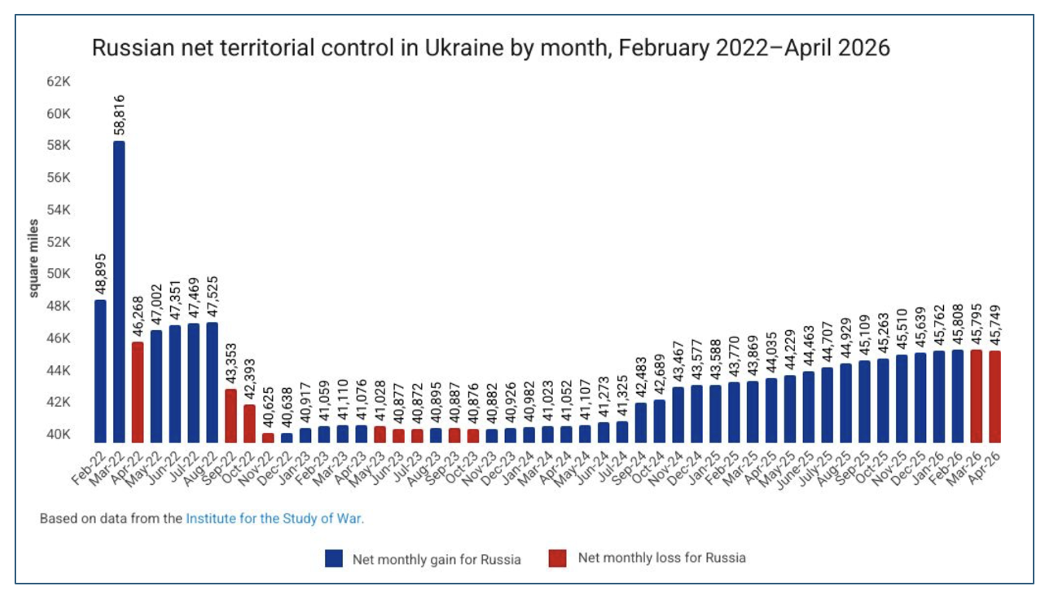
May 12, 2026, update: Russia Matter’s analysis of ISW’s data for the past four weeks (April 14–May 12, 2026) indicates that Russian forces endured a net loss of 45 square miles (about twice the size of Manhattan Island) of Ukraine’s territory during that period. This contrasts with the previous four-week period (March 17–April 14, 2026), in which Russian forces lost a single square mile of Ukraine’s territory. In the past week (May 5–12, 2026) Russia recorded a net loss of 12 square miles (about half of Manhattan Island). Notably, Russia launched more than 8,000 drones last month, the highest monthly total on record since the start of its full-scale invasion of Ukraine on Feb. 24, 2022, according to data published by CSIS since September 2022 and analyzed by RM. Meanwhile, FT reported, citing two people in contact with Vladimir Putin and a Ukrainian intelligence assessment, that Russia’s top commanders have convinced Putin their forces could seize the whole of the Donbas by this fall. Since the beginning of the war, RM and other analysts estimate Russia has military losses of more than 1,000,000 men, 14,000 tanks and armored vehicles, 361 aircraft, and 29 naval vessels.
War, Inflation, and Putin’s Paranoia: Has Russian Public Opinion Begun to Shift? Russian Roulette (Center for Strategic and International Studies Podcast)
Dr. Sam Greene, professor of Russian Politics at King’s College London, discusses the state of Russian public opinion today and whether domestic conditions have begun to change given the state of the economy, war, and reportsof increasing paranoia in the Kremlin.
Geoeconomics
America Is Experiencing A Productivity Miracle Economist Staff The Economist
The 2019–2024 uptick in US productivity wasn’t driven by the information sector, whose growth and scale is on par with its 2000–2019 mean, but rather by professional services and management, which together make up ~10% of the economy.
The Microstructure of AI Diffusion: Evidence from Firms, Business Functions, and Worker Tasks National Bureau of Economic Research
Abstract: Using novel, nationally representative data from the 2026 AI supplement to the U.S. Census Bureau’s Business Trends and Outlook Survey (BTOS), we characterize AI diffusion across three layers: firm-wide adoption, business-function deployment, and worker-task use. During Nov 2025–Jan 2026, 18% of firms used AI in at least one function (32%, employment-weighted), with adoption expected to reach 22% within six months. Use is concentrated in large firms and knowledge-intensive sectors, reaching 50%–60% (60%–70%, employment-weighted) among very large firms in Information, Professional Services, and Finance. Among adopters, scope remains limited: 57% use AI in three or fewer functions, most often Sales and Marketing (52%), Strategy (45%), and IT (41%). Worker-level use appears in 23% (41%, employment-weighted) of firms, primarily for writing, document analysis, and information search; 65% restrict use to three or fewer tasks. Evidence suggests both top-down and bottom-up diffusion: worker use can occur without firm adoption, and vice versa. Most firms (66%) use AI for task augmentation, while employment reductions are rare (2%). Regression results show a positive relationship between firm performance and AI integration breadth. However, functional deployment and operational investment are associated with employment declines, while worker-task use is not once these factors are controlled for.
Can Tax Reform Solve the Debt Problem—or Just Slow It? Tax Foundation
The US federal government faces several fiscal challenges in the coming decades, as the Congressional Budget Office projects that, under current law, publicly held debt as a share of GDP will rise to a new record high within the next four years and continue rising to 175 percent of GDP by 2056. While revenues are projected to grow as a share of GDP, spending will grow faster so that deficits rise to 9.1 percent of GDP by 2056. This study simulates several large tax increases and consistently finds that even tax increases large enough to close the primary deficit in the near term will lose ground over time and fail to put the debt on a sustainable course. The most popular proposals, from hiking taxes on the rich to raising tariffs, tend to target a narrow set of taxpayers and produce the least sustainable revenues. These options are likely to introduce large economic distortions and slow economic growth without substantially improving the debt trajectory. The results suggest deficit reduction efforts should focus first on reducing the growth of major entitlements, and second on relatively efficient, broad-based tax increases.
Latin America
Mexico Gains From U.S.-China Trade War; Inefficiencies Limit Benefit Ricardo Reyes-Heroles, Luis Torres and Diego Morales-Burnett Federal Reserve Bank of Dallas
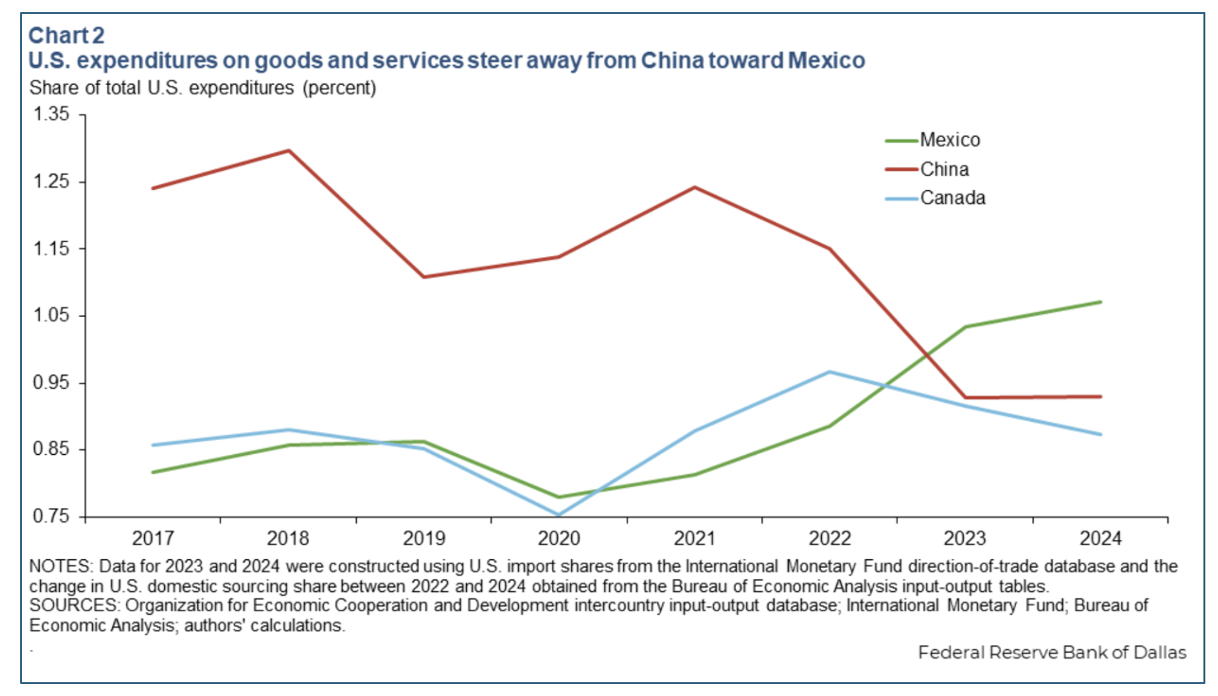
Abstract: We examine the effects of the tariffs implemented during the U.S.-China trade war on Mexico’s GDP, using a multi-country, multi-sector general equilibrium trade model. Higher U.S. tariffs on Chinese goods reduce the competitiveness of Chinese exports in the U.S. market, thereby shifting U.S. demand toward alternative suppliers, including Mexico. Model simulation indicates the U.S. - China tariff shock generated a positive effect on Mexico’s GDP, shifting U.S. demand from goods produced in China toward those produced in Mexico. There was a clear increase in U.S. demand for goods produced in Mexico during 2017–24, suggesting that output in Mexico expanded to meet this increased demand in response to the China trade tension. In the medium run—a period when aggregate capital does not change through investment—Mexico experiences a modest increase in GDP of 0.35 percent, driven primarily by higher exports to the United States and expansion of sectors integrated into North American value chains. Once Mexico’s capital stock adjusts, GDP expands by an additional 0.73 percentage points (total of 1.08 percent), reflecting increased investment in expanding industries (Chart 3). Although trade reallocation has contributed to economic growth in Mexico, structural constraints led to underperformance.
The Strategic Link Between USMCA and Critical Minerals Arturo Sarukhan/Americas Quarterly
Critical minerals have emerged as one of the issues most likely to define what the “new USMCA” stands for: not merely a trade agreement, but the enforcement spine of a broader hemispheric economic-security strategy that integrates market access, technology governance, and supply chain integrity. If the review produces a meaningful minerals annex—or a trilateral minerals side agreement—it will represent a genuine architectural advance. If it fails to do so, the continent risks locking in bilateral templates.
Unpacking Peru’s First-Round Elections 35 West Podcast
On April 12, Peruvians took to the polls to vote in the first round of elections that would decide the country’s next president. Some hoped the elections would help usher in an end to the country’s long running political crisis where no president has served out a full term since 2016. However, delays and complications in counting the votes, and fraud allegations leveled by some candidates turned the April election into its own miniature crisis. In this episode, Henry Ziemer sits down with Mitra Taj, a freelance reporter based in Lima to unpack the results of the first round of voting. Together they explore the key figures and power brokers heading into the runoff, as well as how the two candidates, Keiko Fujimori and Roberto Sánchez, will likely approach key issues of economic development, security policy, and relations with Congress. They also explore the significance of the elections for ongoing U.S.-China competition in South America.
The prediction markets are betting on Colombia’s upcoming election Latin America Reports
Prediction market giants Kalshi and Polymarket are showing a recent surge in bets on right-wing populist Abelardo de la Espriella to be the eventual winner of Colombia’s presidential election at the end of May. The markets are out of line with conventional polls in Colombia, which have leftist candidate Ivan Cepeda comfortably leading the race with de la Espriella in second, followed by center-right candidate Paloma Valencia. In the last week, however, bets on de la Espriella to win the election have increased relative to bets on his rivals. On May 1, de la Espriella was given a 28.8% chance of victory whilst Cepeda was given 38% on betting market Kalshi. As of May 8, de la Espriella has overtaken Cepeda by 1 percentage point, reaching 42%. Polymarket shows a similar trend. De la Espriella’s odds have risen from 28% to 39% over the last seven days, though he still trails Cepeda, who remains on 41%.
How America Can Coerce the Cartels Benjamin Lessing/Foreign Affairs
There is an alternative to the ongoing violent response to Latin American drug cartels: It is what the author calls “conditional repression.” Countries facing powerful and destructive criminal groups, such as drug cartels and prison gangs, should draw bright redlines and concentrate their fire on the groups that cross them. Escalatory measures, whether military or judicial, could be used to punish only the worst cartel behavior. In this way, the repressive force that is currently failing to stop the drug trade could be used coercively to reduce its most pernicious harms. And nobody understands coercion better than Trump. From tariffs to military operations in Iran and Venezuela, he has seized personal control over levers of power and used it to punish those who do not bend to his will. Trump could do the same to cartels: cow them into ending fentanyl flows and minimizing violence, criminal governance, civilian extortion, and environmental degradation. However contentious his tactics, this president may be uniquely (and surprisingly) qualified to change the way the United States—and the world—fights the drug war.