

Assessing The Iran War’s Global Economic Shocks, The Myths and Realities of Petrodollars, The Fog of AI War, and How the U.S. Post Office is About to Collapse
April 17 - 19, 2026
Below are a number of reports and articles we read this past week and found particularly interesting. Hopefully, you will find them of interest and useful as well. Have a great weekend.
More On the Impact of the Iran War
How the War in the Middle East Is Affecting Energy, Trade, and Finance International Monetary Fund
According to the IMF, “Although the war could shape the global economy in different ways, all roads lead to higher prices and slower growth. A short conflict might send oil and gas prices soaring before markets adjust, while a long one could keep energy expensive and strain countries that rely on imports. Or the world may settle somewhere in between—tensions linger, energy stays costly, and inflation proves hard to tame—with ongoing uncertainty and geopolitical risk. Much depends on how long the conflict lasts, how far it spreads, and how much damage it inflicts on infrastructure and supply chains.”
"Look Through" the Hormuz Shock if You Want. U.S. Inflation is Still Running Hot Matt Klein/The Overshoot
Core goods inflation was running ~1 percentage point above pre-pandemic levels in both 2023 and 2024, with price declines slowing from mid-2024 onward — before tariffs became a primary factor. The question for policymakers is what this “one-time thing”, as Federal Reserve boss Jerome Powell has called it, will do to the underlying trend rate of inflation.
Petrodollars. Myths and Reality Brad Setser Council on Foreign Relations
The Iran War has brought renewed focus to the role of Petrodollars. The foundation of the dollar’s global role, it is sometimes argued, rests on the willingness of the Gulf countries (but not Russia) to price their oil in dollars. But it was never quite clear why oil pricing mattered quite as much as some claim. To be sure, there are network effects around dollar pricing. But it isn’t hard to pay for oil in a global currency like the euro, even if the underlying contract is priced in dollars. There is a deep and liquid market for converting euros into dollars, and a firm aiming to lock in the euro price of oil 3 months forward can buy oil forward in dollars and dollars forward with euros, thereby locking in a euro price. Dollar settlement is a problem for countries that are sanctioned by the U.S. and the EU and for frontier economies that cannot settle their oil bill in local currency, but it hasn’t required most European oil importers to build up big stocks of dollar reserves just to pay for oil. What has mattered at times is how the big oil exporters manage their surplus funds when there is a surge in the global price of oil.
Three Scenarios for the Gulf States After the Iran War Carnegie Emissary
Amid a tenuous U.S.-Iran ceasefire, Arab Gulf monarchies are aiming to project strength. “We prevailed through an epic national defense . . . in the face of treacherous aggression,” Emirati diplomatic adviser Anwar Gargash wrote on X. Saudi-owned newspaper Asharq Al-Awsat emphasized the kingdom’s “intensive political consultations” with regional countries as leading to the present calm. Yet member states of the Gulf Cooperation Council (GCC) still face immense challenges in shoring up their security. A substantial U.S. and Israeli air campaign was unable to eliminate Iran’s will or capability to exert power in the Gulf, with Iran turning historically secure neighbor states into war zones overnight. Neither the United States nor any other actor put forward a decisive solution for the de facto Iranian closure of the Strait of Hormuz, while the Islamic Republic retains its highly enriched uranium and its nuclear program. And the GCC has no seat at the table, despite its entreaties, for negotiations that will shape the bloc’s economic and security environment for years to come. Where do the Gulf states go from here? We offer three scenarios—a hopeful one, a realistic one, and a cautionary one—that illustrate both potential areas of cooperation and the risks of greater fragmentation.
What the Iran War Means for the “Axis of Resistance” Hamidreza Azizi/Foreign Affairs
The war is heightening the salience of Shiite identity across multiple arenas at once and, in doing so, reshaping how political and military actors assess both their interests and their risks. Groups that might otherwise have remained on the sidelines are becoming more likely to get involved in the strife, and those already fighting face growing pressure to escalate. The consequence is a feedback loop: actions driven by fears of marginalization provoke responses that alarm more and more people, expanding the social base for Shiite mobilization. The “axis of resistance,” Iran’s network of nonstate allies and proxies across the region, has endured numerous setbacks since 2023. But ongoing U.S. and Israeli military actions may lead to its reconstitution, not through the orchestration of Tehran but rather as a result of the altogether more organic impetus of an embattled Shiite identity.
Europe
A Transatlantic Economic Reset Penny Nass/German Marshall Fund
The fixation on tariffs and trade skirmishes obscures a more consequential reality, one in which the EU-US relationship is being shaped by a rapidly deteriorating geopolitical environment that tests political trust and strategic coordination. It also overshadows the fact that the transatlantic relationship is not primarily a trade relationship but the world’s largest and most strategically significant investment partnership. Three areas demand urgent join action: Critical minerals, the Digital Stack, and Infrastructure.
The Fog of AI War Raluca Csernatoni/Carnegie Strategic Europe
An irreducible uncertainty haunts every battlefield: the fog of war. And for two centuries, military innovation has promised to lift that fog. Artificial Intelligence (AI) was supposed to be the technology that finally did so, replacing human guesswork with machine precision and processing oceans of data at speeds that would render uncertainty obsolete. But acknowledging the advantages is not the same as ignoring what happens when speed, attrition, and scale become organizing principles of warfare. U.S. President Donald Trump's dispute with Anthropic, which insisted that its models should not be used without guardrails against fully autonomous weapons and mass domestic surveillance, ended with the Pentagon designating the company a supply chain risk. The message from the world’s largest military power is that normative constraints on military AI are obstacles to innovation rather than preconditions for lawful use. Europe can play a key role in all of this.
Assessing the damage: What the Iran war really means for Europe’s defense European Union Institute for Security Studies
Regardless of whether the ceasefire between the US and Iran holds, the war in the Middle East complicates European rearmament and support for Ukraine, while also further eroding confidence in the United States as a reliable guarantor of Europe's defense. To put their defense ramp-up on a firmer footing, Europeans should reduce exposure to US political volatility, industrial bottlenecks, and the diversion of defense equipment during wartime.
Geoeconomics, Technology, and Trade
A Tax Revolt Is Under Way In America The Economist
Democrats and Republicans alike think they are overtaxed, as do both rich and poor. YouGov’s polling finds that around 60% of Americans at every income level think they are taxed too much—despite being taxed at very different rates. Statehouses are hearing this, too. Many, citing strong economic growth, have cut taxes in recent years. Enthusiasm is building to go further and faster, leaving some observers wary. “Most have done so responsibly thus far,” says Jared Walczak of the Tax Foundation, a think-tank. “But they now risk overreaching and making reductions they cannot afford.” A wave of localities is pushing through property-tax exemptions for retirees. Florida is flirting with abolishing non-school property taxes altogether. Ohio has a possible ballot initiative to scrap them in all forms.
Evaluating the Impact of Tariffs on US Agriculture a Year After Liberation Day Joseph Glauber/American Enterprise Institute
In April 2025, the Trump administration levied 10 percent tariffs on virtually all countries and higher “reciprocal” tariffs on certain countries, ushering in a new and uncertain tariff architecture that saw significant changes, exemptions, and additional actions over the following year. The tariffs modestly reduced overall US agricultural and food imports, but with significant heterogeneity by exporting country and product category. The tariffs had mixed effects on US agricultural exports, with exports to China and Canada falling partly because of retaliatory tariffs and consumer reactions, respectively. After imposing the tariffs, the United States negotiated several bilateral trade deals with other countries. However, given the lack of product-specific details, China’s continued retaliatory measures, and the Supreme Court’s decision striking down most of the US tariffs, it is unclear whether these deals will actually improve agricultural market access for US exporters.
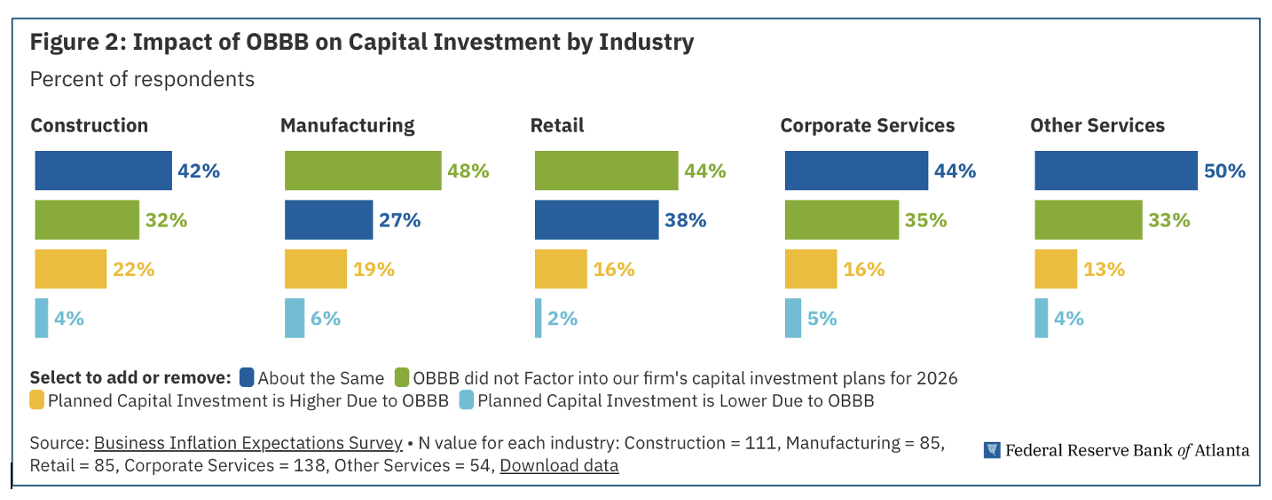
Did the OBBB Affect Firms' Plans for 2026? Federal Reserve Bank of Atlanta
Around 20 percent of respondent firms in the Atlanta Fed's Business Inflation Expectations (BIE) survey told us that they consider the One Big Beautiful Bill (OBBB) in their decision-making and short-term planning. The remaining firms said they did not factor in the OBBB when planning for outcomes such as capital expenditures, employment, and sales revenue forecasts. These results may be a reflection of the fact that many of the provisions of the law were already in place and with the passage of OBBB are now extended or made permanent (such as provisions of the 100 percent bonus depreciation and the 20 percent deduction for qualified business income). Our findings suggest that a broad-based and sizeable future surge in business activity stemming from the policy change may not be likely.
Congress Seeks Solution for Averting USPS Fiscal Collapse Kevin Kosar/Washington Examiner
Last month, U.S. Postmaster General David Steiner added another major item to Congress’s already long to-do list: rescuing the Post Office. “The Postal Service is at a critical juncture. At our current rate, we’ll be out of money in less than 12 months.” That may not sound like a big deal. Government agencies run out of money each year, and every January and February, they go hat-in-hand to Congress and ask for funding. Usually, they get it, and when Congress fails to deliver the dollars, agencies close for a bit or their staff work without pay until legislators enact a spending law. The U.S. Postal Service is different. USPS is one of 17 government corporations that pay for themselves by earning revenue through the sales of goods and services. The agency sells around $80 billion in postage each year, mostly to large companies offering credit cards (e.g., Capital One) or selling goods (e.g., Walmart). When the Post Office runs out of cash in the first half of 2026, Steiner explained, “the Postal Service would be unable to deliver the mail.”