

Recommended Weekend Reads
The Global Threat Assessment, The Iran War and What Comes Next, China – US Relations At an Inflection Point, and AI and the Fable of ATMs
March 20 - 22, 2026
Below are a number of reports and articles we read this past week and found particularly interesting. Hopefully, you will find them of interest and useful as well. Have a great weekend.
The Global Threat Assessment
The 2026 Annual Threat Assessment of the U.S. Intelligence Community Office of the Director of National Intelligence
The Office of the Director of National Intelligence (ONDI) – which oversees all 18 US intelligence agencies and organizations – this past week published it annual global threat assessment. The report details cybersecurity risks posed by nation-states to U.S. networks and critical infrastructure, as well as the increasingly sophisticated capabilities of cybercriminal ransomware actors. It outlines the current threat landscape, focusing on nation-state adversaries linked to the governments of China, Russia, Iran, and North Korea. The report also emphasizes the growing cyber espionage threat from Iran targeting U.S. networks and critical infrastructure.
The Iran War: Why Is It Happening and What’s Next?
You Can’t Print Molecules Jeff Currie and James Gutman Carlyle
When the dust settles and the strait reopens — partially, gradually, and perhaps on Tehran’s terms — the cost of rebuilding will likely be enormous. Governments must simultaneously finance defense, rebuild strategic reserves, restart domestic energy production, and harden infrastructure. All of this comes at a moment when inflation expectations are driving the cost of funding sharply higher — Germany’s 10-year bund auction technically failed this week, not for lack of liquidity, but because the bond market is already pricing the inflationary impact. Where does the capital come from? Capital will flow from the sectors that prospered during the era of open sea lanes and cheap energy, asset light, into the sectors that will build the replacement, asset heavy. The rotation back toward physical assets is not a trade — it is a regime change.
Tracking US Military Assets in the Iran War The Atlantic Council
The Forward Defense program of the Atlantic Council’s Scowcroft Center for Strategy and Security have just launched a new regularly updated tracker to analyze what the US military is committing to the war in Iran and what that means for a potential conflict with China. Operation Epic Fury is stressing military capabilities—aircraft carriers, bombers, missile defense systems—in ways that will have an impact in other theaters around the world. That includes US efforts to credibly deter Chinese aggression and prevail against China in a future conflict. Monitoring the military assets that are relevant to US strategy in the Indo-Pacific and currently deployed to Iran offers insight into how the war might affect the US military's readiness to meet the threat posed by Beijing—the most consequential challenge the United States faces. Actual numbers of US inventory and deployment data are classified. This tracker provides estimates for a subset of assets where open-source information is most reliable. It will be regularly updated and expanded with new data and expert context.
The Stunning Failure of Iranian Deterrence And Why It Augurs a More Dangerous World Nicole Grajewski & Ankit Panda/ Foreign Affairs
Although it was the United States and Israel that instigated attacks on Iran on February 28, leaders in Tehran deserve some of the blame for failing to effectively deter their adversaries. As the deceased commander of the Islamic Revolutionary Guard Corps Aerospace Force, Amir Ali Hajizadeh, once put it, maintaining deterrence is like riding a bicycle: “You have to keep pedaling all the time, or else the bicycle will fall.” Over the past three years, Iran started to lose its balance; now it has tipped over.
Why Escalation Favors Iran Robert Pape/Foreign Affairs
Iran’s military strategy cannot be dismissed as acts of scattered retaliation, the flailing lashing out of a dying regime. Rather, they represent a strategy of horizontal escalation, a bid to transform the stakes of a conflict by widening its scope and extending its duration. Such a strategy allows a weaker combatant to alter the calculus of a more powerful foe. And it has worked in the past, to the detriment of the United States. In Vietnam and Serbia, U.S. adversaries responded to overwhelming displays of American airpower with horizontal escalation, eventually leading to American defeat, in the former case, and, in the latter, frustrating U.S. war aims and spurring the worst episode of ethnic cleansing in Europe since World War II. Decapitation strikes, in particular, create powerful incentives for horizontal escalation: when a regime survives the loss of its leader, it must demonstrate resilience quickly by widening the conflict. Although the United States has hugely battered Iran, it must reckon with the implications of Iran’s response. Otherwise, it will find itself losing control of the war it started.
How Iran’s ‘forward defense’ became a strategic boomerang Chatham House
The war has exposed the limits of Iran’s long-standing strategy of ‘forward defense’. Worse still, that strategy has significantly contributed to Iran’s current predicament. So much so that, depending on the current conflict’s outcome, Tehran may need to fundamentally reconsider an approach to its security that it has refined, expanded and invested in for more than four decades. Since the 1980s, Iranian leaders have tried to push threats away from their borders by cultivating armed partners in fragile and divided Arab states. Through Hezbollah in Lebanon, militias in Iraq and Syria, Palestinian militant groups in Gaza and the Houthis in Yemen, Iran built a destabilizing network that allowed it to project influence while avoiding direct armed conflict with Israel and America.
China
Trump, Xi, and the Case for Strategic CalmRyan Hass/Foreign Affairs
After a decade of elevated tensions, Washington and Beijing now find themselves navigating relatively calm waters. Last October, U.S. President Donald Trump and Chinese leader Xi Jinping reached an agreement in Busan, South Korea, to pause the trade war between their two countries. The truce paused new U.S. tariffs and rolled back Chinese restrictions on American access to rare earths and magnets. That reprieve is real—but fragile. Expectations are high that the next time the two leaders meet—originally scheduled to be March 31, in Beijing, but now delayed at Trump’s request because of the U.S. war in Iran—they will reaffirm and potentially extend their trade war truce. But the truce is driven less by a desire to resolve underlying challenges in the U.S.-Chinese relationship than by a convergence of interests between the countries’ leaders to buy time for their own domestic self-strengthening projects. What will determine the balance of power for years to come is not what Trump and Xi say to each other at this highly staged summit but what the United States and China each does during this larger respite of calmer relations. To take advantage of this current period of fragile stability in its relations with Beijing, Washington will need to wind down its military operations in Iran and refocus on a more consequential national imperative: rebuilding capacity to compete with China.
Double-Edged Swords: How Military Purges Shape Authoritarian Appetite for War War on the Rocks
In less than three years, dozens of senior Chinese military officials have been removed. Many of these officers were promoted by Xi after he assumed power in 2012, when he pledged to eliminate endemic corruption within the armed forces. This unprecedented wave of purges among the highest-ranking generals has prompted questions regarding the implications for China’s international and military ambitions: How do military purges affect authoritarian regimes’ propensity to initiate war?
Geoeconomics, Markets & Politics
Why People Disagree About What Drives Stock Prices Andrew Atkeson, Fabrizio Perri & Jonathan Heathcote/National Bureau of Economic Research
Abstract: We show that, to a first-order approximation, estimates of fluctuations in Shiller’s fundamental price relative to observed price depend primarily on forecasts of long-horizon expected returns. Researchers using different measures of cash flow and valuation may reach different conclusions about the extent to which values fluctuate excessively relative to fundamentals, but that is only because return forecasts based on different cash-flow-to-value measures will be different. Using U.S. equity data, we demonstrate that the amount of persistence in expected returns, rather than the amount of short-run return predictability, is the key determinant of implied excess volatility. Disagreements about stock market valuation therefore reduce to disagreements about long-run expected returns.
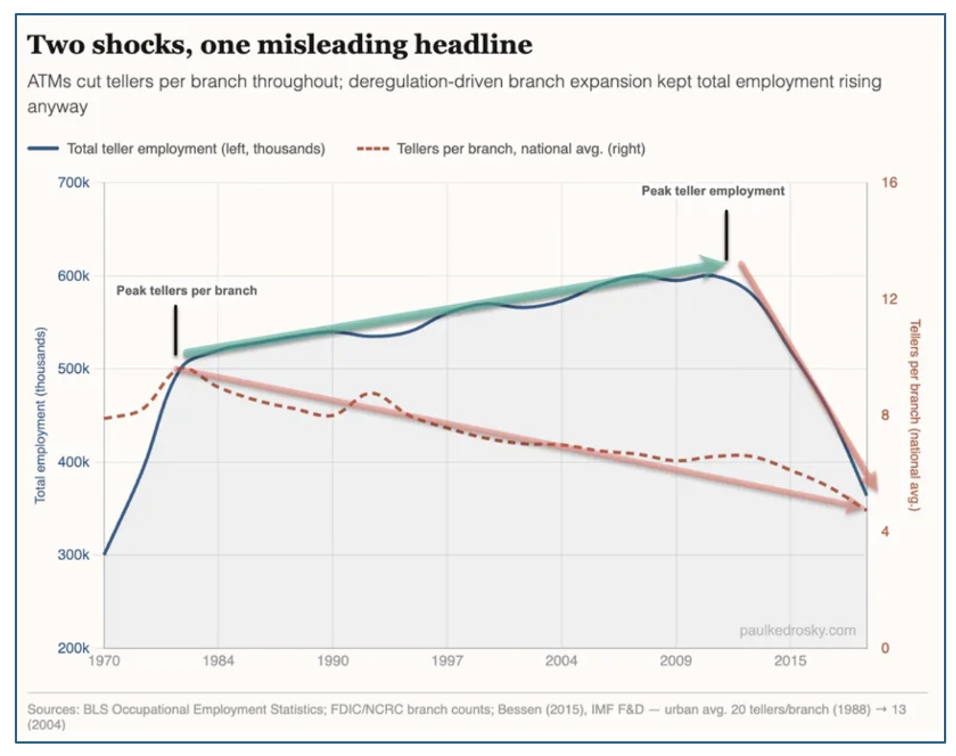
AI and the Fable of the ATMs Paul Kedrosky/Notes on Complexity
The author points out that the implantation of bank ATMs did reduce teller labor demand — just not in the way the standard story claims. What kept total teller employment up was not automation-driven demand growth, but a massive branch expansion driven by deregulation. That matters because the ATM example is often misused as proof that task automation naturally creates offsetting new human work. The real lesson for AI is harsher: unless you can identify the offsetting force, job survival may be coincidence rather than mechanism.
The Micro-Geography of Persuasion: Randomized Peer Exposure and Legislative Outcomes Lauren Cohen & Bo Li/National Bureau of Economic Research
Abstract: We find that randomly assigned peers play a sizable and unique role in shaping political economy. Closely seated, and exogenously assigned, US Senate peers have a significant impact on Congressional voting, shifting votes by 11.9 percentage points (t=7.34). Physical distance is the largest and most consistent of any characteristic outside of party or state in impacting voting behavior. The distance effect is concentrated in the closest peers, existing for up to 19.6 feet on the Senate floor, then dissipating. Close peers additionally increase the probability of aisle-crossing (voting with the opposite party), with the aisle-crossing impact being roughly eight times larger on the final votes on bills. We then utilize a state-of-the-art AI-enhanced computer vision model based on real-time interactions using CSPAN video data at every 10-second interval amongst Congressional members. Using these observed interactions, we find that face-to-face interactions are associated with significant impacts on immediately pending votes. The interactions are largely driven by distance, with aisle-seated Senators from both parties being amongst the most likely to engage in face-to-face interactions across party lines. By conducting counterfactuals through randomized Senate seating, 59 consequential bills would have switched outcomes over our 30-year sample period.