

Recommended Weekend Reads
Crypto and US Household Finance, How Disconnected Youth Spend Their Time, Challenges to the US Industrial Base Policy, and the EU Growing Focus on Geopolitical/Geoeconomic Threats
July 17 - 19, 2026
Below are a number of reports and articles we read this past week and found particularly interesting. Hopefully, you will find them of interest and useful as well. Have a great weekend.
Crypto, AI, and Fiscal Policy
Do You Even Crypto, Bro? Cryptocurrencies in Household Finance Federal Reserve Bank of Cleveland
Using repeated large-scale surveys of US households, we study the cryptocurrency investment decisions and motives of households relative to other financial assets. Cryptocurrency holders tend to be young, male, and more libertarian relative to non-crypto holders. Crypto holders expect much higher rates of return for crypto and perceive it as relatively safer than non-holders do. For those holding cryptocurrencies, changes in Bitcoin prices translate into their purchases of durable goods. Finally, information about historical returns of cryptocurrencies in an information provision experiment embedded in the survey leads individuals to increase their desired crypto holdings and increases their actual cryptocurrency purchases subsequently. We compare these views and behaviors to those of households toward other financial assets and argue that cryptocurrency is unique in many of these respects.
How Might Fiscal Policy Respond to the Rise of Artificial Intelligence? Karen Dynan, Douglas Elmendorf, and Louise Sheiner – National Bureau of Economic Research
Abstract: Artificial intelligence will probably generate major changes in the US economy, although the nature, timing, and magnitude of those changes are highly uncertain. We analyze a set of long-term scenarios involving different combinations of faster productivity growth, greater income inequality, job displacement, and a higher capital share of income. For each scenario, we assess the implications for federal debt and potential policy responses related to faster economic growth, the distribution of income, support for workers who are laid off, and taxation and ownership of capital. Given the uncertainty surrounding AI’s economic effects, policies that are robust to different scenarios would be especially valuable.
Economic Well-Being of U.S. Households in 2025 Federal Reserve Board Research and Analysis
A recent Federal Reserve Board research piece shows that 49% of U.S. adults under 30 lived with a parent in 2025, up 12 percentage points since 2019, while 33% of adults lived in households with at least two generations of adults. Specifically, 19% of adults lived with their adult children (age 18 or older), and 15% lived with a parent. Two percent of adults simultaneously lived with a parent and an adult child. The share of young adults who live with their parents has increased in recent years. In 2025, 49% of adults under age 30 lived with a parent. This share was up by 6 percentage points since 2022, and up 12 percentage points since 2019, just before the pandemic. Conversely, adults aged 60 and older were more likely to live alone than were younger adults. Overall, 13% of people lived alone in 2025. Among those ages 60 and older, a higher 20% were living alone.
How Are “Disconnected” Young Adults Spending Their Time? Federal Reserve Bank of St. Louis
In 2024, the share of U.S. 18- to 24-year-olds who were neither employed nor enrolled in school—that is, “disconnected”—was measured at 16%. That share remained essentially unchanged as of December 2025, despite a generally healthy labor market overall. Rural young adults, less-educated young adults, young Black adults, and young adults from lower-income families tended to have higher rates of disconnection than their peers. The American Time Use Survey offers a nuanced view of how disconnected young adults spend their time, suggesting constraints on the way their time can be allocated rather than disengagement or inactivity. Disconnected young adults spend more time on caregiving responsibilities and household activities than their not-disconnected peers, and less time on work- and education-related activities. Patterns in social and leisure time are similar across both groups.
The AI Investment Race Phurichai Rungcharoenkitkul - Bank of International Settlements
AI infrastructure investment is expanding faster than any previous technology boom, including the railway mania and dotcom bubble, within just three years. Debt-fueled buildout and circular financing arrangements are creating financial interconnectedness that makes the current cycle more fragile and prone to sharp correction. The analysis warns, “Their model suggests that investment is 50% above the efficient level.” This fragility is further aggravated by the leverage that accompanies the rapid ramp-up of investment. This boom-bust pattern recurs across history, from the US canal mania in the 1830s and the British railway mania in the 1840s to the roaring 20s and the dotcom boom in the late 90s. These episodes all ended in sharp corrections with wider economic fallout.
The EU’s Global Threat Analysis & The Challenges to US Industrial Base Policy
Common Understanding – The Threats and Challenges We Face: Assessment of the EU’s Strategic Environment Council of the European Union
A new EU report argues The EU faces an uncertain geostrategic context driven by sustained, simultaneous threats on multiple fronts – but singles out China and Russia of trying to “reshape the global order in line with their interests” and “fostering a return to a sphere-of-influence logic.”
The Coming Clash Between China and Europe Thorsten Benner/Foreign Affairs
In 2025, Chinese leader Xi Jinping tried to capitalize on U.S. belligerence toward Europe by promoting China as the responsible great-power alternative. In a message sent to mark the 50th anniversary of diplomatic relations between China and the European Union, Xi invited Brussels to join forces with Beijing, to “uphold multilateralism, safeguard fairness and justice,” and “oppose unilateralism and bullying.” Key EU leaders, as well as the Brussels bureaucracy, are not buying it. They have concluded that the very survival of Europe’s core industries is threatened by China. Increasingly, European leaders are arguing that the EU needs to take action to protect its industries. So severe is the threat that measures that were unthinkable a few years ago are now gaining momentum. An all-out trade war with China is becoming a real possibility.
Europe must really confront China now: delay is no longer an option Steven Everts/European Union Institute for Security Studies
Europe urgently needs a serious debate on China. Not a technical discussion about tariffs, subsidies, or market access, but a strategic one. After all, China affects everything at once: industrial policy, defense, technology, critical raw materials, and trade. This is geopolitics, and therefore a top priority. The challenge is becoming more urgent. Pressure is growing in sector after sector. Electric cars, batteries, solar panels, wind turbines, pharmaceuticals, chemicals – European companies are feeling the rise of Chinese competition everywhere. Behind this lies an economic model in which state aid, cheap financing, export promotion, and strategic market access are closely intertwined. At the same time, it is becoming increasingly difficult for European companies to operate in China itself under fair conditions.
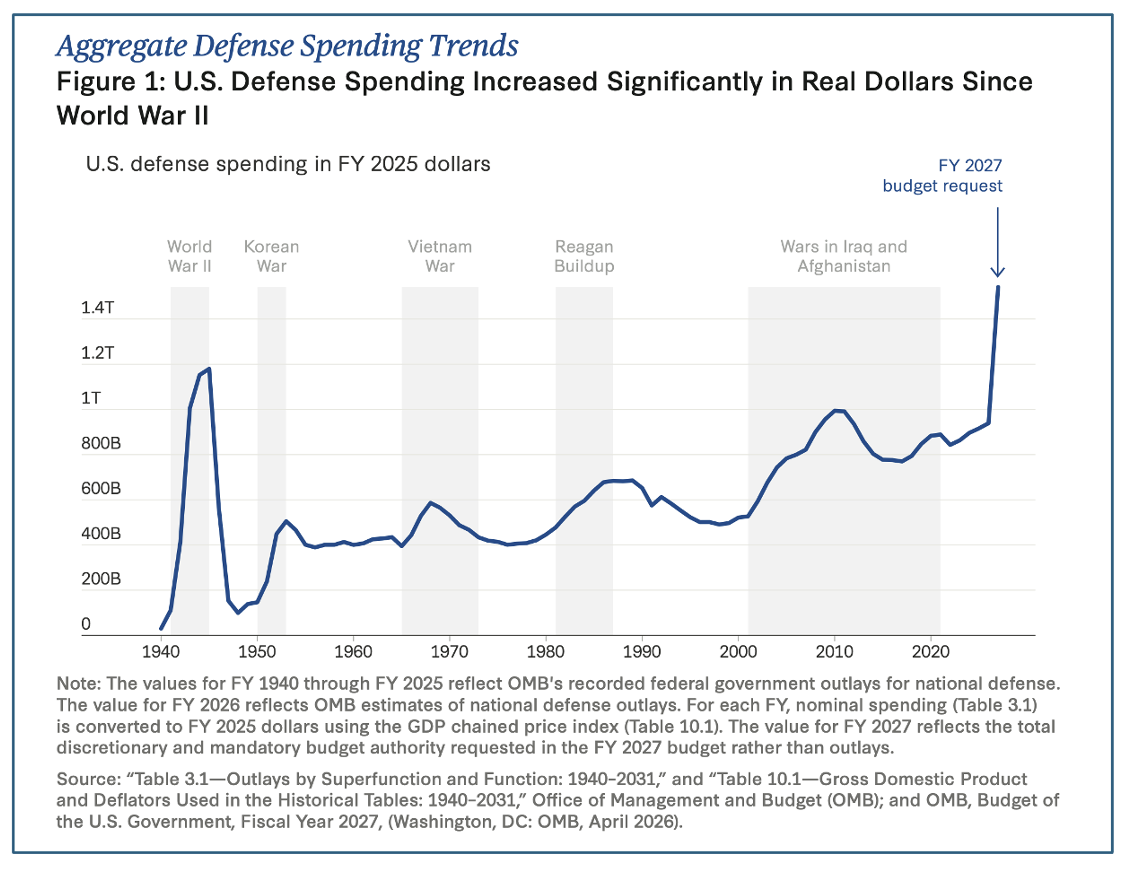
Is the Industrial Base on a Wartime Footing? A Progress Report Jerry McGinn and A.J. Dilts - Center for Strategic and International Studies
Roughly 10,000 new firms have entered the market in the past two years and nontraditional companies received over $120 billion in contract obligations in FY 2025, adding competition and innovation to the sector. Munitions contract obligations have risen 330% since FY 2010. Spurred by this increased demand and depleted inventories, the Pentagon is signing multiyear agreements with munitions producers and suppliers on a historic scale. In addition to developing magazine depth, the DOD is prioritizing magazine breadth, placing an increased emphasis on equipping the Joint Force with a “high-low mix” of both exquisite and affordable missiles and interceptors. Stockpiles require resilient supplies of subcomponents, and new firms and forms of government-industry collaboration are reshaping the solid rocket motor (SRM) sub-sector. At the bedrock of defense supply chains, unprecedented commitments of public and private capital are focused on establishing a secure mine-to-magnet rare earth supply chain outside Chinese control.
Scaling Patriot Production: The Industrial Base Crisis Explained Foreign Policy Research Institute
On April 10th this year, after coalition forces had fired at least 1,700 Patriots in just five weeks, the Pentagon announced $4.76 billion contract to accelerate production. While a seemingly forceful response, the move only highlighted the core problem. At the current build rate of 600 missiles per year, it would take three years to replace what was used in a little over a month. Replenishment runs on an industrial clock, and that clock is measured in years, not days. Patriot missile expenditure by the United States and its allies in the 2026 Iran War is the clearest case study in command of the reload. The problem is not simply how to fire more missiles, but how to sustain missile defense once the opening magazine is gone. That requires three things:
Buying time through multiyear demand that gives industry room to invest;
Buying redundancy across the sub-tier bottlenecks that pace production
Buying efficiency through defensive doctrines that preserve premium interceptors for premium threats.
For decades, US grand strategy was what Barry Posen famously called “Command of the Commons,” the ability to dominate every war-fighting domain to shape the terms of a conflict. That advantage still matters, but the Iran war exposed the harder foundation beneath it. The United States can expend advanced precision-guided munitions in weeks, while the defense-industrial base takes years to replace them. Command of the commons now depends more heavily on “Command of the Reload.”