

Recommended Weekend Reads
Focus on Cuba, Venezuela, and Peru, Iran, and A Look at The Global Implications of the War, and China Cracks Down on “Bone-Ash” Burials in Empty Apartments
April 10 - 12, 2026
Below are a number of reports and articles we read this past week and found particularly interesting. Hopefully, you will find them of interest and useful as well. Have a great weekend.
The Americas: Focus on Venezuela, Cuba, and Peru
Preparing for the Consequences of Collapse in Cuba Christopher Hernandez-Roy & Team/Center for Strategic and International Studies
Much has been written on what comes next for Cuba—in terms of U.S. pressure, regime change or regime management, and who might be Cuba’s “Delcy”—with less focus on the impact that U.S. policy is having on the people of Cuba, who already faced a dire humanitarian situation created by their leaders. What consequences would stem from a sudden collapse of the regime, and what should the United States and the international community be doing to prepare for this eventuality?
Peru: Meet the Candidates 2026 Americas Quarterly
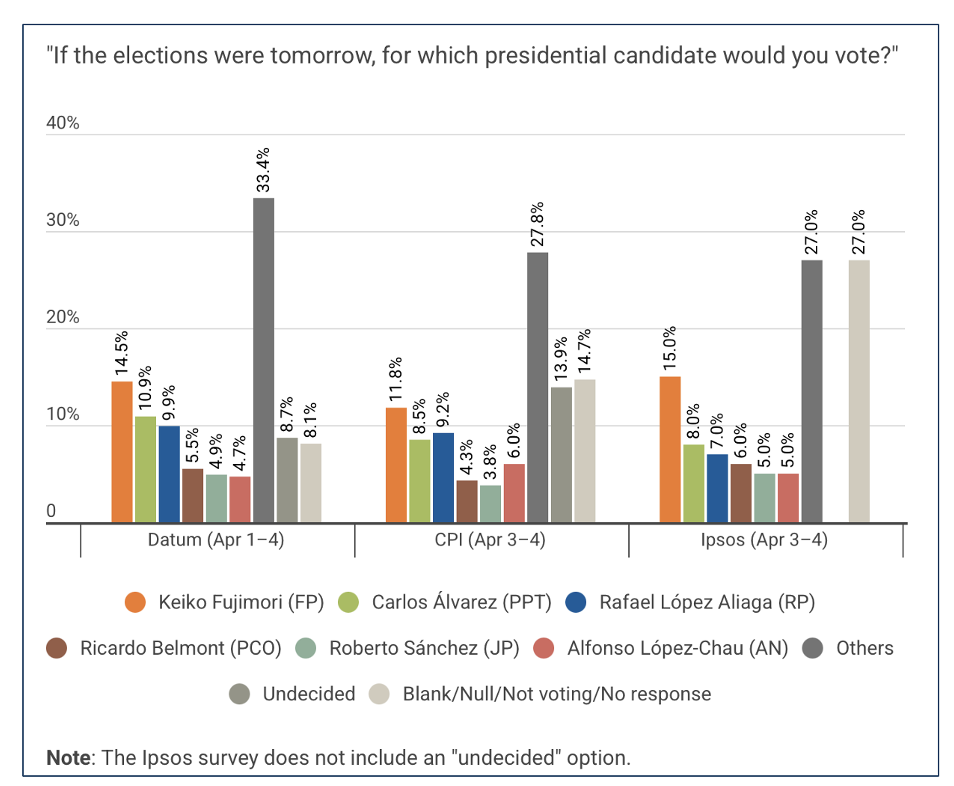
A record 36 candidates are now vying for the presidency, crowding the field and reflecting the country’s fragmented political landscape. If no candidate wins more than 50% of the vote on April 12, the top two will advance to a June 7 runoff. All seats in Congress are also up for election in the high-stakes April 12 contest. For the first time in decades, the country will vote to choose a Senate, the result of a 2024 electoral reform that reinstituted a bicameral system and reversed a ban on consecutive terms for legislators. All winners will be elected to a five-year term. For this analysis, AQ has included only candidates polling above 6% in recent IPSOS surveys, listed in alphabetical order by last name, and has asked eight nonpartisan experts on Peru to help us identify where each candidate stands on two spectrums: left versus right on economic matters, and personalistic versus institutionalist on leadership style.
Poll Tracker: Peru’s 2026 Presidential Election Americas Society/Council of the Americas
The AS/COA has been closely monitoring the upcoming Peru elections. Via this link you can dive into the details of voter polling in advance of the election and post-election analysis.
Peru’s Dysfunctional Politics Are an Economic Time Bomb Bloomberg
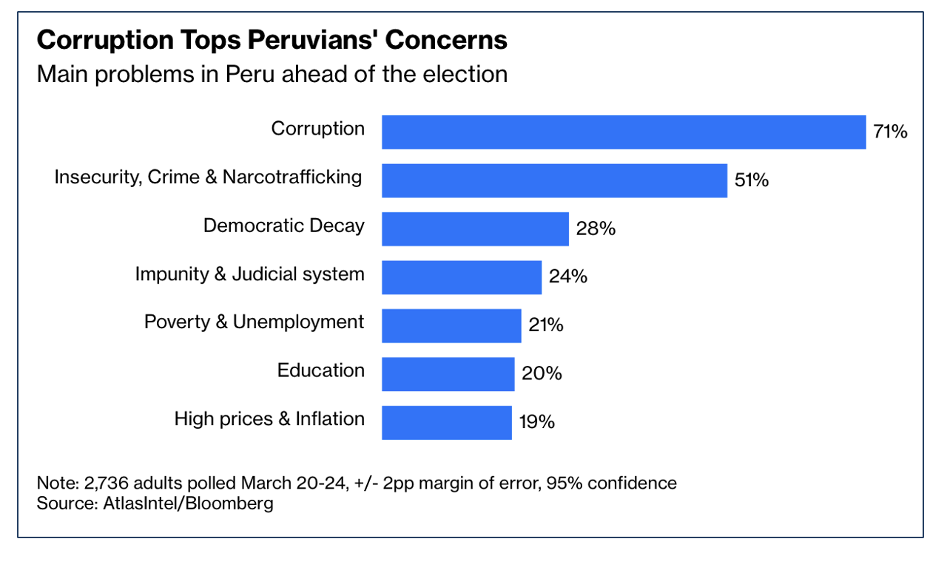
Peru has had three presidents since October, yet markets have largely remained unaffected, with country risk and credit default swaps only marginally increasing. The economy continues to expand, with exports hitting records and inflation remaining low, despite the political turmoil and a fuel-price shock in March. The upcoming general election may not resolve the country’s political instability, and the next government will likely face challenges in addressing corruption, insecurity, and geopolitical pressures.
Venezuela’s Treacherous Recovery: The Peril and Promise of an Economic Boom Moisés Naím/Foreign Affairs
Venezuela may soon experience something it has not seen in years: a surge of economic growth and activity. Although the removal of President Nicolás Maduro by U.S. forces in January left his deputy, Delcy Rodríguez, in place, it has nonetheless opened possibilities that for decades seemed out of reach. Political prisoners are slowly being released, exiles are considering returning home, investors are exploring new opportunities, and countries are reopening their embassies in Caracas. Venezuelans’ long-suppressed hopes are flaring back to life. However, many Venezuelans have great expectations for what the future might hold. Should the state fail to deliver, it could plunge the country into chronic political instability. The only way to guarantee that an economic recovery serves all Venezuelans is to also ensure a political recovery, one in which institutions can once again constrain executive power and in which the will of the public finally finds expression in elections that are genuinely free and fair.
Venezuela Seems to Be Going … Well? Missy Ryan/The Atlantic
Three months after U.S. troops snatched Nicolás Maduro and brought him to New York, life in Venezuela has returned to normal, whatever normal is in a nation that has been gripped by turmoil and economic calamity for years. Government services and the bleak economic conditions that Venezuelans have been living under haven’t improved much, but there is a sense of optimism that Maduro’s departure brings the possibility of better days. Oil revenue is increasing. And Washington’s handpicked interim authorities, led by Maduro’s vice president, Delcy Rodríguez, have rolled out a succession of investor-friendly measures devised by their new North American patrons. A recent pollappears to bear this out. The survey, from Atlas Intel and Bloomberg, shows that nearly 80 percent of Venezuelans think their country is the same or better off now than under Maduro; 54 percent said that greater U.S. influence is positive; 52 percent say that the country’s civil liberties have increased. Trump could only wish for such favorable numbers at home.
What Happens Next with Iran and The Possible Implications of the War For the Rest of the World
The Iran War’s Real Lessons for China: U.S. Tactical Successes Should Give Beijing PauseForeign Affairs
The performance should give pause to U.S. adversaries that have been watching the war in Iran unfold. Massive volleys of long-range drones and ballistic missiles are a preferred offensive tool of China, North Korea, and Russia, used to pound military bases and headquarters, sink fleets, and level civilian infrastructure. If a U.S. adversary were to undertake a war of aggression in Asia or Europe,its plan would be to launch strikes to try to neutralize U.S. and allied military forces, likely inflicting high civilian losses in the process, and then use that cover to carry out its war objectives. The success of high-end Western missile defenses against Iranian strikes calls such a plan into question. Ballistic missiles and drones may not be the decisive offensive weapons that many countries thought them to be. They could still be effective in a campaign of attrition and coercion—but this would be a slow process, not a path to quick victory.
The war on Iran: Nobody won, everyone paid Mahjoob Zweiri/Al Jazeera
Yet before the architecture of this agreement is examined, it is worth pausing to assess the conflict itself: its origins, its legal standing, and who ultimately absorbed its costs. he US-Israeli campaign has failed to achieve its goals. Iran has been badly hit, and the Gulf is paying the bill too.
Hormuz Exposes Africa’s Fertilizer Structural Risk African Futures Blog
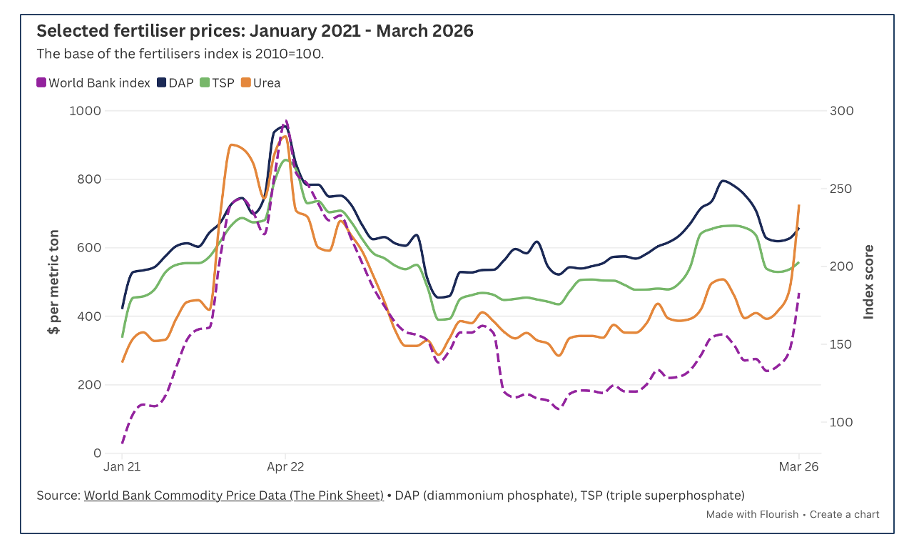
For Africa, the recent tensions in the Middle East are exposing an already known, deeper dependency. The continent’s agricultural systems largely rely on fertilizer supply chains shaped by external production hubs, energy markets and geopolitical risk. In addition to rising costs of direct agricultural input, disruptions in fertilizer supply chains can quickly affect food prices and availability, as many African countries have high import volumes and bills for foodstuffs. Domestic fertilizer production in Africa remains uneven and insufficient to meet the growing demand, with many countries depending heavily on imports to sustain agricultural output. Production capacity exists in parts of North and West Africa, driven by massive phosphate deposits and natural gas reserves. Morocco leads in phosphates, accounting for over 50% of Africa’s supply, and ranks among the top five global phosphate fertilizer exporters, while Nigeria, Egypt and Algeria dominate in nitrogenous (urea) fertilizer production.
Geoeconomics, Demographics, and Tech
How Regions Shaped World Population Growth since 1960 Federal Reserve Bank of St. Louis
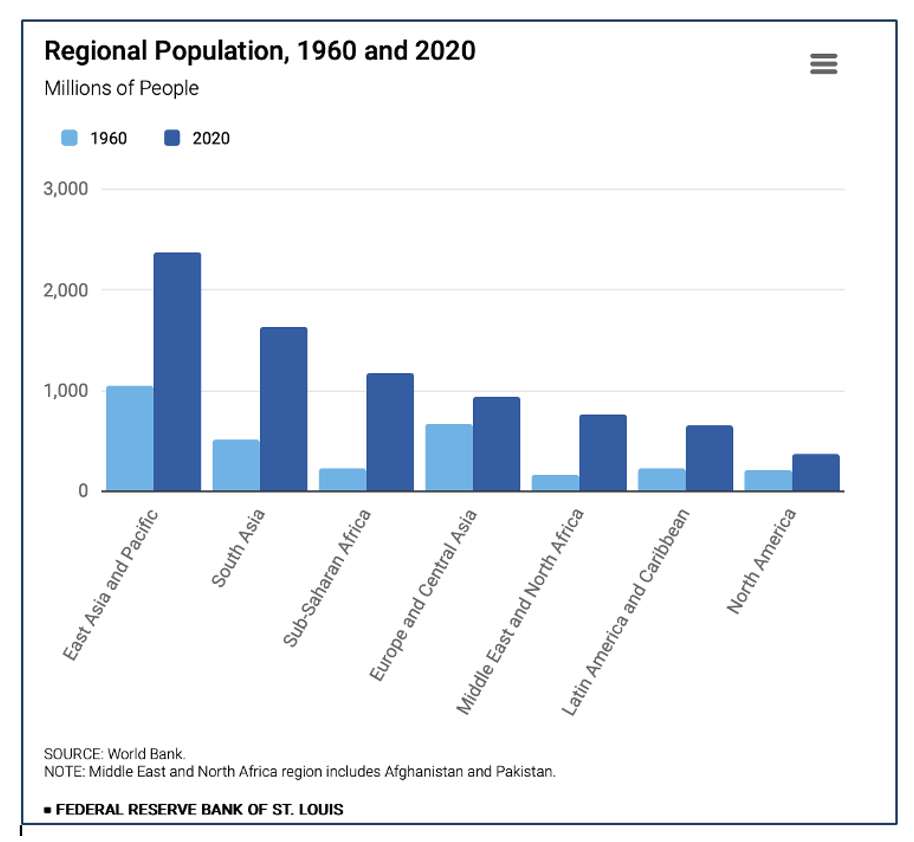
World population has increased from approximately 3 billion in 1960 to almost 8 billion in 2020. While global population growth is significant, some countries are concerned about declining population trends within their borders. This blog post documents population shifts across various geographic regions. While North American population increased from 199 million to 370 million, South Asian population increased from 508 million to 1.6 billion and sub-Saharan African population increased from 228 million to almost 1.2 billion.
China Cracks Down On ‘Bone Ash’ Burials In Empty Apartments Financial Times
Chinese funeral expenses were 45% of the mean annual wage in 2020. As real estate prices declined, many families started using empty apartments as “bone ash apartments.” The practice was formally outlawed two weeks ago. Rapid urbanization has raised demand for limited cemetery plots in cities. Coupled with this, China’s population is ageing at one of the fastest paces in history. The number of deaths in 2025 was 11.3mn, up from 9.8mn in 2015 and outpacing 7.9mn births last year. In contrast to apartments, whose prices have fallen sharply since President Xi Jinping’s campaign that “properties are for living in, not for speculation,” cemetery plots have become prohibitively expensive. A global funeral expense survey in 2020 by the insurer SunLife showed that China’s average funeral expenses were the second highest in the world at about Rmb 37,375 ($5,400), after Japan, accounting for about 45% of average annual wages. While residential properties in China carry 70-year usage rights from the government, cemetery plots come with only a 20-year lease.
Space for the Departed: Land Scarcity and Bone-Ash Apartments in ChinaXinyi Wu/Pitzer College, Claremont Graduate University
Abstract:The rise of bone ash apartments in China reflects a layered response to urban land scarcity, shifting funeral policies, and real estate speculation. As the state mandates cremation and restricts private cemetery development, traditional burial customs are increasingly reshaped by spatial limitations, economic pressures, and political regulation. For some families, bone ash apartments function as modern ancestral halls—domestic spaces for remembrance and ritual continuity. For others, they represent a pragmatic investment strategy, offering long-term storage of ashes within assets that retain market value. This thesis examines how urban planning, state funeral policy, real estate dynamics, and the disintegration of neighborhood relationships collectively give rise to this phenomenon. Rather than interpreting bone ash apartments as merely a cultural departure or financial tactic, the study argues that they embody a complex convergence of spatial constraint, ritual transformation, political governance, and socio-economic adaptation within the conditions of contemporary urban China.
Private Credit Markets Theory, Evidence, and Emerging Frontiers Jiacheng Zou/Cornell University
Abstract: Private credit assets under management grew from $158 billion in 2010 to nearly $2 trillion globally by mid-2024, fundamentally reshaping corporate credit markets. This paper provides a systematic survey of the academic literature on private credit, organizing theory and evidence around four questions: why the market has grown so rapidly, how direct lender technology differs from bank lending, what risk-adjusted returns investors earn, and whether the sector poses systemic risks.
The payment system puts a floor on the Fed’s balance sheet The Brookings Institute
If the Federal Reserve wants to shrink its massive balance sheet—as President Trump’s nominee to be the next Fed Chair, Kevin Warsh, advocates—it must find ways to reduce the demand by banks for reserve deposits at the Fed or risk severe disruptions to money markets. On the asset side of its balance sheet ($6.6 trillion in mid-March), the Fed holds mainly Treasury securities and government-guaranteed mortgage-backed securities. The Fed’s largest liability is in the form of reserve balances, currently totaling about $3 trillion. These are deposits held at the Fed by banks. The Fed controls short-term interest rates primarily through the interest rate it pays on those balances.