

Recommended Weekend Reads
Looking at How the Iran War is Impacting the Rest of the World, Will a Tax on Billionaires Have the Desired Effect? and Why Brazil’s Lula is Struggling Ahead of the October Elections
March 13 - 15, 2026
Below are a number of reports and articles we read this past week and found particularly interesting. Hopefully, you will find them of interest and useful as well. Have a great weekend.
The Growing Global Impact of the US-Israel- Iran War
The Other Global Crisis Stemming from the Strait of Hormuz’s Blockage Carnegie Endowment
The Gulf region is a key producer not only of liquified natural gas (LNG) and oil products but also of fertilizer. About one-third of global seaborne trade in fertilizers typically passes through the Strait of Hormuz, which has been nearly entirely closed since the United States and Israel attacked Iran on February 28. In particular, Gulf countries are important producers of nitrogen fertilizers, which depend primarily on natural gas burned at high pressure in the presence of hydrogen to synthesize ammonia. (The hydrogen usually comes from natural gas as well.). But it’s not just that Gulf fertilizer can’t make it to export markets such as Sudan, Brazil, or Sri Lanka. It’s also that fertilizer producers elsewhere lack key ingredients. This is where the second-order effects of a supply chain crisis appear, just as they did during Russia’s invasion of Ukraine in 2022, which sent fertilizer prices soaring. Deprived of their natural gas supplies from Qatar, fertilizer firms in India, Bangladesh, and Pakistan have had to shut down production. Egypt, another important producer, has lost its gas imports from Israel and must turn to the ever-pricier LNG market. The benchmark price of urea, the most widely traded fertilizer, is up about 30 percent in the last month.
Germany’s Stress Test Markus Ziener/German Marshall Fund
The outbreak of armed conflict between Iran and the United States and Israel has become a direct stress test of Chancellor Friedrich Merz's government. It is once again exposing the fragility of Germany's post-2022 energy strategy and the dilemmas of European support for Ukraine. Further, it raises the question of whether Germany can be a security provider in an era of hard conflict.
How Azerbaijan Views the Iran War The National Interest
After two Iranian drones struck Azerbaijan’s Nakhichevan exclave last week, Azerbaijani President Ilham Aliyev demanded that Tehran apologize and punish those responsible. Threatening to respond with an “iron fist” if it refused, he ordered the armed forces to prepare “retaliatory measures.” The White House quickly condemned the strikes, declaring: “Attacks on the territory of our partners in the region are unacceptable and will be met with resolute US support for those partners.” The keyword in that statement is partner. America is drafting a new strategic map—tracing a line from Central Asia through the Caucasus to Europe—and Azerbaijan sits squarely at its center. Azerbaijan is the only country that borders both Russia and Iran. Any land route linking Europe with East Asia—if it is to avoid control by Moscow or Tehran—must pass through the South Caucasus and across Azerbaijani territory. In a world increasingly shaped by strategic competition between the United States and its allies on one side and China, Russia, and Iran on the other, this territory could decide the winners.
Shockwaves Across Asia: The Iran War’s Strategic Fallout The Diplomat
The Israeli-U.S. military strikes on Iran that began on February 28 have done more than ignite a Middle Eastern war. They have sent shockwaves rolling across Asia, from the Strait of Hormuz to the Sea of Japan, exposing the brittle underpinnings of regional energy systems, straining diplomatic balancing acts, and forcing governments to make hard choices they have long deferred. The conflict is, at its core, a distant war for most of Asia. But the consequences are arriving fast and close.
Europe’s Disjointed Response to the U.S.- Israeli War with Iran Council on Foreign Relations
The speed and scale of the Iran took most European governments by surprise. After leaving Europe in the dark about the capture of Venezuelan leader Nicolás Maduro, the United States launched a major military operation in the Middle East with little to no consultation with its allies in Europe, while expecting to use their bases and receive their broad support. Once again, European leaders found themselves scrambling to react to a conflict they had neither anticipated nor prepared for—and one in which they had little direct leverage. The result has been a strikingly disjointed European response.
What Is the Endgame in Iran? Colin Kahl/Foreign Affairs
The fog of war is thick in Iran, but two things are already crystal clear. No one can question the unrivaled military prowess displayed by the United States and Israel. Since February 28, U.S. and Israeli forces have killed Supreme Leader Ali Khamenei and senior commanders of the Islamic Revolutionary Guard Corps, struck thousands of military targets across Iran. Nor should anyone doubt the cruelty of the Iranian regime they are targeting, which has spent decades killing Americans, brutalizing its own people, threatening its neighbors with missiles and terrorist proxies, and racing to build up its nuclear program. But so much else about this war of choice remains unclear, and the biggest questions have gone unanswered by the Trump administration. In particular, how will this war end? And what will be the ultimate strategic implications of the Iran gamble?
The Potential Impact of a Billionaire Tax
The Net Present Value of the Billionaire Tax Act: An Assessment of the Fiscal Effects of California's Proposed Wealth Tax Benjamin Jaros, Joshua Rauh, Greg Kearney, John Doran, et al. Stanford University
The California Billionaire Tax Act of 2026 proposes a one-time 5% tax on the worldwide net worth of individuals exceeding $1 billion. This measure applies to tangible and intangible assets, including those held through trusts and certain recent transfers. Our proxy for these taxable assets in this dataset is the “Net Worth” of each California-based billionaire listed in the 2025 Forbes Billionaires listing. Our preferred revenue estimate implies that approximately 55% of the billionaire income tax base has or will avoid the tax, nearly double the 30.7% break-even threshold under even [proponent’s optimistic] assumption of six confirmed departures at a 1.5% real discount rate and approaching the 61.4% threshold at 3%. The wealth tax has positive net present value only if the one-time revenue exceeds the present value of foregone income taxes from departing billionaires. We simulate draws from uniform distributions over the plausible ranges for discount rates, revenue from the wealth tax, and lost income tax collections; 71% of draws yield a negative net present value, with a mean of [-] $24.7 billion, with a median of −$19.1 billion, and standard deviation of $38.4 billion. [See Figure 3 in gallery]. These estimates are conservative in that we exclude all non-income-tax fiscal spillovers, including lost sales tax, property tax, and business activity, such as employing other income taxpayers.
Why a Billionaire Wealth Tax Is the Most Direct Policy Tool To Curb The Growing Concentration of Wealth Emmanuel Saez & Garbiel Zucman, Professors of Economics, University of California, Berkeley (via the press release of the legislation via the website of the Office of Senator Bernie Sanders (I-VT)
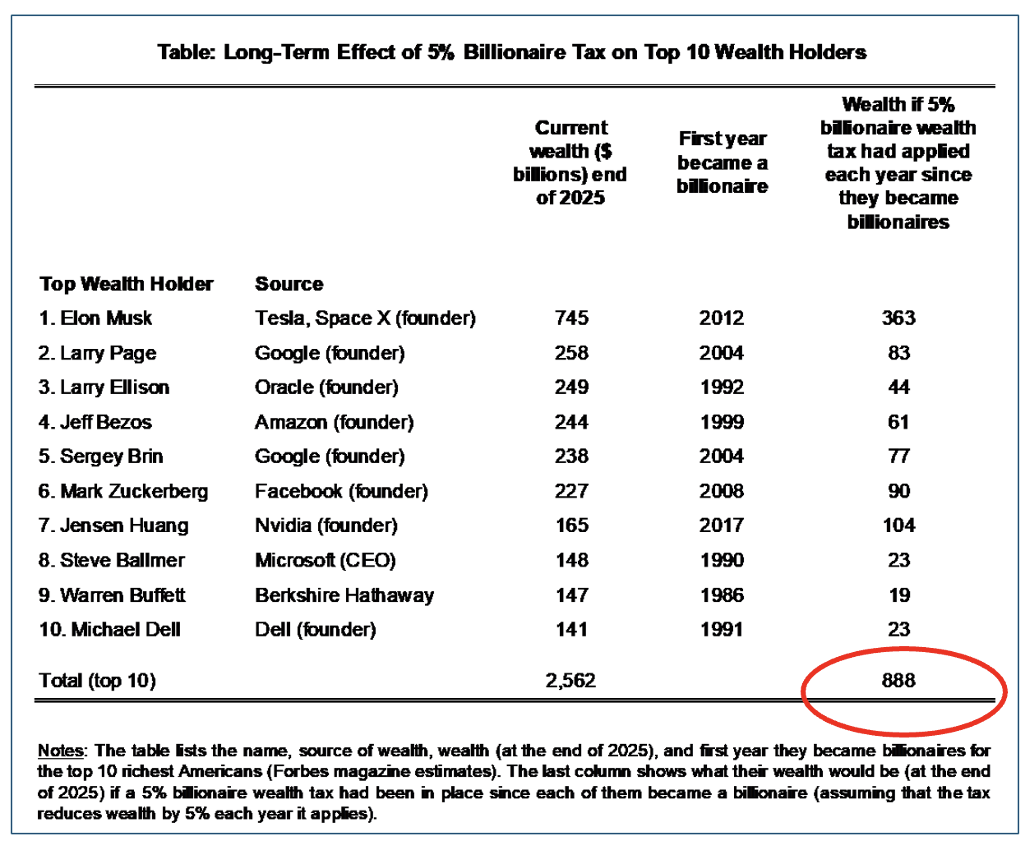
The two UC-Berkely economics professors analyze Senator Bernie Sanders (I-VT) legislation proposing an annual 5% wealth tax. In their analysis, the believe it would raise approximately $4.4 trillion over the coming decade. They also argue that if such a tax had been in place since 1980, the current top 10 wealthiest Americans would be worth $888 billion, about 1/3 of the $2,562 trillion they currently possess as of the end of 2025.
The Limits of New York’s “Tax the Rich” Policy E. J. McMahon Manhattan Institute
As the nation emerged from the Great Recession in 2010, the capital gains of income millionaires were disproportionately concentrated in the four most populous states: California, New York, Texas, and Florida. Between 2010 and 2022, taxpayers earning $1 million or more in these states accounted, on average, for 50% of the nation’s total capital gains realizations. At the start of the period, California led all states, with 16% of capital gains among all U.S. income millionaires. New York ranked second, at 14%, while Texas and Florida trailed at 8.7% and 8%, respectively. The next 12 years saw a significant shift in the rankings. By 2022, Florida had topped the list, with 16.7% of capital gains income among millionaire earners, followed by California at 14.9% and Texas at 9.7%. New York had dropped to fourth place, with 8.9%—essentially changing places with Florida.
How Much Revenue Would Senator Sanders’ Wealth Tax Proposal Really Raise? The Tax Foundation
According to the Tax Foundation analysis of Senator Bernie Sanders (I-VT) recently introduced 5% wealth tax on billionaires, the projected $4.4 trillion of revenues raised over 10 years would be significantly less. The analysis also points out that most European countries have repealed wealth taxes due to limited revenue and administrative and compliance challenges.
The Americas
Why Lula is Struggling: Brazil’s October Election Now Looks Like a Coin-Flip Brian Winter/Americas Quarterly
As recently as six weeks ago, President Luiz Inácio Lula da Silva seemed to be cruising to reelection. Unemployment was at record lows; the stock market at record highs; inflation had closed 2025 at its lowest level in seven years. Lula’s archrival, former President Jair Bolsonaro, was in prison—and had just chosen Flávio, widely seen as the least charismatic of his four sons, to be his preferred candidate in October’s vote. Today, there is nary a breeze. A Datafolha survey published Sunday showed Lula with just a three percentage point lead in a hypothetical runoff against Flávio Bolsonaro, down from a 15-point advantage in December. Other polls have shown similar dynamics. The tightening is in some ways a return to familiar battle lines; after all, Lula won the 2022 election by just a 51%-49% margin. But there are signs that the Lula of 2026 is struggling to connect with voters and could be at genuine risk.
Latin American Small States in the Belt & Road Initiative: Narrating Status Amidst US-China Tensions Zara Albright/Diego Telias/Tom Long – Cambridge Review of International Affairs
Abstract: Starting in 2017, most small states in Latin America and the Caribbean joined China’s Belt and Road Initiative (BRI). Near-uniform membership contrasts with variation in the Asian power’s importance to regional economies. The BRI has brought little new investment in these states; recently, participation has risked retaliation from the United States. What explains these states’ affinity for the BRI, despite heterogeneous material costs and benefits? We argue that the region’s small states have approached the BRI less for its immediate material benefits than for the salient discursive resources that it offers. Political leaders mobilize these resources to construct status narratives that justify, especially to domestic audiences, how BRI participation will improve national status. We analyze paired case studies during each of two temporal waves: Chile and Ecuador (wave 1, 2017–2019) and Honduras and Nicaragua (wave 2, 2020–2025). In addition, we consider Panama as the first Latin American signatory (wave 1) and the only country in the region to renounce BRI membership (wave 2).