Recommended Weekend Reads
May 29 - 31, 2026
Below are a number of reports and articles we read this past week and found particularly interesting. Hopefully, you will find them of interest and useful as well. Have a great weekend.
Sanctions, Tariffs, and the Financing of Global Wars
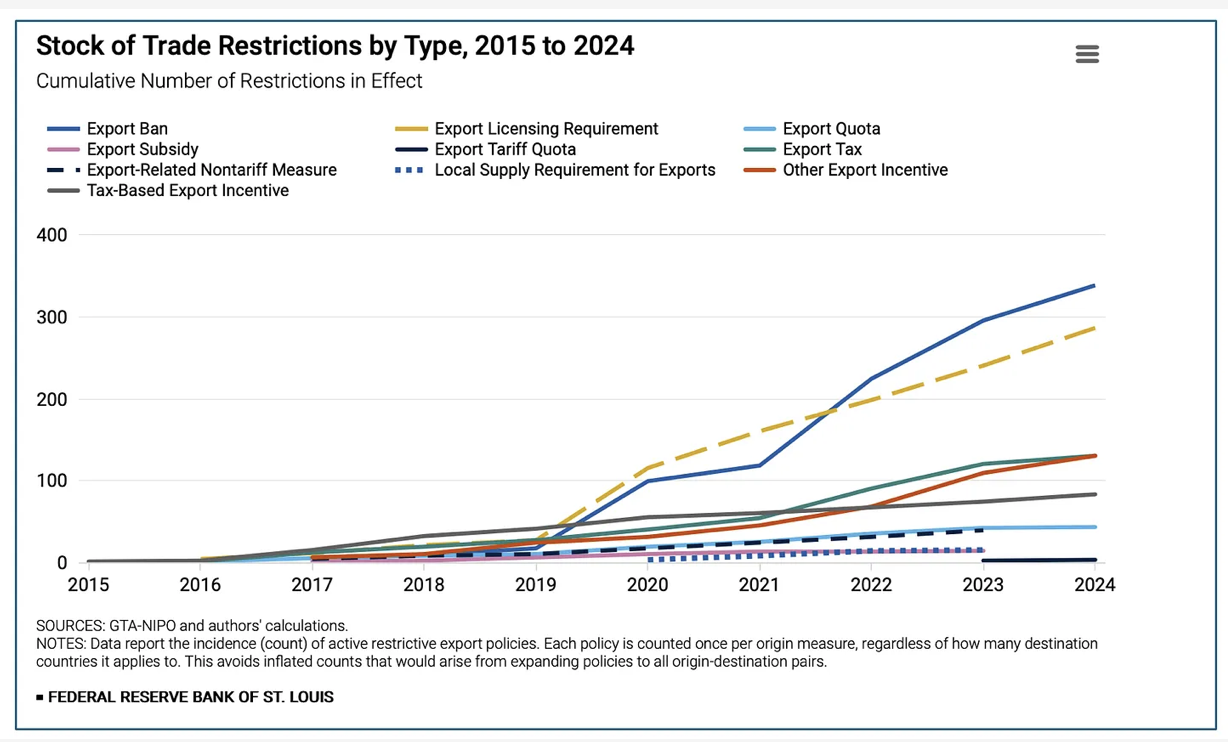
How Trade Policy is Changing: From Broad Rules to Targeted RestrictionsFederal Reserve Bank of St. Louis
From 2015 to 2024, the number of new export-related trade restrictions introduced across the globe each year and the cumulative number of restrictions in place both grew, with a particularly sharp increase after 2019.During this period, trade restrictions accumulated steadily across a wide range of policy instruments, reflecting a sustained shift in how trade policy is used.Targeted measures, particularly export bans and licensing requirements, expanded much faster than traditional, broad-based trade instruments like tariffs.The effects of targeted trade restrictions are not spread evenly across the global economy; rather, they tend to be concentrated in certain strategic, high-value and high-technology sectors.
States as Financiers: International Lending in War and Peace Kiel Institut
States are major international financiers, but their role is poorly understood. We study state-driven cross-border lending over two centuries using a new database covering 1.2 million official loans and grants by 134 governments and 70 multilateral institutions since 1790. We document a dual, state-contingent structure of international credit. In normal times, private creditors dominate cross-border lending. In adverse states of the world, such as wars and financial crises, official creditors step in, at times on a massive scale. These official flows are driven by great powers, are highly subsidized, and are largely absent from canonical models in international macroeconomics.
Perspectives is a reader-supported publication. To receive new posts and support my work, consider becoming a free or paid subscriber.
Shifting Conclusions From The Crises Of The Past 30 Years Louis-Vincent Gave Gavekal Research
Louis-Vincent Gave argues that “the lesson of the Strait of Hormuz” is to continue the shift toward investments in gold and industrial commodities – which will create a sustained liquidity drain on global financial markets. The lesson of the 1997-98 Asian and emerging market crisis was to accumulate more US treasuries. The lesson of the 2008 global mortgage crisis was to accumulate more US treasuries. The lesson of the 2011-13 eurozone crisis was to accumulate more US treasuries. The lesson of the 2022 Ukraine war and consequent financial sanctions was to accumulate more gold. Then what will be the lesson of the Strait of Hormuz crisis? Odds are it will be to accumulate larger inventories of industrial commodities, energy and food while reinvesting in the resilience of one’s own power grid. All of this will require capital and therefore act as a sustained liquidity drain on global financial markets for years to come.
Geoeconomics: What’s the Cost of Coercion in Global Trade? Federal Reserve Bank of Boston Podcast
When countries practice geoeconomics, they use their economic might to win concessions from other nations. Geoeconomics can include tools like industrial policy, tariffs, and embargoes. But some say these economic coercion tactics could reduce trust and cooperation among nations – and have critical impacts on global trade. Listen to the panel discussion with economists Douglas Irwin, Karen Dynan, and Caroline Freund and download the paper given by professor Jeffry Frieden at the Boston Fed’s 69th Economic Conference, “The U.S. Economy in a Changing Global Landscape.
State Dependence of Monetary Policy During Global Supply Chain Disruptions Jesus Fernández-Villaverde/National Bureau of Economic Research
Abstract: We study how global supply chain disruptions affect monetary policy transmission. Post-pandemic evidence indicates surging transportation costs, goods-market imbalances, and rising prices. We develop a model in which logistical bottlenecks (upstream slack coexisting with downstream shortages) steepen the aggregate supply curve. This convexity amplifies price responses to monetary policy while dampening output effects. Threshold VAR and Local Projection estimates are consistent with this mechanism: during disruptions, contractionary policy reduces prices more at smaller output cost, easing the stabilization trade-off.
Glass Jaw? The New Economic Fragility Recasting American Power War on the Rocks
A pair of children’s shoes is an odd place to look for the changing dynamics of American power. But stick with me because, after the past year, it is one of the clearest places to see them. Long before those shoes reach a store shelf, tariffs have raised the cost of materials, components, and importation. Oil touches nearly everything else: synthetic fabrics, foam, adhesives, packaging, and freight. When both shocks arrive together, companies cut margins, cut orders, cheapen materials, delay investment, and eventually pass the pain on to consumers. Now, multiply that across the economy, and you start to see the troubling scope of the strategic problems this is causing. The Trump Administration’s International Economic Powers Act tariffis and subsequent Section 122 tariffs have degraded the ability and agility of the U.S. economic system to absorb future shocks — critical parts of the systemic bedrock of American economic power. This is vital to understand because America’s economic power is not being hollowed out exclusively because of the Iran war and decreased energy supplies. In reality, the oil crisis is being layered on top of America’s new tariff-induced fragility, pushing America into a new economic cycle: one of higher prices and diminished capacity for American businesses to absorb and navigate global shocks to their supply chains. American businesses are already feeling this in real time. The shocks are still moving through the system and more will follow.
What Demographic Prediction Can and Cannot Achieve Samuele Lo Piano, Marta Kuc-Czarnecka, Roger Pielke, and Andrea Saltelli Social Science Research Network
Abstract: Simulation of the decision chain yielding projections of world population in 2050 that range from 6 to 14B suggests most of the variance in demographic forecasts arises not from parameter uncertainty or data randomness but from model choice. We explore demographic predictions by propagating all plausible choices that can be made during the analysis through the modelling process. This approach involves navigating the so-called ’garden of forking paths’—mimicking in silico what would happen if multiple investigators were to examine the same problem. For this, we now abandon [the Chinese government mathematician] Song Jian’s ‘historic’ model and turn to models currently in use: the Cohort-Component and UN WPP models, the Lee-Carter model and the Lotka-Volterra model. Note that in standard use, these tools are used in isolation, see e.g. the FAO’s How to Feed the World in 2050, resting on a single UN WPP population trajectory shielding the reader from the compounding effect of their uncertainty. Unsurprisingly, the exercise capturing the modelling of the modelling process for global population projections to 2050 and 2075 reveals distinct characteristics regarding the sensitivity and projection outcomes of the different models. Once abandoned the straitjacket of Song’s approach, uncertainty is free to manifest itself. The overall uncertainty distributions of the projected populations show a wide range of possible outcomes, reflecting the inherent uncertainties in demographic projections.
Americas
Hong Kong and the Shadow Fleet: How One City Helped Sustain Maduro’s Oil Trade China Strategic Risks Institute
Whatever one thinks of the US government’s unilateral actions toward Venezuela in recent months, there should be no confusion about what networks used to help sustain the regime. Maduro’s regime remained in power through repression, corruption, and the systematic plunder of state resources while ordinary Venezuelans paid the price. The vessels moving Venezuelan crude outside normal channels were part of that survival strategy. They were part of what is commonly called the shadow fleet, the loose and constantly shifting ecosystem of ageing tankers, opaque shell companies, false flags, ship-to-ship transfers, and other deceptive practices used to move sanctioned oil for regimes such as Russia, Iran, and Venezuela. The usual way of telling this story is as a maritime one, about suspicious voyages, evasive maneuvers, and interdictions at sea. But the more important story is often on land. Again and again, when the ownership and management chains behind these vessels are traced backwards, they lead to Hong Kong, to shell companies incorporated there, to secretarial firms that provide them a sheen of legitimacy, and to a Western sanctions designation and enforcement system that fails to identify targets hidden in plain sight.
Cuba’s Only Choice: A Deal With Washington Is the Island’s Best HopeForeign Affairs
Ever since U.S. commandos removed Venezuelan President Nicolás Maduro from power in January, Washington has piled unprecedented pressure on Cuba, Caracas’s beleaguered former ally. The island’s economy had already been spiraling as a result of the first Trump administration’s “maximum pressure” sanctions, the COVID-19 pandemic, and Havana’s failure to adopt deeper economic reforms. But Cuba’s loss of access to heavily discounted Venezuelan oil dealt a lethal blow. Time is running short. Frustrated by Havana’s intransigence, the Trump administration has threatened to impose crippling new secondary sanctions on foreign companies doing business in key sectors of the Cuban economy. This is not just a story about Washington’s choices, however. For decades, the island’s government has prioritized internal control and external patrons over political and economic transformation. The onus to avert catastrophe is now on Havana. The longer Cuban leaders treat the path forward as a matter of revolutionary dignity rather than national survival, the more certain it becomes that whatever follows will be worse.
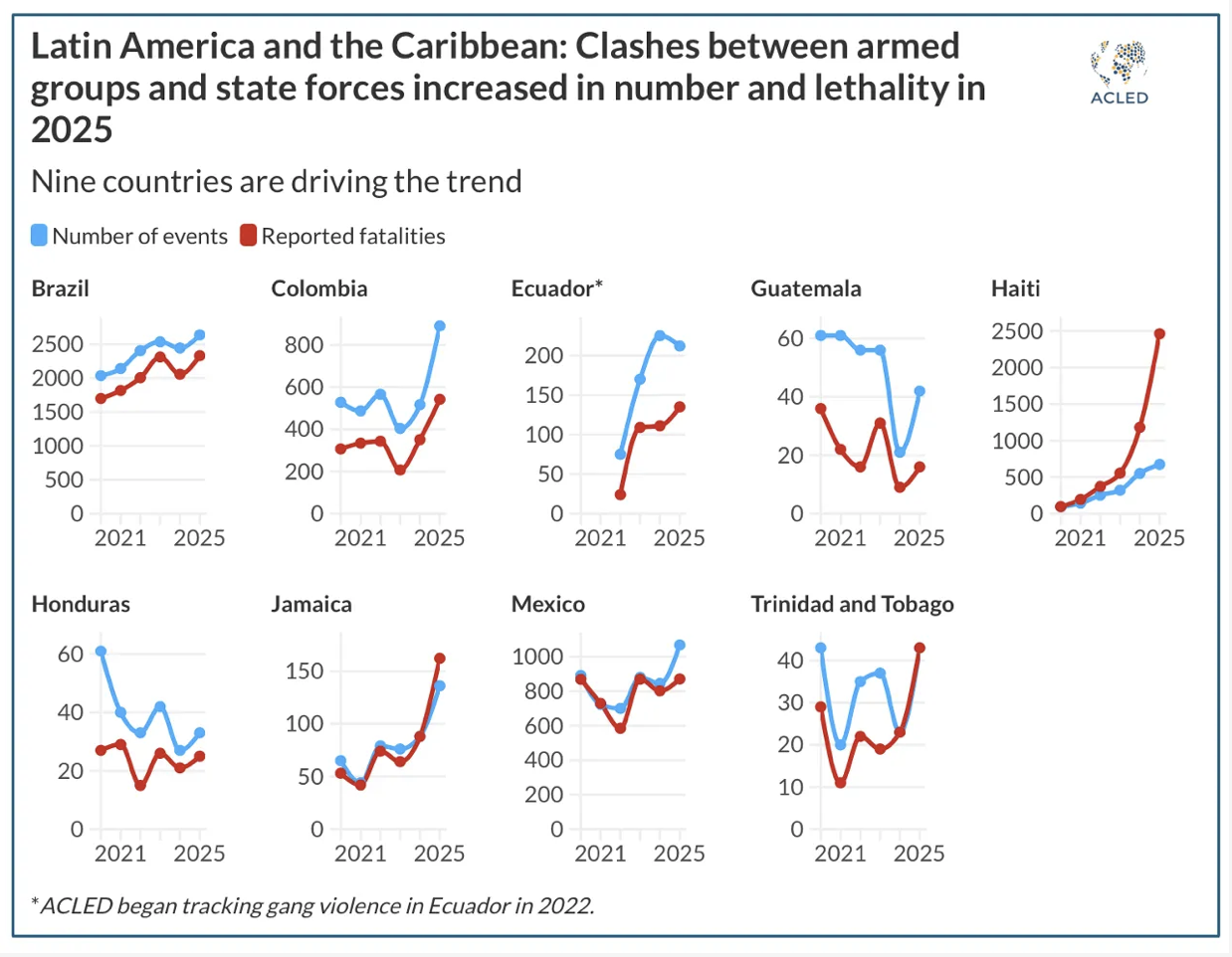
The US’ Donroe Doctrine is reshaping conflicts in Latin America and the Caribbean ACLED (Armed Conflict Location & Event Data)
The US has escalated its use of direct military force with governments it perceives as failing to meet its policy objectives, but direct military interventions are less likely during the remainder of President Donald Trump’s administration, which favors bilateral agreements or forced negotiations secured through pressure and threats. US pressure on organized crime is accelerating the spread of militarized security approaches in the region, which has had a number of knock-on effects:
The number and lethality of clashes between security forces and armed groups have surged, and the approach has fostered an environment of impunity for security forces.
Violence has decreased in areas where criminal groups have more limited resources, but gangs have responded by relocating, scaling back visible activities, and turning to selective forms of violence.
Armed groups have fragmented, increasing competition in countries where organized crime groups’ revenue sources are more diversified.