

Recommended Weekend Reads
Germany’s China Shock, Trump’s Monroe Doctrine is Aimed at China, How The U.S. Population Has Shifted, Why China Doesn’t Want A U.S – Iran Deal, and How AI is Both Helping and Replacing Workers
February 27 - March 1, 2026
Below are a number of reports and articles we read this past week and found particularly interesting. Hopefully, you will find them both interesting and useful. Have a great weekend.
The Americas
Trump's latter-day Monroe Doctrine is aimed at China Peterson Institute for International Economics
The US intervention in Venezuela, attacks on vessels in the Caribbean, financial squeeze on Cuba, and its bailout of Argentina should perhaps have come as no surprise. After all, the Trump administration has made no secret of its intentions, as laid out in the 2025 National Security Strategy (NSS) document: To "reassert and enforce the 'Monroe Doctrine' to preserve U.S. preeminence in the [Western] Hemisphere and deny outside powers control of strategic locations and assets." It would certainly appear that the administration is currently achieving the goals set out in the NSS, entrenching Latin America as the main stage for a geopolitical confrontation between the United States and China. But these actions could also introduce further turbulence into a region mired in political and economic problems. China is heavily invested in Latin America through various channels, notably its "green" Belt and Road Initiative. The framework has enabled China's public banks and state-owned enterprises to underwrite massive projects in renewable energy sources, critical minerals, and infrastructure. It is estimated that since 2010, China has invested around $35 billion in renewable energy projects alone. The figure does not include the $1.3 billion spent to finance the massive Port of Chancay in Peru, which connects South America's Pacific Coast to Shanghai.
Population drops and gains in every state FlowingData
The Census Bureau released population estimates for 2025. Most states gained population, but a few states saw more people move out than move in, with births not enough to compensate. By percentage, Puerto Rico, Hawaii, and West Virginia decreased in population the most since 2020. By total change, New York and California decreased by about 200,000 people each. The population in Louisiana, Illinois, and Mississippi also dropped. Idaho went the other direction with the largest increase over 10%. Texas and Florida populations increased the most, with total increases of 2.56 million and 1.92 million, respectively.
How Trump’s 15% Tariff Move Impacts Latin America Americas Quarterly
Latin American economies seem relatively well-positioned following the U.S. Supreme Court’s decision to invalidate last year’s tariffs on imports of goods and services and President Donald Trump’s announcement of a new 15% global tariff. Trump's previous levies were invalidated on February 20, after a majority of the U.S. Supreme Court’s justices (6-3) ruled that the president exceeded his authority to issue them, dealing the government a major setback. That day, Trump set a replacement global tariff of 10%, which was increased to 15% the next day.
Europe, China, and Iran
Germany’s China Shock Internationale Politik Quarterly
The China shock is here,” the German Economic Institute declared last July. Indeed, 2025 will go down as the year in which it could no longer be denied. Germany's trade deficit with China reached a record level of €87 billion—an increase of €20 billion compared to the previous year. And German exports to China continue to be in free fall. The United States, France, the Netherlands, Poland, and Italy have by now become more important export markets for Germany than China. At the beginning of this century, China accounted for 6 percent of global industrial production. Today, the figure stands at around 30 percent. China’s economic model is firmly geared toward global dominance in industries where Germany has been traditionally strong, such as automotive, mechanical engineering, and chemicals—as well as in future industries such as robotics and biotechnology. Beijing not only leverages the economies of scale of its vast domestic market but also makes forward-looking investments in research and development.
Why China Doesn’t Want the US and Iran to Make Peace The Diplomat
While Beijing publicly advocates restraint, sustained tensions between the U.S. and Iran serve its strategic interests. China's broader perspective on Iran is unlikely to change absent a major shock. Beijing views Tehran as a useful strategic partner in its long-term effort to counter Western – especially U.S. – dominance of the international system. As a result, China supports Iran diplomatically and economically, while also offering limited and discreet military-related assistance. This support does not typically take the form of overt arms sales, but rather the provision of dual-use components and technologies that can be used in Iranian drone and missile production. These activities allow Beijing to strengthen Iran’s resilience without incurring the costs associated with formal military alliances or large-scale weapons transfers.
What It Will Take to Change the Regime in Iran Behnam Ben taleblu/Foreign Affairs
The Islamic Republic of Iran is, quite possibly, at its weakest point since its founding in 1979. In June, Israeli and U.S. attacks destroyed its uranium enrichment capacity and many of its air defense systems. In December and January, the country experienced the most widespread domestic uprising since the birth of the Islamic Republic. Throughout, it has faced spiraling economic and environmental crises that it cannot fix. None of these events has knocked out the Islamic Republic. But there is no doubt it is down. It is easy to see why the Trump administration is prioritizing diplomacy and limited strikes. The Islamic Republic may be weak, but it is still lethal and capable of harming U.S. forces and civilian targets throughout its region. Such measures could inspire the masses of Iranians who took to the streets in December and January to do so again. Just this week, Iran witnessed smaller-scale campus protests, showing that animosity against the regime very much remains. If regular protests resume, American military power could level the playing field between the street and the state, giving the country’s demonstrators a chance to succeed.
Geoeconomics
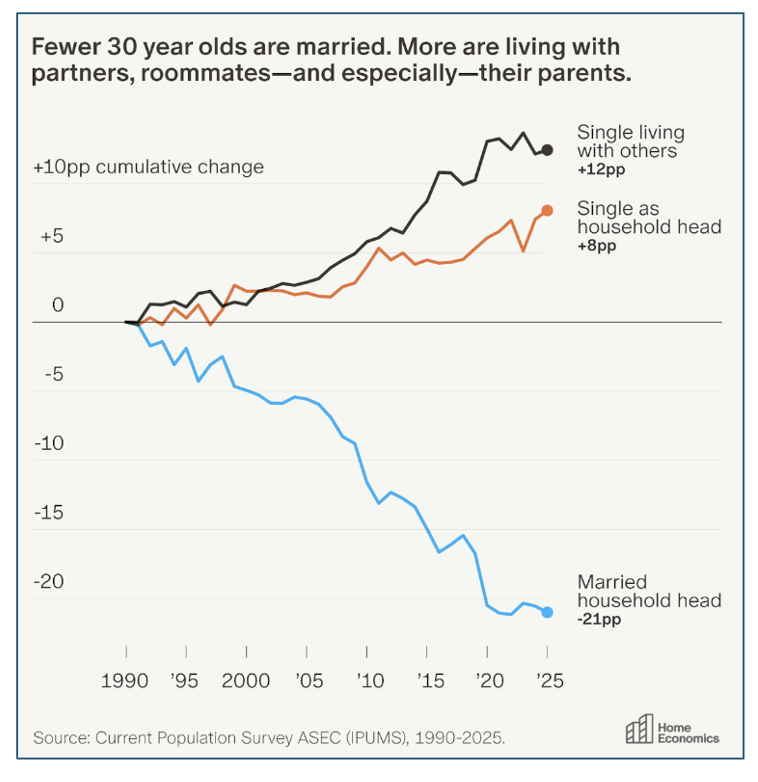
Living With Mom And Dad At 30 Aziz Sunderji Home Economics
The share of American 30-year-olds living with their parents or roommates nearly doubled btw 1990 and 2025, from 17% to 32%. Aziz Sunderji finds that this group is largely responsible for the age cohort’s 15pp decline in homeownership over that period.
The New Global Tariffs Are Also Unlawful Philip Zelikow/Hoover Institution’s Freedom Frequency
On February 20, the Supreme Court ruled that President Trump’s tariffs imposed under an emergency powers law were unlawful. After raging at the court, the president imposed a new set of global tariffs using a different statutory authority. Now, the Trump Administration has moved to use Section 122 to carry on the tariff policy. And the author – who was involved in the recently decided case – argues the use of 122 is both obsolete and illegal.
The 2028 Global Intelligence Crisis Citrini Research
In this widely-hailed essay, Alap Shah of Citrini Research models a scenario that the author writes about the potential impact of AI on society. Shah’s vision is that “In every way AI was exceeding expectations, and the market was AI. The only problem… the economy was not…. AI capabilities improved, companies needed fewer workers, white collar layoffs increased, displaced workers spent less, margin pressure pushed firms to invest more in AI, AI capabilities improved… It was a negative feedback loop with no natural brake. The human intelligence displacement spiral. White-collar workers saw their earnings power (and, rationally, their spending) structurally impaired. Their incomes were the bedrock of the $13 trillion mortgage market - forcing underwriters to reassess whether prime mortgages are still money good.”
Speed Can Reindustrialize America Austin Vernon Blog
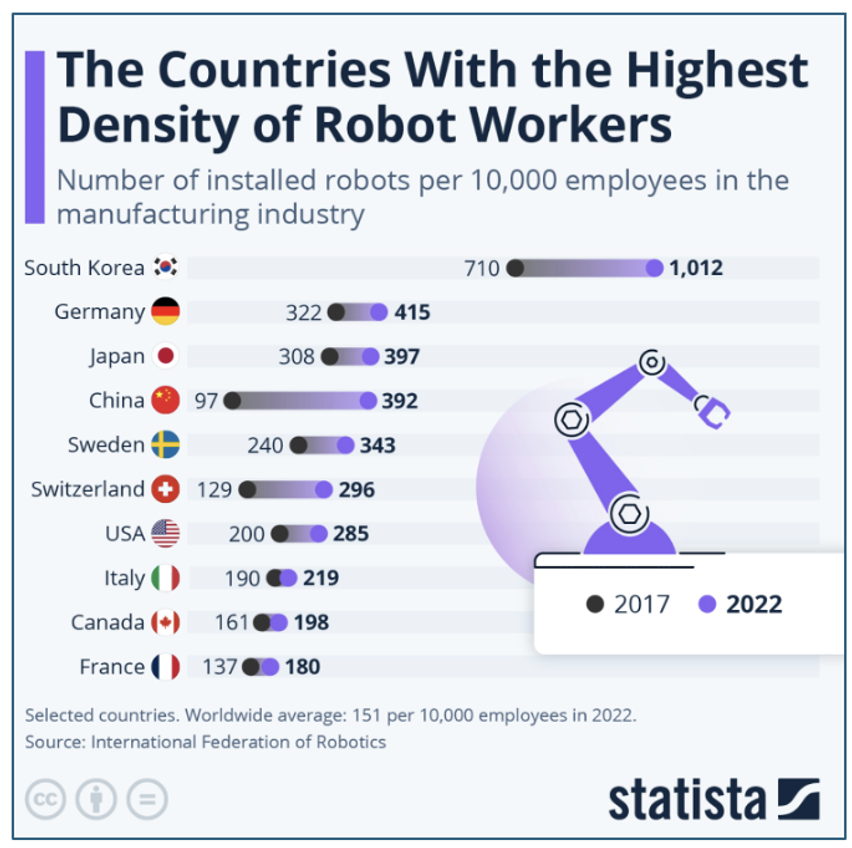
High US wages for skilled workers constrain robot adoption in manufacturing. “Many less productive US manufacturing firms could buy a robot, but couldn’t attract the talent to program it.” The US can’t “emulate” the low-wage, high-skilled China model.
AI Is Simultaneously Aiding and Replacing Workers, Wage Data Suggest J. Scott Davis Federal Reserve Bank of Dallas
For occupations with a very low experience premium, AI exposure lowered wage growth, likely due to substitution of AI for costly experienced workers. At the top of the experience distribution, AI raised wage growth, as it complements experienced workers.
The Flawed Paper Behind Trump’s $100,000 H-1B Fee Economic Innovation Group
Abstract: Do H-1B visa holders earn more or less than Americans? There are two different ways to answer this. If we compare H-1B holders to the average native-born worker, the answer is unequivocal that the visa holder is paid more. Median H-1B pay in 2024 was $120,000 per USCIS, compared to $67,000 for the average native-born worker. However, when we compare H-1B holders to otherwise similar native-born workers, the question becomes more complex. Answering it correctly requires careful examination. Unfortunately, a recent attempt at answering this question from Harvard economist George Borjas contains major errors.