Recommended Weekend Reads
Can the U.S.–China Spiral Be Reversed? The Coming U.S. Military Drawdown from Europe, How Businesses Are (Or Aren’t) Adopting AI, and How Family Incomes in the U.S. Have Grown
September 18 - 20, 2026
Below are a number of reports and articles we read this past week and found particularly interesting. With Chinese President Xi Jinping’s visit to Washington this week, we put a special focus on U.S.-China relations. Hopefully, you will find all or at least some of these pieces of interest and useful. We hope you have a great weekend.
China
Strategic Stalemate: Ryan Hass on How Beijing Sees America — and Trump Sinica Podcast
In this episode of Sinica podcast, the guest is Ryan Hass, Director of the John L. Thornton China Center at Brookings, former NSC director for China, Taiwan, and Mongolia, and co-host of the Beijing Brief podcast. Ryan has just published two pieces that couldn’t be better timed: a long essay in China Leadership Monitor, “China’s Great Power Vision Comes into Focus,” which argues that the 2020s may be remembered as the decade Beijing finally laid its cards on the table — and a shorter Brookings piece, “Why Beijing Isn’t Taking the Bait with Trump,” on why Xi Jinping has answered an unusually accommodating American president with a poker face, and what that means for Xi’s state visit to Washington later this month.
Trump and Xi Can’t Stop the U.S.-China Spiral Orville Schell/Foreign Affairs
Today, as U.S.-Chinese relations spiral into an ever more adversarial state, the longing for another breakthrough delivered by “great men” is especially acute. U.S. President Donald Trump has egged on that desire by boastfully insisting that he alone can cut the kinds of deals the United States needs through force of personality. Even seasoned foreign policy hands who consider themselves realistic have been prone to entertaining unrealistic visions of success. When a Beijing summit between Trump and Xi was announced for the spring of 2026, the meeting was sanguinely billed in Foreign Affairs as “a geopolitical heavyweight matchup” that could “change the course of U.S.-China competition.” Sadly, no such breakthrough came to pass. The May summit in Beijing, which I attended as a member of the press corps for this magazine, may have helped sustain a cryptic peace—a “constructive strategic stability,” as Xi euphemistically termed it. But it did not change the fundamentally adversarial nature of the relationship between the two countries. They remain locked in a dynamic of strategic ambiguity marked by endless bouts of punitive “chokehold” diplomacy, with each exploiting its control over critical supply chains to pressure the other.
American Power: A View from China Wu Xinbo/Carnegie Endowment for International Peace
The United States’ 250th anniversary has rekindled strong interest within China about the direction of America’s domestic development and the nation’s role in international affairs. Chinese strategists are once again debating whether American power is declining and whether U.S. hegemony is experiencing irreversible decay in a world defined by fierce geopolitical competition and major economic, technological, and political transformations. Addressing these questions requires assessing American power from three perspectives: the status and outlook of American power growth, America’s power superiority vis-à-vis China, and America’s hegemonic power on the world stage.
The United States and China: Still Not Number One Nina Gohel/Center for Strategic and International Studies
In December 2020, the Trustee Chair published the first iteration of “Not Number One,” which provided global rankings of the United States and China covering a wide array of metrics, including the military, the macroeconomy, health, quality of life, technology, social stratification, and other issues. The conclusion was clear: While the United States and China are widely assumed to be engaged in a battle of the best, across most indicators—especially those pertaining to the quality of life—neither country were anywhere near number one.Nearly six years later, the Trustee Chair has updated the analysis to see if any of the tables have turned. Spoiler alert: They have not, as summarized in Table 1.The United States still leads the globe in military spending and commercial wealth, with a $954 billion defense budget and 902 billionaires. It is also the unenviable leader in firearm deaths, accounting for 17.9 percent of the world’s annual total. Meanwhile, China takes the cake for patent applications and patents granted, filing over a million more than any other nation. China also holds the lowest poverty headcount ratio, having claimed “complete victory” over poverty in 2021. As a reminder, China’s national poverty line, established in 2011, is roughly $340 (¥2,300) per year, which equates to $0.93 (¥6.3) per day. In tier 1 cities this tends to support no more than a packet of instant noodles or bag of chips, if that.
Who Paid for China’s Last Debt Cleanup, and Who Will Pay for the Next? Michael Pettis/Carnegie Endowment for International Peace
Chinese debt has risen over the past ten to fifteen years at perhaps the fastest pace in history, leaving China with one of the highest debt-to-GDP ratios in the world—second only to Japan among the major economies. What is more, surging debt has always been the warning for investment-driven “miracle” economies that their growth model has become unsustainable. That is why it is not surprising that analysts have become increasingly concerned about how China will ultimately resolve its debt burden. Some look back to the cleanup of China’s banking system in the early 2000s, following the explosion of bad lending during the 1990s, as a possible model for dealing with today’s debt overhang.
Russia and China’s Grand Strategy Elizabeth Wishnick/China Leadership Monitor
Is China poised to advance an alternative vision of the global order in partnership with Russia? After gathering momentum during the previous decade, the Sino-Russian partnership has been deepening under Xi Jinping. Since 2022, progress has been notable in military cooperation and, although Sino-Russian economic ties have long been a weak spot, they have made some progress in energy and regional relations. The full-scale war in Ukraine has highlighted China as an indispensable partner for Russia, and it has also increased Russia’s value to China, especially due to the Russian military’s ongoing experience in drone-driven battlespace. Although China and Russia are in alignment in their efforts to counter U.S. power as it comes to bear on their immediate interests, they are not in lockstep in their efforts to envisage an alternative order. Nevertheless, their parallel efforts, especially those built on deeper military cooperation, may have a significant impact on regional dynamics.
U.S. Defense Policy and NATO
The Crumbling Defense of Europe Franklin Miller, Eric Edelman, and Walter Slocombe/Foreign Affairs
The United States appears ready to pull much of its military from Europe. The Trump administration’s 2025 National Security Strategy, a key policy document, declared that it was time for the continent to “stand on its own feet” and take “primary responsibility for its own conventional defense”—or, put differently, that it needs to get ready for when Washington withdraws. At a June 2026 meeting of NATO’s defense ministers, U.S. Secretary of Defense Pete Hegseth announced that the Pentagon was “moving fast and irreversibly toward Europe stepping up to take primary responsibility for the defense of Europe.” Two months later, in August, U.S. Undersecretary of Defense Elbridge Colby said that NATO would transition to what he called “a stronger, more equitable and sustainable alliance,” or one in which the continent would do most of the work of defending itself. The administration followed up by sending a questionnaire to all NATO allies, seeking to elicit whether they were aligned with President Donald Trump’s policies and priorities; unspoken was the clear threat that those who were not would face decreased U.S. support. To Trump and his officials, withdrawing from Europe makes perfect sense. The continent, they argue, is rich and powerful enough to fully defend itself. Washington, meanwhile, must spend its military resources on growing challenges in Asia and the Middle East. But the administration’s logic is incorrect. Pulling back from Europe will not advance Washington’s interests in any part of the world. Quite the contrary: it will weaken not only NATO but all of the United States’ partnerships. It could even threaten the American homeland.
What is the value of a ‘Europeanized NATO’ for the United States? Brookings Institution
NATO can become more European, with non-U.S. allies seeking to become an equally strong overall pillar of the alliance. But NATO will not and should not become truly Europeanized—with Europe being independently responsible for its own defense. Were the European countries of NATO (and Canada) to develop roughly three times today’s deployable conventional combat capacity—including much greater use of drones and counter-drone defenses—they could effectively defend NATO’s exposed eastern flank, at least initially and for some scenarios. For the United States, there would be enormous benefits from such a European pillar of the alliance that approached America’s own likely capacities for waging war in Europe.
Both Brazil and Cuba Facing Transformative Change
Brazil’s Scandal-Plagued Election Americas Quarterly Podcast
Only a few weeks ago, there was a near consensus in Brazil that President Luiz Inácio Lula da Silva was the favorite to win this October’s election over his main challenger, conservative Senator Flávio Bolsonaro. Today, most polls show the race is tied, and Flávio Bolsonaro seems to have the momentum. With the first round of voting on October 4 and a second round very likely on October 25, it’s been a unique—and to outsiders, somewhat confusing—campaign in Brazil. In recent months, the main issue has been not the economy, or security, as we’ve seen in other recent Latin American elections, but a corruption scandal involving Daniel Vorcaro, a disgraced banker whose network of influence and business ties extended to much of Brazil’s political and economic establishment. Back in May, Bolsonaro was badly damaged by alleged ties to Vorcaro. But more recently, attention has shifted to Vorcaro’s alleged ties to Supreme Court Justice Alexandre de Moraes. Those revelations, in turn, seem to have damaged Lula. (All deny any wrongdoing.)
Brazil Inc. Can Boom — If the Government Cleans Up Its Act Juan Pablo Spinetto/Bloomberg Opinion
Brazilian executives believe in Brazil’s potential and will continue investing regardless of the outcome of the presidential vote, with companies such as Embraer SA, WEG SA, and Suzano SA evolving into global champions. The next president has a chance to break the cycle of fiscal irresponsibility and excessive regulation and unlock investment and productivity through a virtuous fiscal adjustment and structural reforms.
Cuba’s Point of No Return: The Country Is Collapsing Even as Its Regime Survives Will Freeman/Foreign Affairs
Cuba, on its current trajectory, is headed for the fate of the design school: what lies ahead is an accelerating collapse of the state and economy. Unless this course is reversed soon, rebuilding the island as a stable, prosperous, and democratic place could become virtually impossible.
AI and How Businesses Are Adopting It… Or Not
What Work Does Generative AI Do? Federal Reserve Bank of St. Louis
Two new measures of AI adoption offer another way to study the technology’s effect on the U.S. labor market. They track what share of workers in an occupation actually use AI and what share of individuals who perform a given job task use AI to complete it. These indexes, which are based on Real-Time Population Survey data, show AI adoption is widespread. At least 20% of workers use AI in more than 80% of occupations and on more than 40% of job tasks. AI adoption is also shallow. At least half of workers use AI in only 40% of occupations and for less than 3% of job tasks. Together, the indexes can offer a more nuanced view of AI adoption in the workplace than measures that rank occupations and job tasks by exposure to AI, because the type of work may not definitively predict adoption. Findings suggest that understanding why some workers adopt AI while others do not may be as important as understanding the work the technology can do.
Businesses Are Using AI to Transform Work, Not Cut Jobs Liberty Street Economics/Federal Reserve Bank of New York
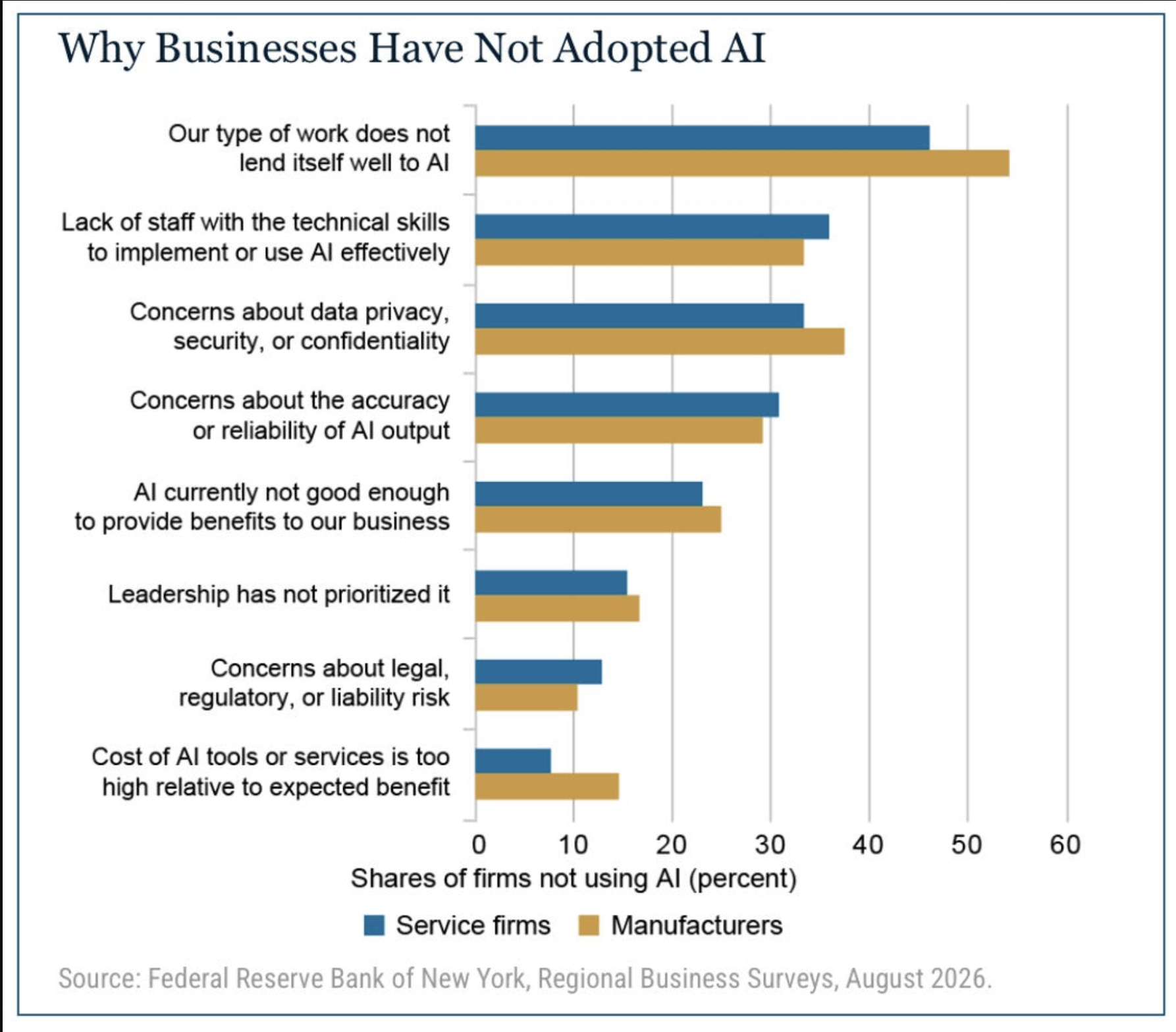
The ongoing advancement and adoption of artificial intelligence continues to raise concerns about widespread job losses. Over the past three years, our regional business surveys have asked firms about their AI adoption and its effects on their workforces. This year, we found that AI use among regional businesses has continued to rise sharply, with more than 60 percent of service firms and about half of manufacturers now using AI—a notable increase from 40 percent and 26 percent, respectively, reported in 2025. Despite this rapid adoption, regional firms’ investments in AI are generally modest, usage tends to be concentrated among a small share of workers within firms, and layoffs have remained uncommon. And, while some firms have scaled back hiring due to AI, others have added workers to help them use it. Retraining employees in response to AI remains the primary way firms are adjusting their workforces.
Economic Growth and Family Income
Family Income Continues to Grow in 2025 Data Economist Writing Every Day
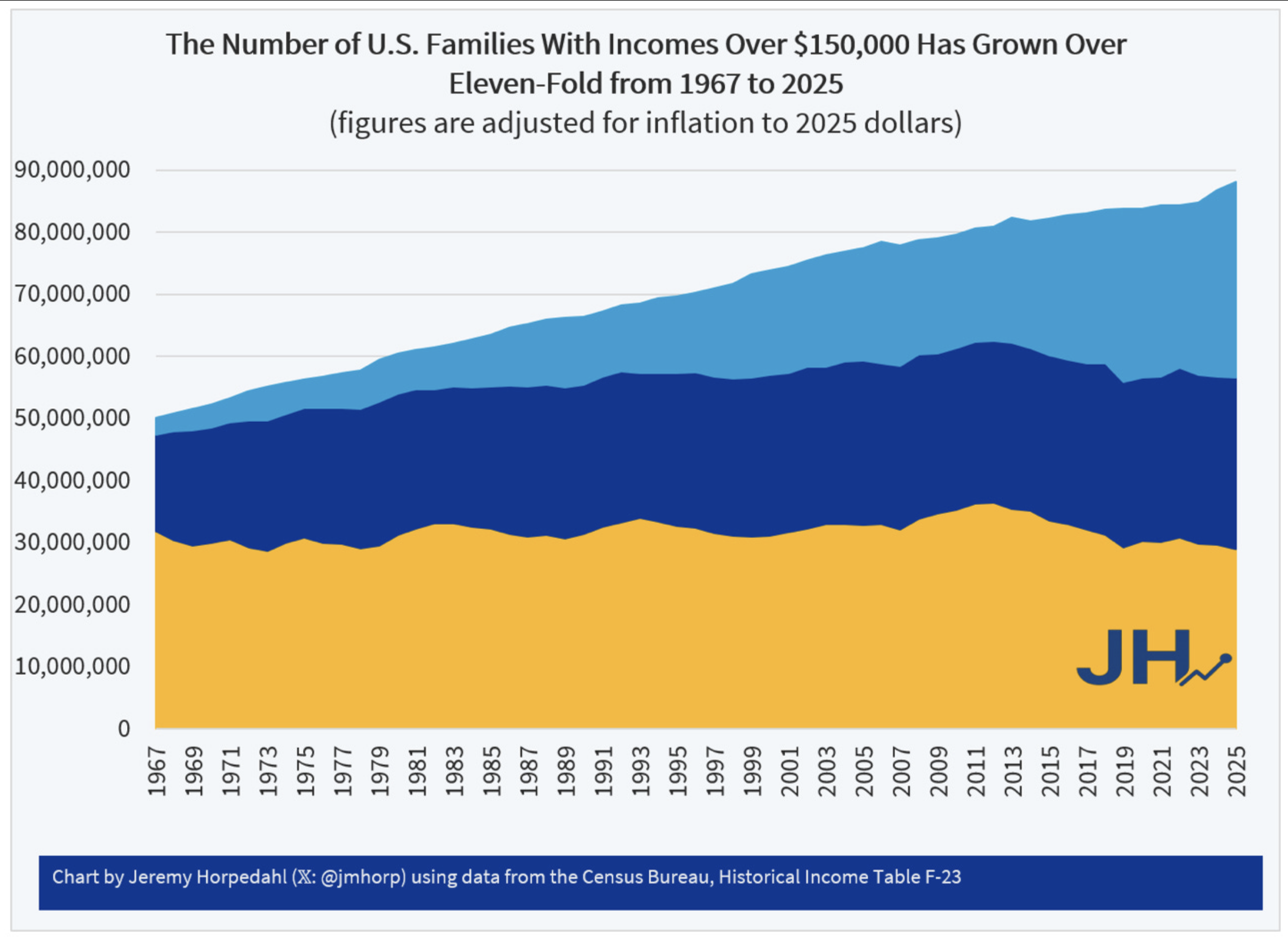
The Census Bureau this past week released their annual treasure trove of data from the Current Population Survey, Annual Social and Economic Supplement. The data showed the following: In 1967 there were fewer than 3 million families with incomes over $150,000 (in 2025 inflation-adjusted dollars). By 2025, that had grown to over 31 million families. If we look at the highest income threshold in this Census data — over $200,000 — the number of families has grown from just 1 million in 1967 to over 20 million in 2025. And there are fewer lower-income families too: the number of families under $75,000 shrunk, not just as a proportion of the total but even in absolute terms by almost 3 million families from 1967 to 2025. Of course, some of these families do have more earners than in 1967, though we shouldn’t overstate that too much. Using other data from Census, we can see that the share of families with multiple earners hasn’t increased much since 1967 and especially hasn’t since the mid-1990s.