

Recommended Weekend Reads
Foreign Private Capital Overtook Central Banks in the Treasury Market, U.S. Grand Strategy and China, and How a Quiet US – AU Deal Could Reshape Investment in Africa
April 24 - 26, 2026
Below are a number of reports and articles we read this past week and found particularly interesting. Hopefully, you will find them of interest and useful as well. Have a great weekend.
Geoeconomics, Financial Markets, and AI
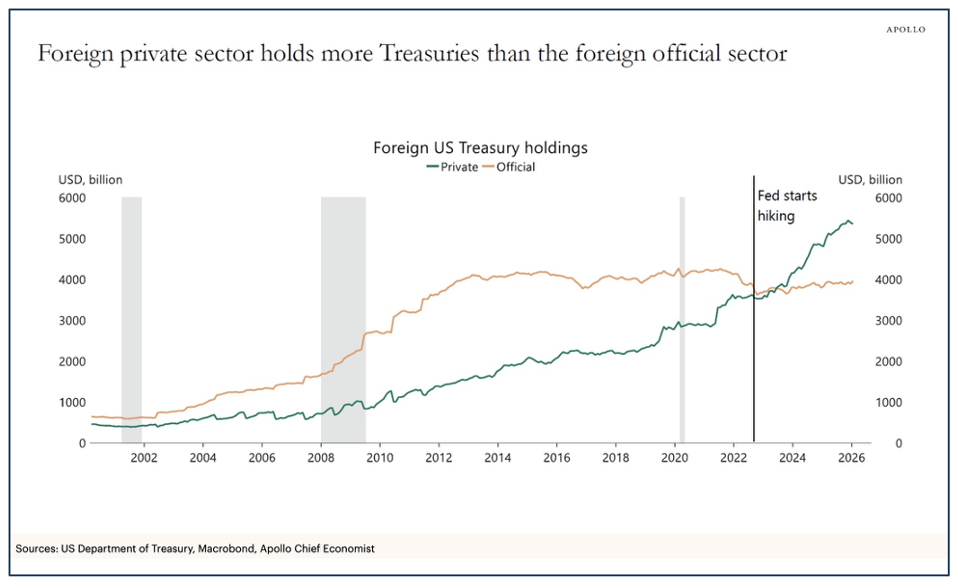
Foreign Private Capital Has Overtaken Central Banks in the Treasury Market Torsten Sløk Apollo
For the first time, foreign private buyers own more Treasuries than the foreign official sector, Slok notes, suggesting the “Treasury market [may be] increasingly sensitive to the return expectations of price-sensitive private capital.”
Corporations in the Crosshairs: Commercial Actors, Conflict Escalation, and Crisis Simulation Journal of Simulation and Gaming
Abstract: The authors reach three substantive findings. First, the game demonstrated that cyber and kinetic attacks on commercial assets can trigger escalation—challenging arguments that attacks on commercial targets are less provocative than attacks on military and government targets. Second, the growing role of commercial firms in the international security arena makes communication channels for information sharing and coordination between the government and these firms critical for crisis management. Third, the wargame highlighted how relying on influential private sector leaders involves tradeoffs. These individuals can provide critical information to governments, leverage their companies to support government efforts, and help coordinate broader private sector engagement. However, they may also prioritize their own commercial interests over national ones. Additionally, the simulation revealed lessons that may assist designers of future simulations involving commercial actors.
Drivers of Population Growth: Natural Increase vs. Net Migration Federal Reserve Bank of St. Louis
National population growth reflects both natural increase and net migration, with each factor shaping countries differently across income levels. Natural increase drove almost all population growth in poor countries from 1960 to 2023. In rich countries, however, both natural increase and net migration sustained their population growth during that same period.
Six Reasons Claude Mythos Is an Inflection Point for AI—and Global Security Council on Foreign Relations
Anthropic’s new AI model has taught itself to hack into software infrastructure systems believed to be among the most secure in history. While there is no question that the technology is profoundly dangerous, it is unclear if defenders will win a race against time to protect a sea of vulnerable targets.
Forecasting the Economic Effects of AI National Bureau of Economic Research
Abstract: We elicit forecasts of how AI will affect the U.S. economy, comparing the beliefs of five groups: academic economists, employees at AI companies, policy researchers focused on AI, highly accurate forecasters, and the general public. The median respondent in each group expects substantial advances in AI capabilities by 2030, small declines in labor force participation consistent with demographic shifts, and an annual GDP growth rate of 2.5%, which exceeds both the typical medium-run (2.0%) and long-run (1.7%) baseline forecasts from government agencies and private-sector forecasters. Conditional on a “rapid” AI progress scenario, in which AI systems surpass human performance on many cognitive and physical tasks, experts forecast substantial, though not historically unprecedented, economic shifts: annualized GDP growth rising to around 4% and the labor force participation rate falling from its current level of 62% to 55% by 2050, with roughly half of that decline—equivalent to around 10 million lost jobs—attributable to AI. A variance decomposition suggests that expert disagreement about these effects is driven primarily by different beliefs about the economic effects of highly capable AI systems rather than by disagreement about the pace of AI progress. These forecasts map onto notably different policy preferences across groups: experts strongly favor targeted measures such as worker retraining, whereas the general public supports both targeted programs and broader interventions, including a job guarantee and universal basic income.
·Construction Costs Rarely Fall Brian Potter Construction Physics
Multiple measures show real construction costs have “virtually never fallen” since 1875, with the striking exception of 1975–95—consistent with input cost and productivity series. The upward drift is not new; if anything, it has moderated over time
Africa
A quiet US-AU deal that could reshape investment in Africa Africa Futures/AUDA NEPAD
The Trump administration and the AU have started a bold journey that could ‘flip the script’ on decades of development cooperation. The Strategic Infrastructure and Investment Working Group (SIWG), formed on 28 January 2026, will enable senior officials and experts to identify investment opportunities, particularly involving the US private sector. It could strengthen African and US strategic options amid major-power rivalries globally. But both sides must ensure Africans’ full partnership as investors and decision makers in those projects.
The Sudan War in 10 Charts The Center for Strategic and International Studies
Sudan’s civil war has now entered its fourth year, with its two main factions locked in a grinding war of attrition. The conflict began on April 15, 2023, between the Sudanese Armed Forces (SAF) led by General Abdel Fattah al-Burhan, and the Rapid Support Forces (RSF) paramilitary, led by Mohamed Hamdan Dagalo, popularly known as Hemedti. Today, the country is split roughly in two, with the SAF in control of the east and the RSF in control of the west. As a result of the war, Sudan is now the world’s largest displacement and hunger crisis. Rape and sexual violence are both widespread and systematic and have become a defining feature of the war. Sudan’s rich cultural heritage, too, is being erased.
Impact of the Iran War
The Iran War Is a Stress Test for Gulf States Carnegie Endowment for International Peace
The U.S.-Israeli war on Iran has had dire security and economic consequences for the Arab states of the Gulf Cooperation Council (GCC). Iranian missiles and drones struck airports, hotels, and energy infrastructure across the region, triggering the largest oil supply shock in the history of global energy markets and a near-total collapse of aviation and tourism. Attacks on desalination plants have raised fears of a humanitarian emergency. Threats to shipping through the Strait of Hormuz have disrupted over 70 percent of the region’s food imports. Externally, the war has prompted questions about the risks and costs of the region’s reliance on American security guarantees and bases. Beyond these effects, the Iran war is a stress test for domestic governance and social cohesion inside Gulf states, surfacing and sharpening preexisting fissures and vulnerabilities while introducing new pressures. Among the more prominent of these dynamics are a worsening crackdown on freedom of expression and increased securitization more broadly; a rise in sectarian tensions and internal scapegoating amid the very real threat of Iranian subversion; and the imperilment of the Gulf’s migrant labor communities, upon which much of the region’s prosperity relies. None of these shocks poses a serious challenge to stability or the survival of the region’s monarchies—Gulf regimes are hardly brittle and have weathered such shocks in the past.
The Strait of Hormuz in 8 Charts Center for Strategic and International Studies
CSIS has put together a superb interactive, moving set of charts showing what is happening – and not happening – in the Strait. Overall, access to the Strait of Hormuz, which carries roughly a quarter of global oil flows, remains contested. The waterway has been effectively closed since March 2, following U.S. and Israeli strikes on Iran. Although Tehran declared the strait open on April 17, the Islamic Revolutionary Guard Corps reversed course and announced it shut just one day later. The United States has since moved to enforce its own presence, including by seizing an Iranian-flagged cargo vessel on April 19. Vessel tracking and maritime trade data offer key insights into the ongoing dispute.
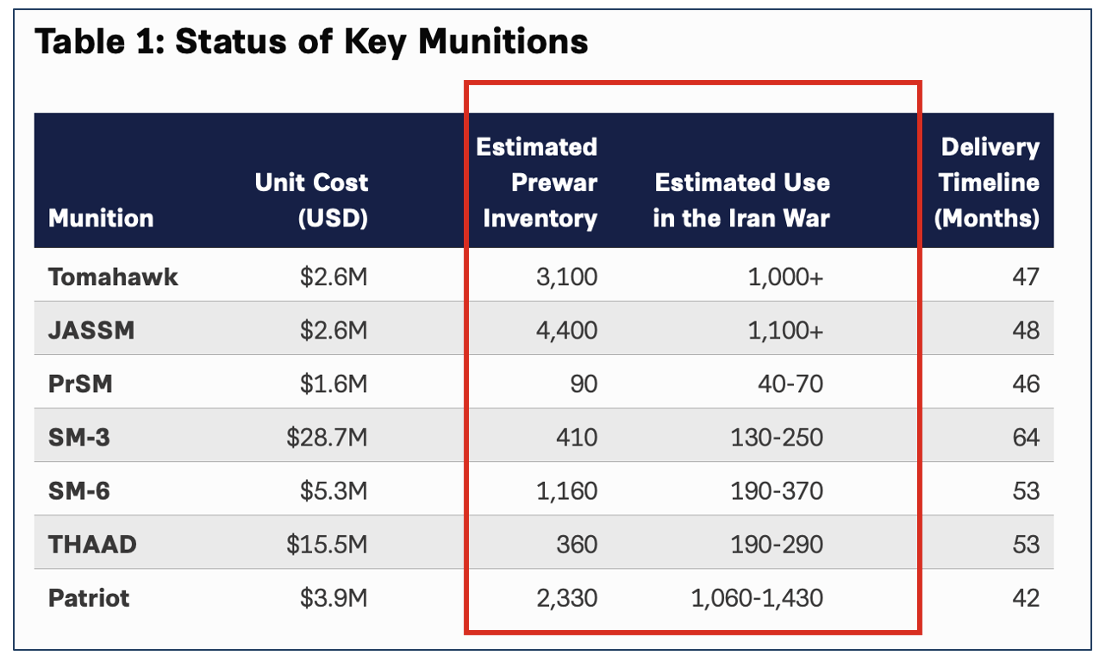
Last Rounds? Status of Munitions at the Iran War Ceasefire The Center for Strategic and international Studies
Concern about the status of U.S. munitions inventories has intensified as reports emerge about high expenditures of Tomahawks, Patriots, and other missiles in the Iran war. As Operation Epic Fury remains paused in a shaky ceasefire, there is an opportunity to assess whether the U.S. military nears the point of going “Winchester”—or running out of ammunition. Analysis of seven key munitions shows that the United States has enough missiles to continue fighting this war under any plausible scenario. The risk—which will persist for many years—lies in future wars.
Strategy Going Forward from the U.S. And German Perspectives
US Grand Strategy and the China Factor with Nadia Schadlow China Considered Podcast
Dr. Elizabeth Economy sits down with Nadia Schadlow, former deputy national security advisor for strategy in the first Trump administration and author of the influential 2017 National Security Strategy (NSS). Schadlow reflects on how the NSS was architected around the shift toward great power competition and America's four core national security interests: protecting the homeland and way of life; promoting American prosperity; preserving peace through strength; and advancing American influence. The conversation moves through key differences between the first and second Trump administrations, including process, tone, and the role of ideology in foreign policy, before turning to a substantive debate about the limits of multilateral institutions and Schadlow's argument in a recent Foreign Affairs essay that state-centric approaches can outperform global governance frameworks. Economy and Schadlow also assess the strategic landscape ahead of a potential Trump-Xi summit, discussing where US leverage is real, where it may be overstated, and whether tariffs alone can move China's economic model. They close with a shared critique: that the United States has consistently failed to develop a coherent, assertive diplomatic and development strategy to compete with China's Belt and Road Initiative.
A Grand Strategy of Consolidation: How Trump Can Revitalize American PowerA. Wess Mitchell/ Foreign Affairs
For three and a half decades, it has maintained peace and sustained influence in all the world’s major regions without difficult tradeoffs. It continued to assume it can do so even as the country’s relative economic strength decreased, and rival military buildups eroded its superiority. As a consequence, the United States now faces a serious misalignment between its national power and the strategic objectives to which it has become accustomed.
The Return of Power Politics to the Market: Theory and Practice of the Geoeconomic Zeitenwende The Stiftung Wissenschaft und Politik/German Institute for International and Security Affairs
The return of power politics to the market is a defining feature of the geoeconomic Zeitenwende, as is currently being experienced in international politics. This has brought renewed attention to the long-standing conventional wisdom that economic activity can not only generate prosperity but also promote foreign and security policy objectives. The analysis and strategy of foreign, security, and economic policy require a clear conceptualization of the term “geoeconomics”. This is necessary not least to weigh the costs and benefits of geoeconomic measures in a well-founded manner, and to assess their prospects for success more realistically. The contributions to this research paper focus on the theoretical and conceptual foundations of geoeconomic thought and examine selected empirical case studies of geoeconomic action in functionally defined policy areas. In order for German geoeconomic policy to become more effective and coherent, the following approaches are recommended: first, the establishment of interagency structures for the cross-cutting task of geoeconomics; second, the expansion of communication and coordination with relevant stakeholders from the business sector and academia; and third, the strengthening of international cooperation with like-minded partners.