Recommended Weekend Reads
The Incredible Global Birth Crash, NATO’s Nightmare, the Realignment of Tech Supply Chains, and Calculating the Rise of Anger in Political Communications
August 21 - 23, 2026
Below are several reports and articles we read this past week and found particularly interesting. Hopefully, you will find them of interest and useful as well. Have a great weekend.
Demographic Trends
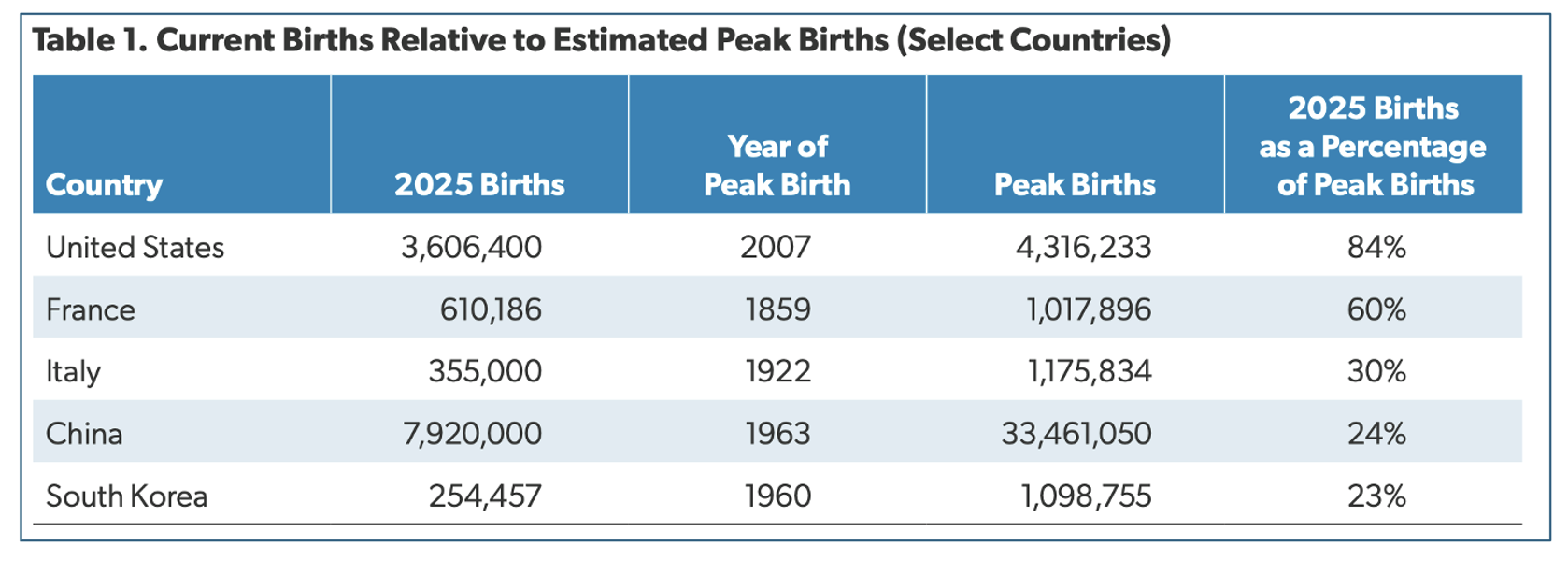
The Incredible Global Birth Crash Nicholas Eberstadt & Patrick Norrick/American Enterprise Institute
We are in the midst of a headlong global birth crash—a plunge underway all around the world, in rich and poor regions alike, very possibly presaging an indefinite global depopulation, with our “peak human” moment coming shockingly soon. For many decades, demographers assumed that the postwar drop in worldwide birth rates would lead to an eventual equilibrium, with childbearing converging in one region after another at a little over two births per woman, the level required for long-term replacement. No longer. Instead, it is now apparent that we are witnessing a spreading worldwide march into the terra incognita of prolonged sub-replacement fertility, with no hints yet of how far humanity’s birth rates will ultimately fall, or when—if ever—they will recover.
Economists should be worried about birth rates Noah Pinion Substack
Recently, a lot of people (including myself, but also prominent economists) have begun worrying about low fertility rates. Across all countries — poor as well as rich — fertility just keeps going down and down, with no floor in sight. This presents two distinct dangers: population aging and population shrinkage. Aging, rather mechanically, creates a burden for young people, because you have more retirees who have to be supported by each worker, either through taxes or through family support. It also might reduce productivity, for example if older managers are less innovative, but that’s more speculative. Population shrinkage, meanwhile, is a threat to total GDP, which you might care about if you want your country to be more powerful. There’s also the possibility that a smaller population might reduce growth — by reducing the opportunities for specialization, or by reducing the available pool of researchers.
America’s Debt Crisis
America’s Risky Debt: What Markets See That Policymakers Don’t Hanno Lustig Aspen Economic Strategy Group
Abstract: The goal of the Federal Reserve (the Fed) and Congress should be to restore complete price discovery in US Treasury markets. Price discovery ensures that fiscal policymakers in Congress get accurate signals from the bond market about how much fiscal space they have left. To achieve that outcome, the Fed has to commit not to intervene in bond markets, except in narrowly defined circumstances. Currently, the Fed and financial regulators implicitly maintain the view that US Treasurys are safe, even as the premium that investors are willing to pay for their safety has been eroded. When Treasurys sell off in response to adverse fiscal news, Fed officials are likely to interpret the move as a plumbing problem in Treasury markets and respond by absorbing a large share of issuance onto the Fed’s balance sheet. That response hampers price discovery by muting the price signals that Congress relies on to assess debt sustainability, encouraging them to postpone the inevitable fiscal correction.
Dollar dominance: dissatisfaction without displacement Massimilian Castelli/OMFIF
Predictions of the demise of the dollar have become a recurring feature of the international monetary debate. Every geopolitical crisis, every discussion of sanctions and every sign of China’s economic rise has produced a new wave of forecasts announcing the end of dollar dominance. Yet the dominant position of the dollar has proved remarkably resilient. The reason is that most observers focus on what central banks hold today rather than on how reserve managers are thinking about tomorrow. Reserve portfolios adjust only slowly. The international monetary system has entered a new phase best described as ‘dissatisfaction without displacement’. Confidence in some of the institutional foundations of dollar dominance is gradually eroding, yet reserve portfolios remain overwhelmingly anchored to the dollar because no credible alternative ecosystem has yet emerged. The debate is no longer centered solely on fiscal deficits or inflation; Increasing attention is being paid to issues that until recently were largely absent from discussions among reserve managers. These include the independence of the Federal Reserve, the rule of law, political polarization, transparency of public institutions and the growing use of financial sanctions as an instrument of foreign policy.These concerns do not imply an imminent loss of confidence in the dollar. However, they do suggest that the assumptions supporting its long-term dominance are no longer taken for granted.
Trade, Tariffs, and Sanctions
The Realignment of Tech Supply Chains: Lessons from U.S. Trade Sanctions against Huawei The British Academy/Carnegie Endowment for International Peace
Since 2019, the United States has deployed various policy instruments—including tariffs, export controls, investment bans, and sanctions—to block Huawei’s access to advanced U.S. technologies and limit its international expansion. Despite these efforts, the Chinese smartphone company has not only survived but thrived, recovering its global market share and improving its high-end chip production. In a new study, Elisa Oreglia, Thais Lobo, and James Burroughs of King’s College London the corporation’s rebound to a combination of short-term tactics and long-term strategies that permitted it to adapt to, work around, and blunt the impact of U.S. sanctions. Far from crippling Huawei and “achieving decoupling,” the authors conclude, “the U.S. measures have triggered supply chain realignment,” as the company—with support of the Chinese state—has diversified its sources of critical software and hardware. Huawei’s adaptability reveals the limitations of U.S. trade sanctions as a weapon of technology competition.
The Great Transshipment Scam: Rise, Scope, and Costs Office of Trade and Manufacturing Policy/The White House
White House Trade Advisor Peter Navarro published this report past week a paper arguing that the US “faces a growing challenge from the illegal transshipment of goods through third countries to evade applicable tariffs and other trade remedies.” He goes on to argue that “exporters in higher-tariff jurisdictions can abuse differences in US tariff treatment across countries to route goods through lower-tariff jurisdictions before entering the American market.” He offers a number of “remedies” to fix this challenge.
How Much Did Labor Productivity Gains Offset the Inflationary Impact of the 2025 Tariffs? Federal Reserve Bank of St. Louis
This study found that In 2025, the sectors that were more affected by tariffs relative to other sectors experienced significantly greater labor productivity growth, mitigating the cost increases induced by the new trade policy. The sectors that were more exposed to tariffs also experienced a decline in the labor share-the proportion of a sector’s value-added that’s allocated to worker compensation-implying relatively higher profits and return to capital in these sectors. Mapping production costs to aggregate core inflation indicates that on net, tariffs and labor productivity gains contributed an estimated 0.5 percentage point to core PCE inflation in 2025. Wage growth added another 1.9 percentage points. If these cost components’ combined contribution to inflation was only 2.4 percentage points, then tariffs alone may not explain the persistence of 3 percent core PCE inflation last year.
Europe and The Future of NATO
NATO’s Nightmare Simon Shuster/The Atlantic
Western military planners do not seem eager to talk about their nightmare scenario, much less prepare for it. But they tend to agree on how it would begin: a coordinated, near-simultaneous attack on opposite sides of the planet, in which Russia targets a NATO member in Eastern Europe while China makes its move against Taiwan. The U.S. military would need to react on two fronts at once—three if it remains at war in the Middle East. “Let’s just say this is the scenario we’re currently not ready for,” Florence Gaub, the director of the research division at the NATO Defense College, one of the alliance’s main academies for officers, in Rome, told me. NATO strategists remain “keenly aware” of this gap in their planning, Gaub, who specializes in the forecasting and analysis of future threats, said. But they have not taken steps to fill that gap.
Security at what cost? Defence spending, growth, and the fiscal arithmetic European Stability Mechanism Blog
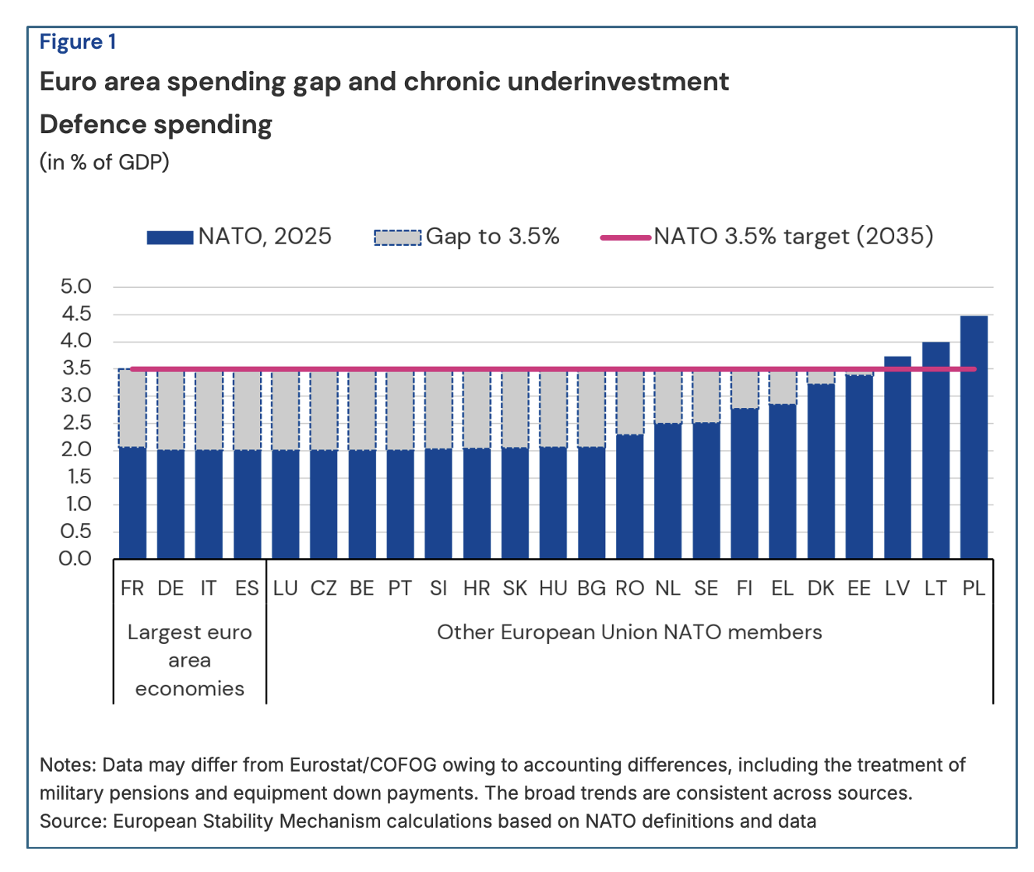
Europe faces increased security financing needs that bring both challenges and opportunities. At the 2025 Hague Summit, North Atlantic Treaty Organization (NATO) allies committed to raising core defense spending toward 3.5% of GDP, well above the old 2% benchmark. This would mean an extra €45 billion a year for the euro area until 2035. While on paper the target looks like a straightforward bill for taxpayers, recent analysis presented in the Euro Area Stability Watch suggests it is more nuanced: when defense spending supports investment, innovation, and productivity, part of the initial cost can be recovered through higher growth and tax revenue.
Germany’s Military Recruitment Crisis is about to Test Berlin’s Rhetoric Defense Priorities
Last year, German Chancellor Friedrich Merz announced his intention to turn the country’s armed forces into “Europe’s strongest conventional army.” Since he came into office, Merz’s government has been outspoken about the need to reduce Europe’s dependence on an increasingly unreliable United States and prepare the continent to face the Russian threat without Washington’s aid. Against this backdrop, the publication in April of Germany’s new military strategy document, which laid out ambitious targets for rapidly expanding German defense capabilities, has been widely heralded as yet another sign that Berlin is determined to carry much of the burden of continental defense. A look beyond this rhetoric, however, reveals a country still far off from turning its proclaimed vision of becoming a serious military power into reality. For months, both German officials and the general public have engaged in an intense debate about one of the key components in Berlin’s rearmament efforts: increasing the size of the Bundeswehr, as the German military is known. So far, the government has bet on a voluntary military service model, but that has failed to hit its recruitment targets.
Angry Tweets and Campaign Speeches
The Rise of Anger: Emotions and Policy Views Yann Algan, Eva Davoine, Thomas Renault, and Stefanie Stantcheva/Harvard University & the National Bureau of Economic Research
Abstract: In this paper, we document the rise of anger in U.S. political communication and study its effects on policy views. We combine online and offline data, including the full record of congressional floor speeches since the 1870s, tweets from members of Congress, tweets from voters matched to electoral registries, campaign speeches, and Reddit comments. Anger in U.S. congressional speeches has risen sharply in the last decade, reaching its highest level in a century and a half. In voter tweets, the share of policy-related sentences expressing anger rises 35% between 2013 and 2025. In tweets by members of Congress, the angry-sentence share rises by 72%. Angry tweets by members of Congress or by voters receive around 60% more retweets relative to tweets with no emotion. Our two experiments show that negative emotions increase support for protectionism, restrictive immigration policies, and redistribution. Positive emotions mainly improve perceptions and reduce support for populism. Anger also changes climate policy views, while fear has no detectable effect. Building on the ACTORC framework of Bordalo et al. (2026), our model shows how emotions direct attention toward different features of policy problems. Overall, emotions shape both engagement and policy views.