

How to Stop US–China Relations from Going Backward, China’s Massive Local Debt Problem, Is Europe Losing the Future, and Why Has US Healthcare Expenditure Growth Slowed?
November 6 - 8, 2026
Below are various reports and articles we read this past week that we found particularly interesting. Hopefully, you will find all or at least some of these pieces of interest and useful. We hope you have a great weekend.
China
Don’t Go Backward on China Policy: The Folly of a Hawkish Restoration Ali Wyne & Ryan Hass/Foreign Affairs
Nearly halfway through his second term in office, US President Donald Trump has undercut both the United States’ capacity to protect its interests related to China and its role as a provider of regional security in Asia. His undisciplined approach to dealing with Beijing, in which he has focused on building warm personal ties with Chinese leader Xi Jinping and discounted or ignored long-standing sources of tension between the two countries, has reduced Washington’s leverage to shape the relationship. Given the failures of Trump’s second-term strategy, many Democrats and even moderate Republicans may try to strike more hawkish postures on China after the midterm elections and during the 2028 presidential campaign. But the authors argue the goal for the next Congress and, eventually, Trump’s successor, should be to prioritize steady competence over performative toughness in dealing with China. Political point scoring and wistful nostalgia for strategies that discount Beijing’s mounting power, and growing domestic support in the United States for great-power calm, would compound Trump’s mistakes rather than mitigate them. A smarter, more coherent China policy—one rooted in disciplined competition with Beijing, patient efforts to build goodwill with anxious allies and partners, and vigorous efforts to refresh the domestic sources of US strength—can make life safer, healthier, and more affordable for Americans.
China’s Local Government Debt: Implications for US-China Competition RAND
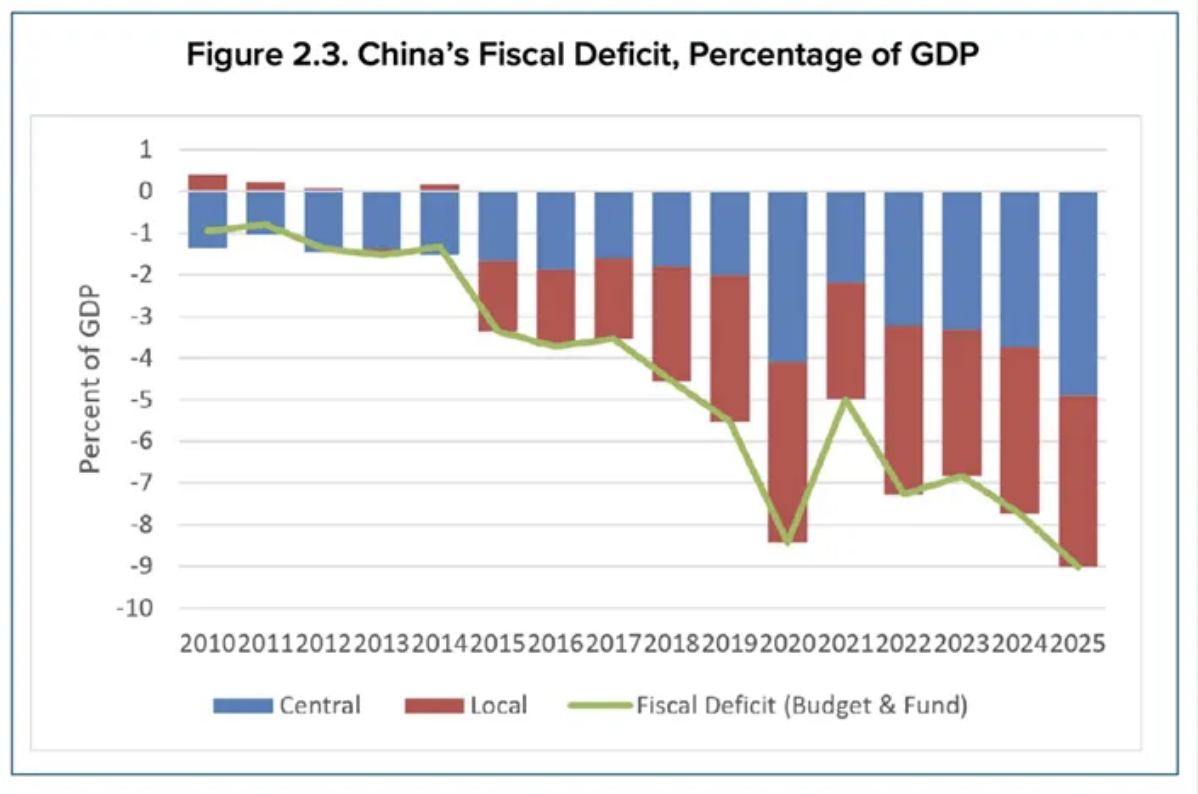
In response to the global financial crisis that began in 2008, China unleashed a debt-fueled stimulus to maintain growth and employment. Although the global financial crisis has come and gone, debt-fueled growth has not. One measure of credit registered China’s debt-to-gross domestic product (GDP) ratio at 315 percent in June 2025. Much of this debt is tied to local governments, which manage about 85 percent of government spending but face a persistent mismatch between their spending responsibilities and revenue. That mismatch has worsened as land sales—one of their largest locally generated revenue sources—have sharply declined because of a downturn in the property sector. The authors of this report examine the profile, scale, and consequences of China’s local government debt. They estimate that local government debt reached at least $12 trillion in 2024, or 64 percent of China’s GDP, including more than $5 trillion in off-balance-sheet borrowing. They also investigate recent debt-resolution measures and argue that these steps can buy time but do not resolve the underlying fiscal imbalances. The authors assess the implications of this debt for China’s economy, public services, and political stability, and consider what it means for competition between the United States and China.
Xi’s party: What to look for at the Chinese Communist Party Plenum Brookings
From October 26 to 29, Chinese President Xi Jinping will convene a major annual Chinese Communist Party meeting focused on party governance. In the run-up, Xi has displayed dissatisfaction with the party’s leadership through speeches and purges across the Politburo, Central Military Commission (CMC), and Central Committee. The purges have been most extensive in the People’s Liberation Army. The CMC only has two members left, including Xi. Only 17 of the Central Committee’s original 44 members nominally remain, and just two have appeared publicly in recent months. This plenum may be Xi’s last opportunity to repopulate and restructure the CMC before next year’s party congress. Xi is almost certainly using this plenum to lay the groundwork for his fourth term, which will begin at next fall’s party congress. He will likely have to replace many of his remaining allies, but his third term’s extensive purges may make it harder to rebuild a team he can trust.
Beijing launches diplomatic flurry amid threat of renewed US war with Iran. The Washington Post
As the prospect loomed of renewed attacks on Iran by the United States and Israel following Tuesday’s US midterm elections, Beijing scrambled to mount a flurry of Middle East diplomacy. Chinese leader Xi Jinping and Foreign Minister Wang Yi hosted separate, high-level talks with Oman, Iran and Saudi Arabia in Beijing on Monday. Xi’s meeting with Oman’s Sultan Haitham bin Tariq was the first visit to Beijing by an Omani head of state since the countries established diplomatic ties 48 years ago. The same day, China’s Foreign Ministry announced details of a Middle East diplomatic blitz in the coming days and weeks, with three senior envoys set to fan out across seven countries spanning the Persian Gulf and the Horn of Africa.
Empires of AI: The Rise and Fall of a New Global Order Niall Ferguson, Lisa Klaassen, and Eric Schmidt/Foreign Affairs
In the span of a few years, China and the United States have each assembled something future historians might recognize as a new kind of empire. Their dominions extend not merely over territory, trade routes, and airspace but over knowledge itself. By controlling the large language models, chips, physical infrastructure, and capital that provide the foundations for advanced machine cognition, Beijing and Washington are not only attaining new heights of economic performance and power projection; they are also setting the terms of all future scientific and intellectual progress. The term “AI superpowers” fails to capture the influence and reach that these rivals now wield. Even without active alliance building or coercion, they can make all other countries that seek access to advanced AI beholden to them. Imperial history carries a warning. In the absence of other forces, empires seldom succumb to a challenger or to barbarians at the gates. More often, they fail because defending their vast dominions drains them dry, whether of material resources, the consent of the governed, or the loyalty of elites. The imperial center finds it can no longer maintain control over the periphery—the regions that once submitted to it. Failure can be financial, as it was for the British Empire after 1945, when the debts of two world wars forced London to liquidate its imperial assets to pay the price of victory: a welfare state for the citizens of the imperial metropole. It can be institutional, as it was for the Qing empire in the late nineteenth century, when it failed to industrialize, reform its bureaucracy, and renew the legitimacy of the Manchu dynasty.
Europe
“Is Europe Losing the Future?” Paul Krugman Delivers the 2026 James Martin Memorial Lecture/Oxford University (video)
Nobel Prize-winning economist Paul Krugman delivered the James Martin Memorial Lecture on October 15, 2026. Krugman discussed how technological change has scrambled both the reality of the world economy and how we measure it. Europe is widely perceived as losing ground to both the United States and China. But is it really? In his lecture, Krugman explored the changing global economic landscape, challenging conventional assumptions about Europe’s economic performance and its position, relative to the world’s other major economies.
Now Comes the Hard Part: Europe’s Defense Industrial Inflection Point JPMorgan Chase
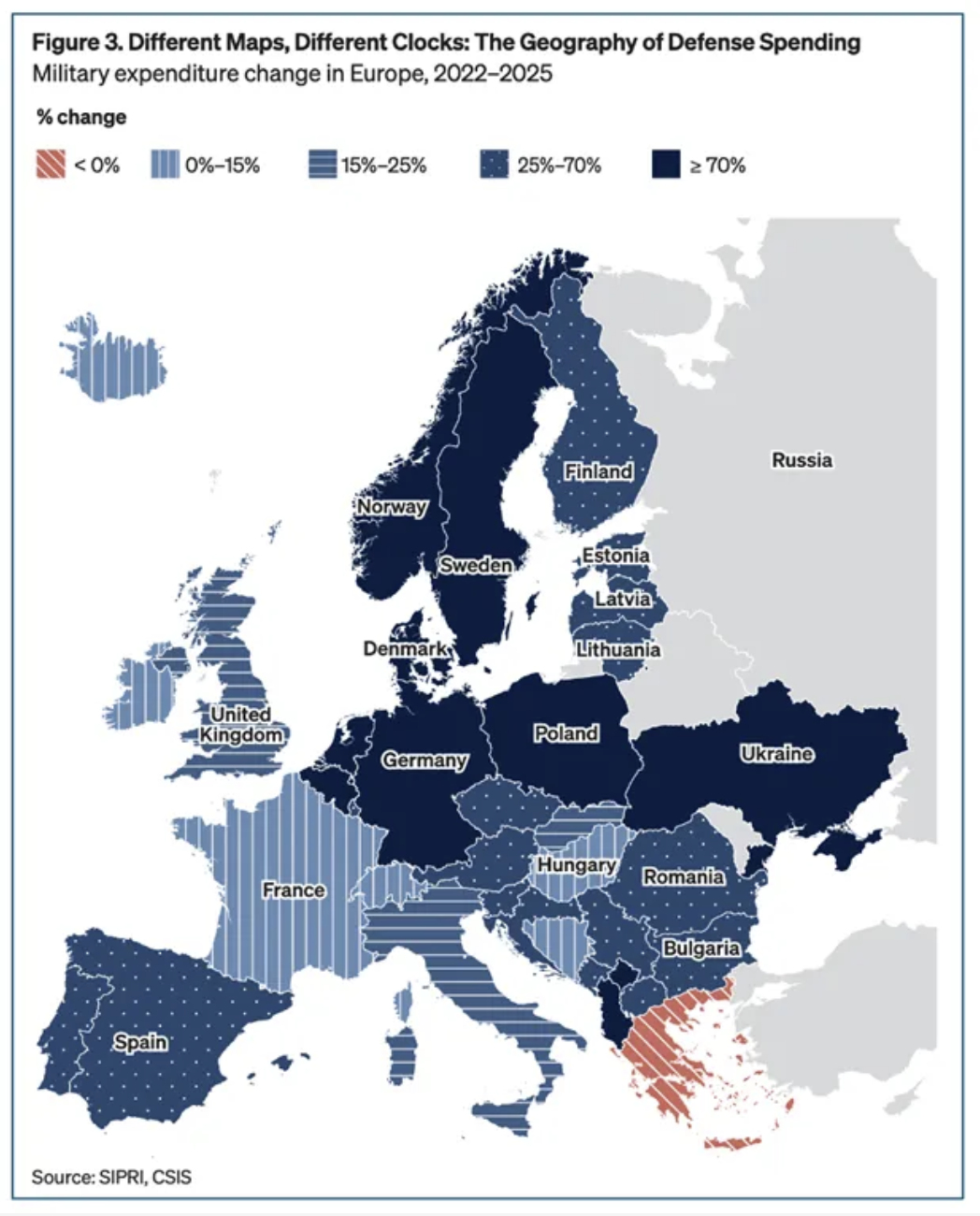
Europe’s rearmament problem has changed. Political will and capital are finally moving; the constraint is increasingly Europe’s ability to translate them into industrial output. The hardest choices are political, not technical. Building at scale means deciding whose systems survive, whose factories get built, when to buy foreign, and how much fiscal and economic pain governments will tolerate in pursuit of greater autonomy. Europe must confront three fundamental tensions: scale versus sovereignty, urgency versus autonomy, and ambition versus industrial capacity. If Europe gets this right, it could change more than Europe’s military balance. A larger European Defense Industrial Base (EDIB) could redistribute power within Europe, alter transatlantic industrial relations, give Europe new leverage in the Gulf and Indo-Pacific, and create a more strategically autonomous—and consequential— European actor.
Geoeconomics, Healthcare, and Export Controls
Examining the Beliefs of Professional Forecasters Federal Reserve Bank of Cleveland
This Economic Commentary studies how professional forecasters update their forecasts in response to macroeconomic news. We find that the two most important news releases for how professionals update their short-term forecasts are the unemployment rate and the three-month Treasury bill rate. News about the unemployment rate is particularly important when updating forecasts about real GDP growth or unemployment, whereas news about the short-term Treasury bill rate tends to be more informative for revisions of inflation and three-month Treasury bill rate forecasts.
Does Growth in the Money Supply Predict US Inflation? Yes, but… Federal Reserve Bank of St. Louis
A famous quote by Milton Friedman — that “inflation is always and everywhere a monetary phenomenon” — suggests growth in the money supply may be a reliable predictor of inflation. An analysis shows that money growth and inflation tend to move together mainly in extreme, high-inflation periods, but otherwise tend to drift apart. This is related to the velocity of the money supply, or the rate at which it circulates. At ordinary levels of money growth, changes in velocity growth can offset changes in money supply growth, nullifying the effect of excess money growth on inflation. Thus, while money growth seems to be a poor everyday predictor of inflation, it does seem to provide a useful signal when the money growth rate moves far outside its historical range.
How Do Banking Supervisors Deal with Failing Banks? Liberty Street Economics/New York Federal Reserve Bank
In this post, we discuss insights from a recent staff report on the role of banking supervision in identifying and disciplining failing banks. We show that bank failures typically result from supervisory closure decisions based on hard information about book equity. Yet hard information is itself partly produced by supervision, as our evidence suggests that supervisors require troubled banks to recognize potential losses. We argue that supervision faces a trade-off: Stricter supervision can reduce the costs of resolving failing banks, but it can also lead to tighter regulatory capital constraints and hold back credit supply.
Why Has US Healthcare Expenditure Growth Slowed? David Cutler & Lev Klarnet/National Bureau of Economic Research
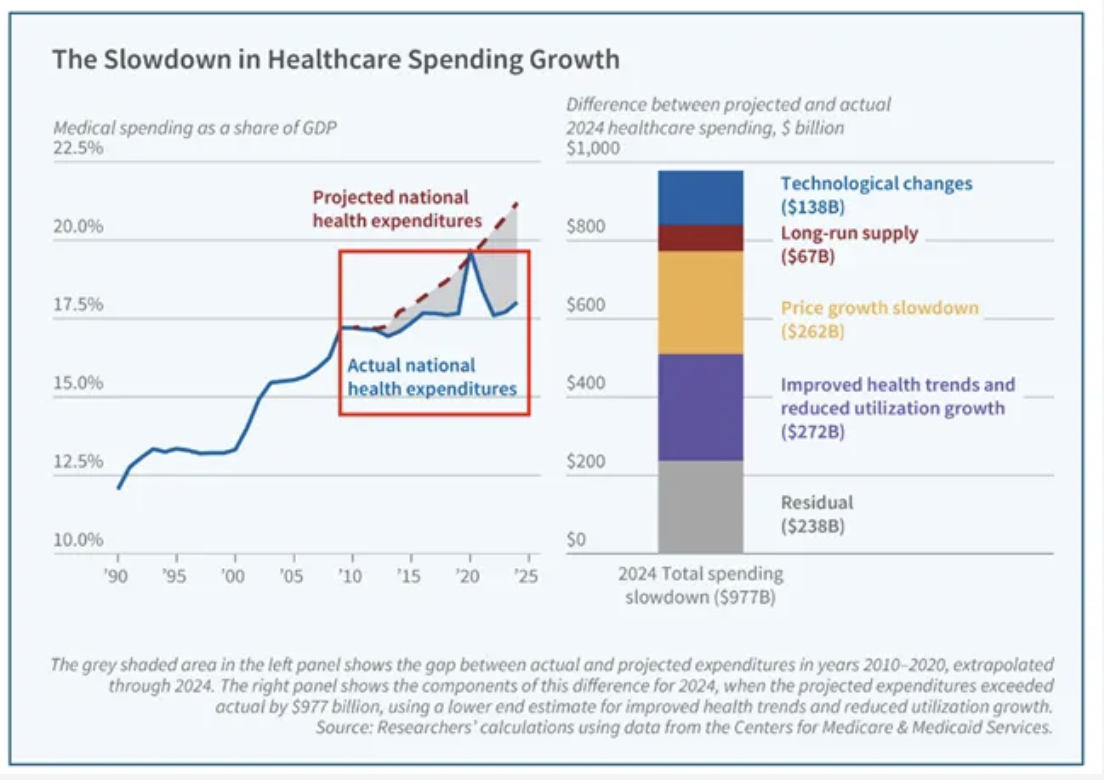
Abstract: Between 2010 and 2024, medical spending in the US grew from 17.2 percent of GDP to 18.0 percent. This growth was substantially below both historical precedent and actuarial projections by the Centers for Medicare and Medicaid Services (CMS). By 2024, annual healthcare expenditures were nearly $1 trillion (15 percent) below the 2010 projections. The authors examine potential explanations for this sustained period of slower growth. They compare actual expenditures to the 2010 CMS actuarial forecast, adjusting for differences between anticipated and realized inflation. Because the slowdown was evident across all payers, the researchers focus their analysis on the total market for medical care goods and services. They decompose the overall slowdown into differences that are attributable to utilization, prices, long-run supply, and technological change.
Export Controls and the Economics of National Security Jingting Fan, Kyle Handley, Nuno Limão/National Bureau of Economic Research
Abstract: Export controls restrict trade to limit adversaries’ access to goods that contribute to military capability, but their effectiveness depends on how trade and production adjust across countries. We combine new data on US export control classifications and licensing outcomes with a quantitative general equilibrium model featuring dual-use production, input-output linkages, and separate civilian and military final expenditure. We estimate large export and entry frictions from these controls. These effects are substantially smaller for US exports to members of multilateral export control regimes (MECRs): the differential is equivalent to an export cost of 15 to 29 log points. Relative to a counterfactual without differential controls on adversaries, multilateral controls reduce their imports of controlled products far more than unilateral US controls. Only 7% of the reduction in controlled exports under the multilateral regime is replaced by other countries, compared with 28% under unilateral US policy. Multilateral controls reduce adversaries’ real military expenditure by increasing their military price index. The security impact, measured as US real military expenditure relative to adversaries, rises by about 1 log point under multilateral controls but only 0.14 log points under unilateral controls, with both imposing a similar civilian real cost. Even a US embargo fails to reproduce the multilateral security outcome.