

Lula’s Comeback and What’s Next for Brazil, What Is America’s Strategy for the Western Hemisphere? How Canada Is Decoupling from America, and Measuring Shipping Disruption by Satellite
October 30 - November 1, 2026
Below is a variety of reports and articles we read this past week that we found particularly interesting. Hopefully, you will find all or at least some of these pieces interesting and useful. We hope you have a great weekend.
Americas
Lula’s Comeback and Challenges Ahead Americas Quarterly Podcast
After a comeback and a win by more than four million votes, Brazilian President Luiz Inácio Lula da Silva must now face a hostile Congress, nervous financial markets and an uncertain relationship with Washington. His opponent, Flávio Bolsonaro, has left for the United States, where he is alleging political persecution. Over a political career spanning more than 40 years, Lula has often evolved according to the needs of the moment. This time, will he take a more orthodox approach to the economy, with Brazil’s budget deficit approaching an unsustainable 10% of GDP? Will he bring more conservative figures into his government? And will he try to make peace with the Trump administration? Our guest is Fábio Zanini, editor of Painel, the political column of Folha de S.Paulo.
What Lula’s comeback win means for Brazil and beyond Atlantic Council
The Council asked a group of experts what to expect now that President Lula has won a historic re-election. Lula’s path forward is far from open. At home, Flávio Bolsonaro—the son of former President Jair Bolsonaro—has refused to concede and has now fled the country for the US. And a right-of-center bloc controls Brazil’s Congress. Where does all this leave Lula and Brazil?
What Is the Future of American Strategy in the Western Hemisphere?Report of the Council on Foreign Relations
The United States’ approach to its own region is ripe for reimagining. For too long, Washington has anchored its Western Hemisphere policy on the threats the region presents domestically, particularly migration, drugs, and crime. Those are real and important challenges—but the future of American strategy must take a broader view of US interests in the region. Opportunities to do so are manifold. North America, Latin America, and the Caribbean have vital roles to play on issues including trade and economic growth, energy and supply chain security, technology cooperation and diffusion, and competition with China. To explore those opportunities, CFR’s Future of American Strategy Initiative asked six leading experts: what comes next for American strategy in the Western Hemisphere?
Rethinking political risk in Argentina: Why the next election may matter less than investors think Dispatches/Atlantic Council
Argentina has long swung from market darling to financial pariah. But that pendulum no longer fully captures the country’s outlook. The mining and energy boom, provincial interests, and memories of the recent inflation crisis would make full policy reversal costly for any future government. Judicial reform, tax reform, and efforts to rebuild Argentina’s international reputation would reduce investors’ dependence on the outcome of any one election.
How Canada is Decoupling From the US Apricitas Economics
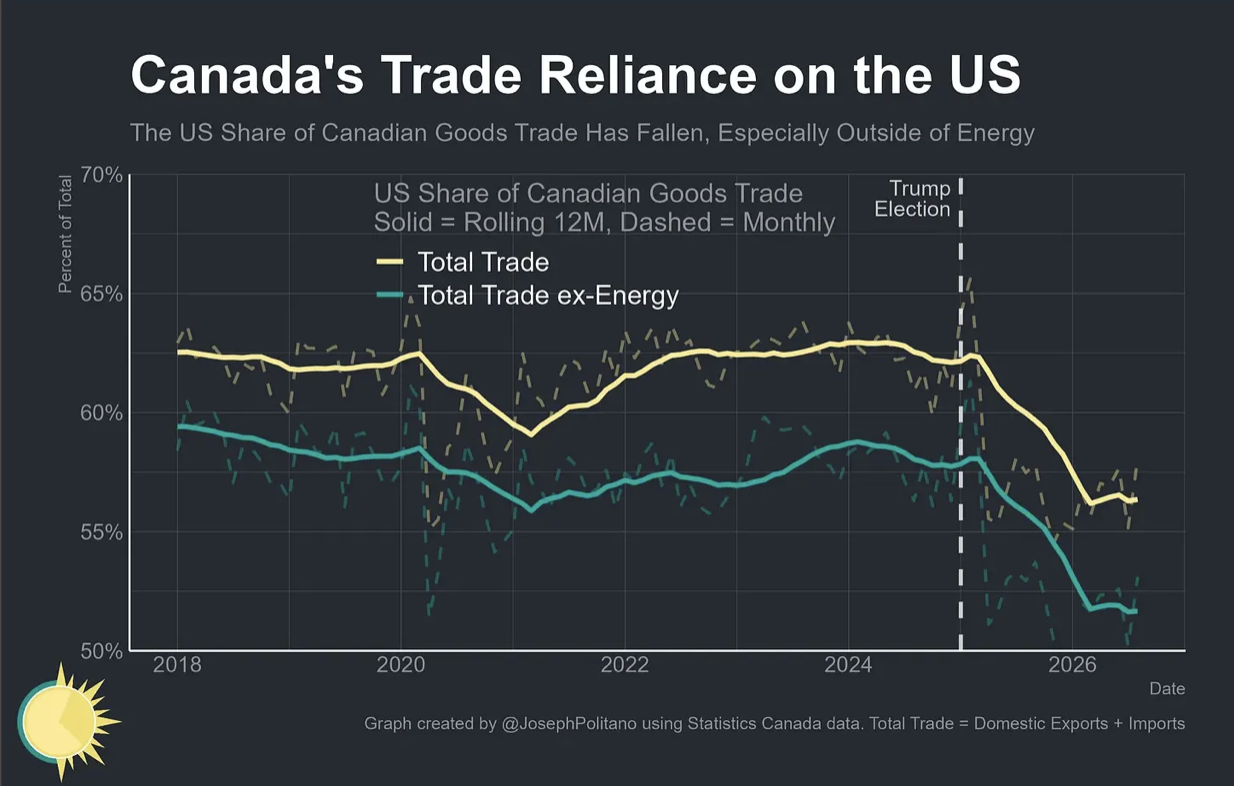
Canada is increasingly decoupling from the US economy—the share of Canadian trade flows headed to the US has fallen to the lowest level in more than 30 years, with both US import and export shares dropping significantly since 2025. Trump’s trade war, consumer boycotts, and a formal Canadian government push to boost non-US trade have all reduced the country’s economic reliance on its southern neighbor.
Geoeconomics
Measuring Shipping Disruptions with Satellite Data Federal Reserve Bank of St. Louis
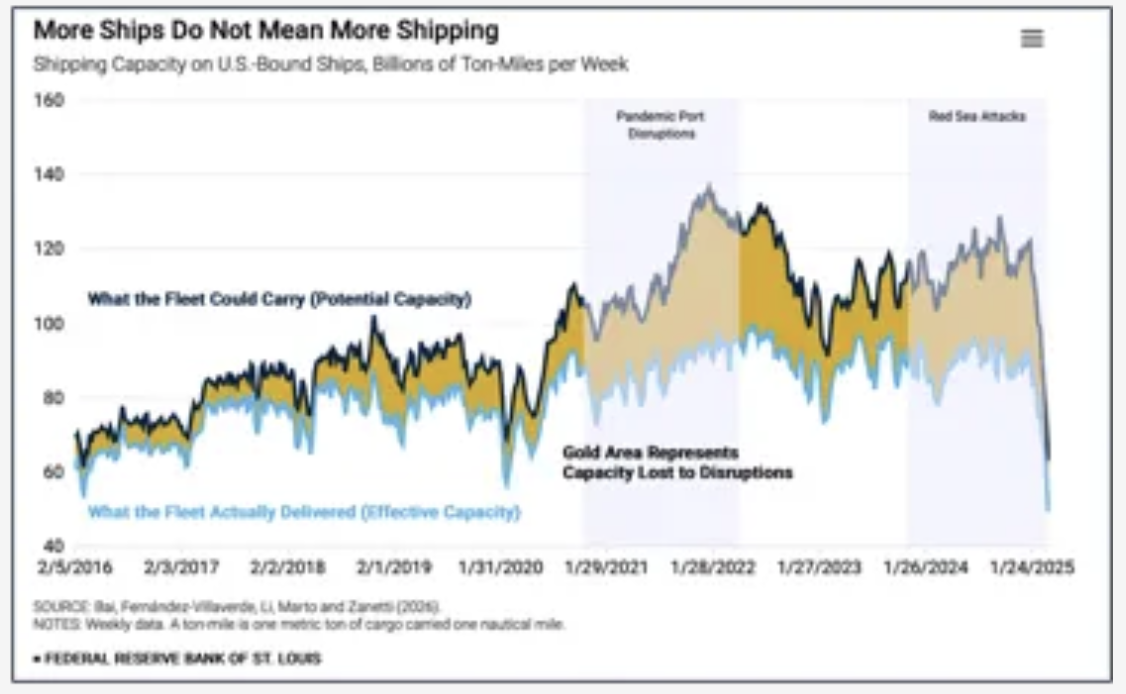
Satellite vessel-tracking data allow us to measure how disruptions such as port congestion, canal bottlenecks, rerouting, and slower sailing reduce the effective capacity of US-bound container shipping. During the 2021-22 supply chain crisis, carriers added capacity to US-bound routes, but shipping utilization fell from about 89% before the pandemic to below 70%. The decline was particularly large on the Asia-to-US West Coast route, with shipping utilization starting to decline in November 2020, before port congestion was visible, from an average of 92% before the pandemic to 53% by late 2021. In 2023, rerouting around the Cape of Good Hope following Houthi attacks in the Red Sea sharply reduced shipping utilization on routes from Asia and the Middle East to the US East Coast, where utilization fell by about 21 percentage points in a year in the route going through the Suez Canal from Asia.
Wall Street’s AI Debt Machine Is Starting to Choke on Supply Bloomberg
Yields are soaring into the double digits on bonds and loans funding the AI infrastructure buildout, making it more difficult for bankers to offload risk to insurers and other investors. The cost of insuring against losses on the debt of companies from Broadcom to SpaceX and Oracle has spiked, reaching levels more typical of junk-rated borrowers, as the market for credit default swaps reflects growing concerns about the potential economic fallout. Citadel Securities is cautioning clients that even the biggest names in tech could get ensnared as they put their balance sheets behind scores of projects critical to their AI ambitions, with a growing disconnect between what Silicon Valley’s top executives believe can be raised and what financiers say they can deliver.
Evaluating New LinkedIn Labor Market Tightness Indicators Federal Reserve Bank of New York’s Liberty Street Economics
The labor market is considered tight if there are few job seekers relative to job openings, implying stronger wage pressures as employers compete for workers. Thus, good measures of labor market tightness (LMT) are important for predicting wage inflation and calibrating monetary policy. Recently, LinkedIn began producing three innovative LMT measures based on user data. The authors use public data to evaluate the ability of these measures to predict wage and price inflation relative to existing LMT measures.