Recommended Weekend Reads
Russia’s Growing Economic Problems, How the Iran War is Changing the Middle East, What Happens When Trust in Economic Statistics Declines, And the Memo That Killed the Penny
July 10 - 12, 2026
Below are a number of reports and articles we read this past week and found particularly interesting. Hopefully, you will find them both interesting and useful. Have a great weekend.
The Ukraine War and Russia’s Growing Troubles
Endgame: The State of the Russian Economy The Kiel Institute for the World Economy
The contours of a genuine economic endgame are coming into view for Russia. The economy has not collapsed, but the structural foundations have eroded fast. Economic growth has come to a standstill, and fiscal buffers are largely exhausted. Higher oil prices as a result of the war in the gulf will likely only bring temporary fiscal effects, as Ukrainian “drone sanctions” have been effective in reducing export volumes. Russia’s current macro stance is not sustainable. High interest rates are stifling the economy, while loose fiscal policy and quasi-fiscal operations are propping up the defense sector. The Q1 2026 budget deficit exceeded the full-year target in just three months. The choice now is between fiscal consolidation or monetary accommodation resulting in even higher inflation. Going forward, export revenues from the sale of raw materials remain the decisive variable for the economic outlook: With fiscal buffers spent, Russia’s war capacity is more than ever directly coupled to hydrocarbon export income.
Putin’s economy is running on fumes after Ukrainian attacks Politico EU
For four years, Russian President Vladimir Putin has largely managed to shield the population from the economic consequences of his war in Ukraine. No more. The Ukrainian missile and drone strikes on key energy infrastructure in recent weeks has turned the war from a relatively minor irritant that most Russians could ignore into an immediate and increasingly acute fuel crisis. Two-thirds of Russia’s 83 regions are now reporting problems with fuel supply, an immediate inconvenience to millions and an equally immediate threat to the viability of many businesses. As far as hard numbers go, the scale of the damage is being disguised, with Russia adding domestic fuel prices to the list of economic data that it no longer publishes. Plenty of Russians, however, are finding out for themselves just how bad things are. Social media are exploding with footage of drivers attacking each other over gasoline at filling stations, or even rampaging in trucks through queues of cars waiting to fill up. It’s gotten to the stage where the nation that the late Sen. John McCain derided as “a gas station masquerading as a country” isn’t even a gas station any more: Reuters reported on Wednesday that India — the biggest foreign buyer of Russian crude oil — will now export some of what it refines back to its country of origin.
Russia’s Losing Hand in the South Caucasus Center for European Analysis
Russia sought to influence Armenia’s recent parliamentary elections and derail the re-election of Prime Minister Nikol Pashinyan’s re-election – and failed. Russian President Vladimir Putin has sought to reassert influence over the South Caucasus nations of Armenia and Azerbaijan but has increasingly been stymied. The Armenian election and the defeat of pro-Putin candidates pushed the Kremlin to work harder to rekindle its relationship with Azerbaijan as it seeks to reassert itself in the region. But Russia has also been increasingly frustrated by both Azerbaijan’s and Armenia’s ties with President Donald Trump’s administration, particularly over critically important transport infrastructure. And now, Russia is facing a significant loss of influence in its “near abroad.”
The War In Ukraine Is Already Over — And Putin Lost James Jay Carafano/1945.com
National security expert James Jay Carafano argues that although the fighting grinds on, the war in Ukraine is strategically over — and Putin has lost. Russia has passed its culminating point, he writes, leaving three realities Moscow cannot change: an independent, well-armed Ukraine, an intact NATO, and a homeland now permanently vulnerable to deep strikes.
The Iran War and How It is Changing the Middle East
Syria deal gives Trump potential route to bypass Hormuz The Telegraph
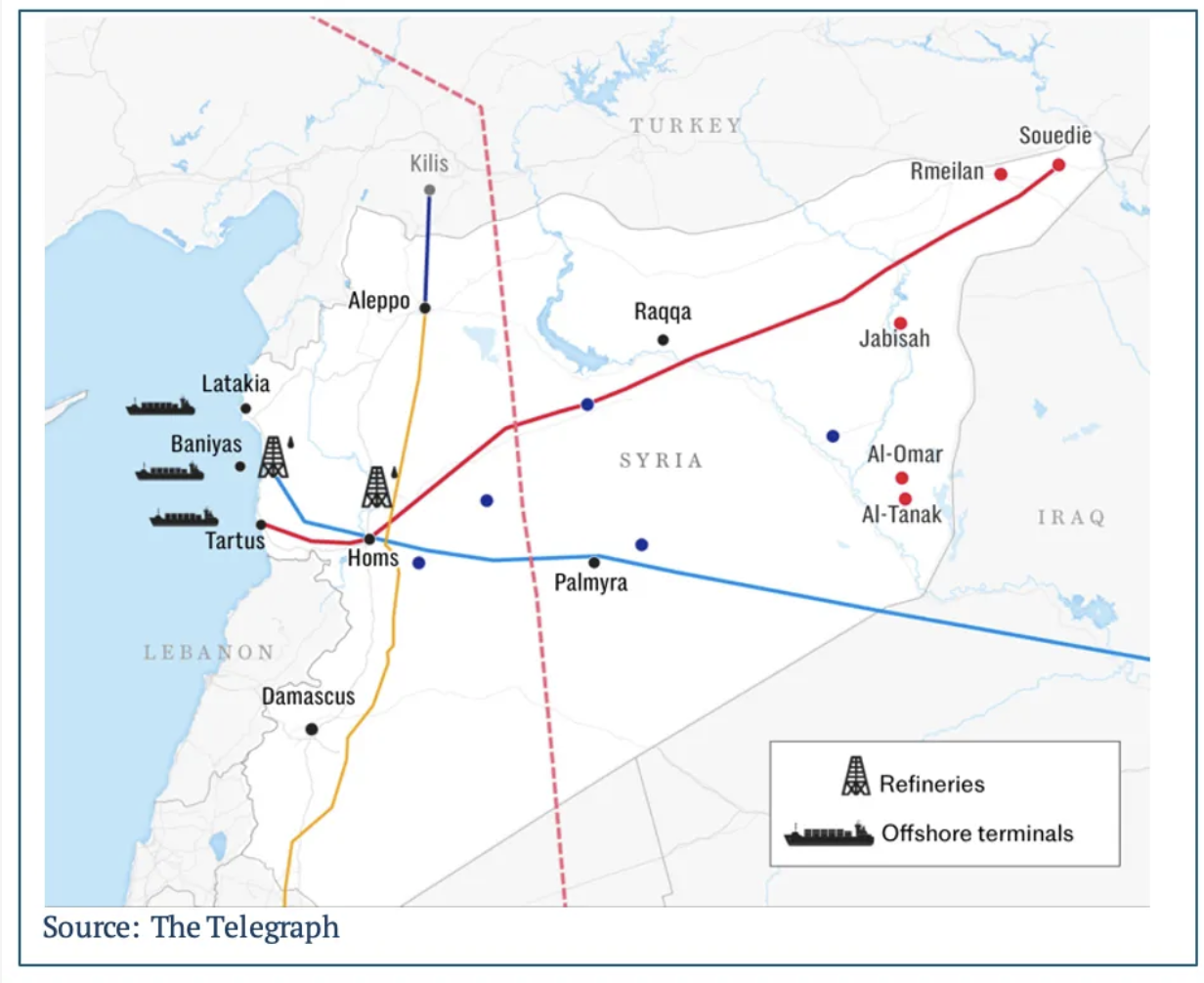
Last Thursday, on the sidelines of the NATO Summit in Turkey, President Trump met with Syrian President Ahmed al-Sharaa. The meeting came as the US announced it would remove Syria from the list of sanctioned state sponsors of terrorism – on top of lifting sanctions last year. And in return, al-Sharaa gave President Trump – and Gulf States – a potential solution to loosening Tehran’s chokehold on shipping oil and gas via the Strait of Hormuz. Syria’s strategic location – with a large stretch of Mediterranean coastline and a land mass connected to oil-rich Middle Eastern nations – makes it easy to connect to global trade. Options include trucking or moving energy supplies through dedicated pipelines to coastal ports where goods can be loaded on to commercial vessels bound for Europe and further afield. Using this route would allow countries to bypass maritime trade through the Strait of Hormuz, reducing the leverage that Iran holds by attacking commercial vessels in transit. Pipeline projects are already under consideration, and could link major energy producers in the Gulf, including Saudi Arabia and Qatar, directly to Syria’s ports in Baniyas and Latakia.
Iran is Losing Iraq Kamaran Palani/Foreign Affairs
Whenever the Iran war comes to an end, the Islamic Republic is likely to emerge in a stronger position. But at least in one area, the war has left Iran notably weaker: Iraq. Ever since the toppling of the Iraqi dictator Saddam Hussein in 2003, Iran has been able to exercise a great deal of influence over its western neighbor. It has embedded itself within Iraq’s Shiite political establishment, mediating between rival factions, shaping successive governments, and using Iraq to gain hard cash through smuggling and currency exchange networks. Iran supported many of the Iraqi paramilitary groups that helped defeat the Islamic State, also known as ISIS, in 2017. Iraqis still grew to resent Iran’s overweening influence in their country, not least because of the involvement of Iranian-backed militias in a brutal crackdown on anticorruption protesters in 2019 and 2020.Now, the tumult of recent months has further tilted Iraqis against Iran’s desire to make their country a staging ground of resistance to the United States and Israel. Leaders of political parties and militia groups that once hewed close to Tehran are pulling away.
Going Over the Brink: How Hizballah’s Risk Strategy Made Lebanon Impossible to Ignore Kelly Grieco, George Saade, and Hunter Slingbaum, War on the Rocks
When the United States and Iran announced their framework agreement on June 15, attention focused on the direct U.S.-Iran dimensions of the deal, including the reopening of the Strait of Hormuz, the lifting of the U.S. naval blockade, and the fate of Iran’s nuclear program. But the agreement also included a commitment to the “immediate and permanent termination of military operations on all fronts, including Lebanon.” Washington had spent months treating Lebanon as a separate issue in negotiations, even as the Israel-Hizballah conflict remained active under a nominal ceasefire in place since April 16. That Lebanon ended up inside the agreement was not an accident. Newly compiled data on 1,155 Hizballah attacks between April 15 and June 14 — 540 drone strikes and 615 rocket, missile, and artillery incidents – and this points to the reason Lebanon was included: Iran via Hezbollah ran a deliberate, calibrated pressure campaign designed to keep the southern front permanently on the edge of escalation to a wider war. By raising the costs of continued fighting and increasing the risk of a broader regional crisis, Hizballah gave Tehran leverage to insist that negotiations could not proceed while Israel’s offensive in Lebanon continued. That linkage, in turn, forced Washington to lean on Israel to de-escalate and ultimately accept Lebanon’s inclusion in the final agreement. But that agreement did not resolve Lebanon. Worse, it institutionalized the conflict as a source of Iranian leverage, giving Tehran another means of extracting concessions from Washington. The United States is now trapped managing a conflict it cannot leave without jeopardizing the broader deal it seeks to conclude.
Geoeconomics, Statistics, and Pennies
·US Monetary Spillovers, Foreign Exchange, and Gold Reserves at Times of Geopolitical Fragmentation Joshua Aizenman, Jamel Saadaoui, Gazi Salah Uddin and Naoki Yago National Bureau of Economic Research
This paper shows that US monetary policy surprises exert significant spillover effects on exchange rate through dollar liquidity and capital flow channels. Using high-frequency exchange rate data and detailed currency composition of reserves for 18 countries, we show that estimated reserve-buffer effects depend on their composition. Dollar-denominated reserves substantially mitigate depreciation pressures, while non-dollar reserves have smaller estimated effects. Gold reserves are also associated with smaller exchange-rate responses, though less strongly than liquid FX holdings due to differences in immediacy and usability. Our results highlight an empirical complementarity between reserve holdings and access to international liquidity facilities such as central bank swap and repo lines. These arrangements are associated with a smaller role for reserve depletion during periods of dollar funding stress. Aggregate reserve size alone does not capture all dimensions associated with external resilience; currency composition and access to dollar liquidity facilities are empirically relevant for exchange-rate responses to US monetary shocks. These findings are consistent with recent large-scale purchases and sales of gold reserves by emerging economies amid sanctions-related restrictions and geopolitical concerns about access to dollar liquidity.
When Trust in Official Statistics Declines Michael Strain, VoxEU/CEPR
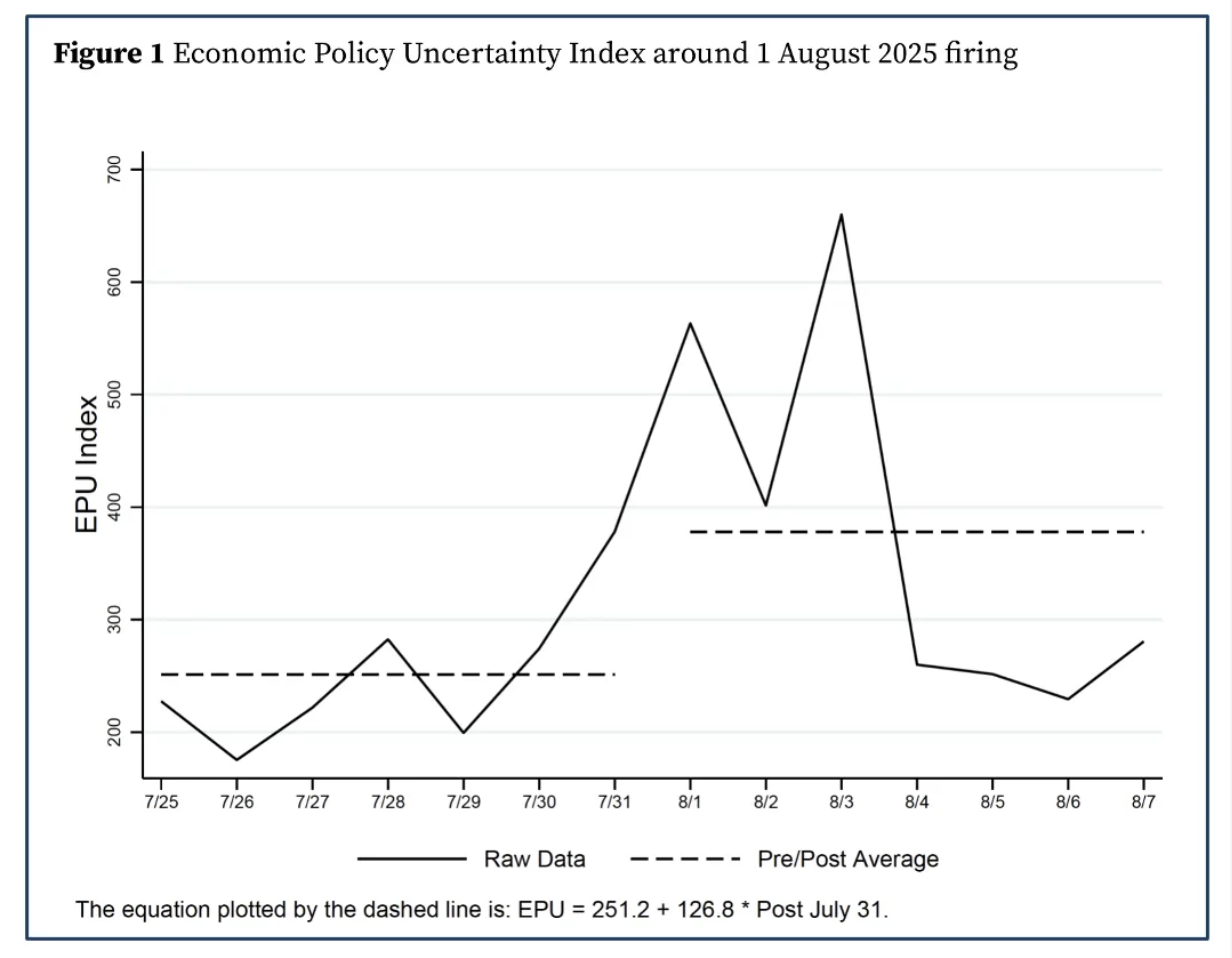
Trust in official economic statistics has become an increasingly salient policy issue, including in the US, where the Commissioner of the Bureau of Labor Statistics was dismissed in August 2025 amid allegations that agency data had been manipulated. This column shows that the events produced a sharp increase in economic policy uncertainty, with existing estimates linking uncertainty to macroeconomic outcomes, implying that the resulting loss of confidence may have reduced US GDP by roughly $20 billion. While some economic activity postponed during periods of uncertainty may eventually occur later, there are reasons to believe that at least part of the effect could be lasting.
·The Memo That Killed the Penny Bloomberg
Previously undisclosed documents obtained by Bloomberg’s FOIA Files reveal how the Trump administration found a way to halt penny production and why officials considered the decision “critical. It was actually Elon Musk’s Department of Government Efficiency (now defunct) that called attention to the skyrocketing costs of producing the penny — a day after Trump was sworn into office. It wasn’t the first time the practicality of the lowly coin was debated. A half-century ago, Treasury Secretary William Simon wrote in a memorandum to President Gerald Ford: “Concerning the one-cent coin, we are rapidly approaching the decision point for continuance or elimination.” In 2013, President Barack Obama seemed to be open to the idea of discontinuing the minting of pennies. Simon and Obama both cited the increased costs to taxpayers to produce the coins and the fact that people were using them with less frequency. They also noted that discontinuing the production of the penny would require an act of Congress, whose coinage power is spelled out in the Constitution.
AI, Immigration, and Collapsing Labor Force Participation Applied Complexity
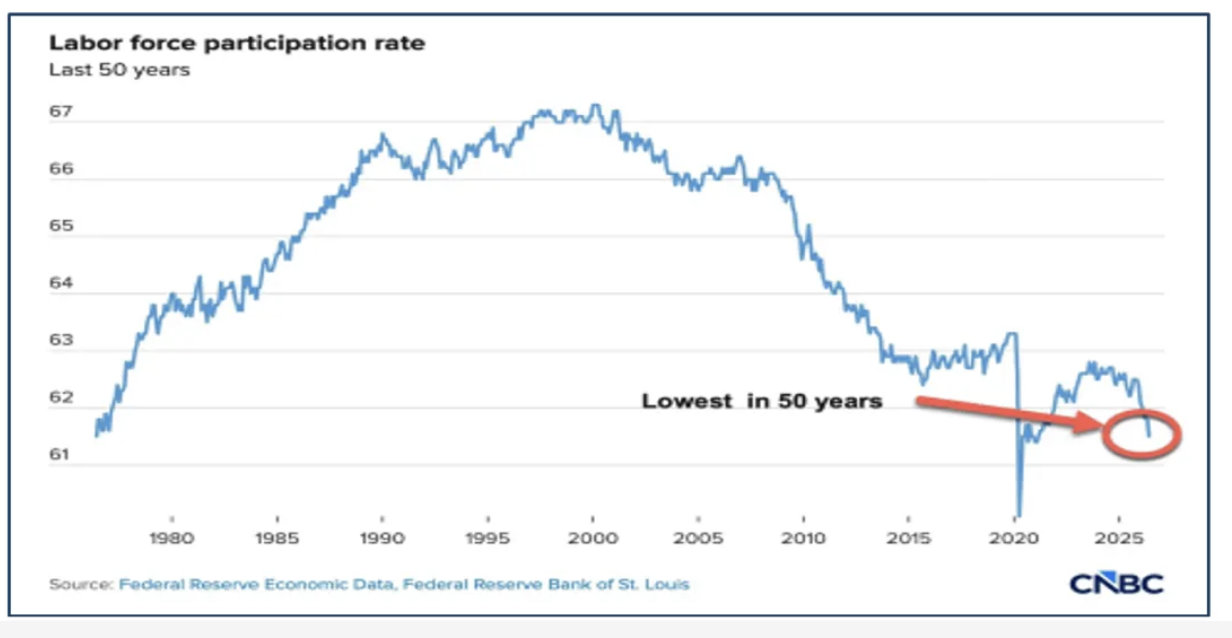
Overall Labor Force Participation (LFP) is at a 50-year low. As fewer adults work or seek work, a larger fraction of voters experience the economy mostly as consumers, retirees, or rentiers, not as workers. That changes political incentives around wages, immigration, AI, taxation, and redistribution. The economy becomes increasingly dependent on a shrinking core. A shrinking group of workers generates the income, taxes, and innovation that support a growing number of non-workers. The economy becomes more fragile because labor shocks are concentrated among fewer participants. Capital must increasingly substitute for labor. Labor scarcity raises the return on automation, AI, robotics, and software. The AI bet becomes as much about compensating for workers’ absence as simple replacement. Growth increasingly depends on productivity, not participation. Any [productivity] miss will be much more consequential than in the past, given that labor no longer picks up the slack.