

Fulcrum Perspectives
An interactive blog sharing the Fulcrum team's policy updates and analysis.
Read Around the World Over the Weekend: January 14, 2022
Russia/Ukraine Tensions
> Rand Corporation “Russia’s Limit of Advance”
Rand has conducted significant research and conducted “war games” analyzing what would happen if Russia actually invaded Ukraine. Here is their latest assessment.
> Carnegie Moscow Center “How Do Russians Feel About a War with Ukraine?”
One of the most asked questions in recent weeks has been whether Russia will attack Ukraine, despite a slight lessening of tensions in the wake of last week’s video call between the Russian and U.S. presidents. But how would ordinary Russians respond to a war with neighboring Ukraine?
> Radio Free Europe/Radio Liberty “How Long Could Ukraine Hold Out Against a New Russian Invasion?”
RFE/RL dives into trying to get a sense of how hard it would be for Russia to invade Ukraine – and how long Ukraine could defend itself.
> Real Clear World “God, Putin, and Ukraine”
The author points out that "If God had built mountains in Ukraine then the great expanse of flatland that is the North European Plain would not be such encouraging territory from which to attack Russia repeatedly.” As it is, Putin has no choice: he must at least attempt to control the flatlands to the west. So it is with all nations, big or small. The landscape imprisons their leaders, giving them fewer choices and less room to maneuver than you might think."

Kazakhstan
> Foreign Policy Research Institute “’A Bright Path’ Forward or a Grim Dead End? The Political Impact of the Belt and Road Initiative in Kazakhstan”
Markets focus on Russia’s interests in Kazakhstan in the wake of the rebellion there. But China – which shares a border with the country – has large investments in the country, much of it conducted via the Belt & Road Initiative. This report looks at China’s efforts and what is next for China’s efforts in the country.
India
> The Print “Kazakhstan unrest matters to India”
The only silver lining for India in the situation in Kazakhstan is that it will possibly complicate China’s plans for Central Europe.
> Foreign Policy “Pentagon Worries About Chinese Buildup Near India”
China’s new airports and highways near the border have put officials on edge.
> Lowy Institute’s The Interpreter “Indian Ocean Step-Up”
India is in the driver’s seat to build new security structures in the region, but it can’t do it alone.
China
> Atlantic Council “What is ‘Common Prosperity’ and How Will it Change China and Its Relationship with the World?”
A new question is being asked in China and around the world: what is “Common Prosperity” and how will it change China? “Common Prosperity” (共同富裕, Gongtong fuyu), a phrase first used by Mao Zedong decades earlier but rarely heard until Xi Jinping mentioned it in a speech early this year, has quickly become the official Chinese slogan of choice, defining the new era of politically led economic development emerging in China.
> Center for a New American Security “China’s Digital Currency and Authoritarianism”
China is the first major economy to develop and implement a central bank currency (CBDC). It has many names – Digital Currency/Electronic Payments, the digital yuan, or the electronic Chinese Yuan. This brief explains what Beijing is doing and why.
Middle East
> The Circuit “The General Who Coined the Abraham Accords”
How a two-star US General from Puerto Rico earned the trust of the Emiratis to later help broker the Abraham Accords – and name it, too.
> The Middle East Institute “The High Price of Iran’s Anti-Israel Policies”
Recently, the Iranian regime’s anti-Israel campaign scored a goal on its own net, so to speak, when various hardline regime news outlets targeted former Iranian national soccer team captain Mehdi Mahdavikia for intense criticism. Mahdavikia's crime? Wearing a jersey at an international exhibition soccer match arranged by FIFA that featured the flags of all 211 FIFA members, including Israel’s. But the backlash to this criticism inside Iran was big and loud showing once again the regime shooting itself in the foot as it attacks Israel and raising further internal political tensions.
Africa
> South African Institute for Security Studies “Sudan’s transition: What are the chances of success?”
Racked by civil war and intense bloodshed, peaceful mass protests led to the military ouster of Omar al-Bashir, ending his 30-year rule in 2019. A power-sharing agreement between the military and civilians has given much to hope for but analysis of the achievements and challenges of the transition so far show that while noteworthy progress has been made, significant challenges remain.
> National Geographic “Giraffe populations are rising, giving new hope to scientists”
Giraffe numbers are 20 percent higher than in 2015, an increase linked to conservation efforts and more accurate survey data. What does this say for the greater preservation effort in Africa?

United Kingdom
> Chatham House “The UK’s Kleptocracy Problem”
The growth of London as a center for financial and professional services coincided with the collapse of the USSR and the rise of post-Soviet kleptocracies in the 1990s. These states and their elites have since become a major source of clients for UK-based services firms and of investors in UK assets. The challenge now is, according to this report, that servicing post-Soviet elites weakens the rule of law in the UK.
Germany
> Fast Company “Berlin is planning a car-free area larger than Manhattan”
The citizen-driven plan that the city is considering now would create the largest car-free area in the city anywhere in the world.
Climate Change/Energy Policy
> Quartz “Maersk could push the entire shipping industry to move up its climate goals”
Maersk, the world’s second-largest shipping line, pledged on Jan. 12 to make its business carbon neutral by 2040 instead of its previously stated goal of 2050 – making their goals the most aggressive in the shipping industry. In doing so, they are likely to push the entire shipping industry to embrace more aggressive climate goals.
> Washington Post “The Race to Defuse Congo’s Carbon Bomb”
At around 56,000 square miles (about the size of Iowa) and more than 30 feet deep in places, the peatland Congo shares with its neighbor, the Republic of Congo, holds at least as much carbon as the whole world currently emits in three years of burning fossil fuels.
> International Energy Agency “Coal 2021: Analysis and Forecast to 2024”
The 2020 collapse in coal demand turned out to be smaller than anticipated – in fact, coal-fired power generation will have reached an all-time high by the end.
United States
> The American Enterprise Institute “The Exit Polls: A History and Trends Over Time 1972-2020”
Since the 1970’s when they were first used nationally, exit polls have been seen as an invaluable tool to understand voters’ views. This report examines just how useful they were and are today.

Economics
> The Economist “The $28 trillion global reach of Asian finance”
As private savings have built up in East and South-Asia, its financiers now wield heft in far-flung asset markets.

> Bain & Company “Young Workers Are Increasingly Overwhelmed”
Younger generations, especially in advanced economies, are under mounting stress that spills over into their work lives.

Global Security Policy/Intelligence Issues
> The Atlantic “How Fake Spies Ruin Real Intelligence”
Espionage-themed entertainment is influencing policymakers, from soldiers fighting on the front lines to justices sitting on the nation’s highest court. Sorry, Jason Bourne and Carrie Mathison…
> World Economic Forum “Global Risks Report 2022”
In their annual report, the WEF shares the results of their latest Global Risks Perception Survey.


Reading Around the World Over the Weekend: January 7, 2022
Happy New Year! We hope you had a restful holiday. Please find our recommended weekend reads covering key issues and events around the world. We hope you find these informative, useful, and perhaps even fun. Please let us know if you want us to add anyone to our mailing list.
Germany
> Foreign Policy “The Kaiser’s Family Wants Its Stuff Back. Germany Isn’t Sure They Deserve It.”
The former royal lost countless artworks, palaces, and wealth in the 20th century. But were they victims – or enablers – of the Nazis?
United States
> Atlantic Council “Seizing the Advantage: A Vision for the Next US National Defense Strategy”
As the Biden administration prepares to release its National Defense Strategy (NDS), the modern challenges facing the United States have continued to evolve, and the risks to the United States, its interests, and those of its allies and partners are more pronounced than even four years ago. The Atlantic Council convened a group of leading experts to offer their strategic views for what should be considered in the forthcoming NDS.
> Congressional Budget Office “The Effects of Recent Legislation on the Economy and the Budget”
Phillip Swagel, Director of the Congressional Budget Office, outlined the agency’s budget and economic analysis during the coronavirus pandemic and described some of the challenges involved in analyzing current economic policy.
China
> Brookings Institute “US-China Technology Competition: A Brookings Global China Interview”
The scale and speed of China’s technological advancements in recent years have raised concerns in Washington and elsewhere over the implications for the United States’ overall economic competitiveness and its national security, as well as the impact on liberal values and good governance globally. Brookings assembled a group of leading experts – including our colleague, Ryan Hass – to explore the issue.
> Peterson Institute for International Economics “US-China Phase One Tracker: Purchases of US Goods”
On February 14, 2020, the Economic and Trade Agreement between the United States and China went into effect. China agreed to expand purchases of certain US goods and services by a combined $200 billion by December 31, 2021. They didn’t make the target. Here is a breakdown of what they did and did not do.

> Foreign Affairs “The Taiwan Temptation” In recent months, however, there have been disturbing signals that Beijing is reconsidering its peaceful approach and contemplating armed unification. Chinese President Xi Jinping has made clear his ambition to resolve the Taiwan issue, grown markedly more aggressive on issues of sovereignty, and ordered the Chinese military to increase its activity near the island. With this in mind, the author argues it is time to take seriously why Beijing might resort to force (Note: This was first published in June 2021 but in light of current events, we thought it worth sharing here).
> Foreign Policy “China’s Two-Ocean Strategy Puts India in a Pincer” The Chinese foreign minister’s island hopping is the latest sign of contestation over the Indo-Pacific – and challenges India’s claim to primacy in South Asian waters which is India’s own maritime backyard.
Kazakhstan
> Carnegie Endowment for International Peace “Kazakhstan’s Unprecedented Crisis” In trying to calm violent protests, President Kassym-Jomart Tokayev has involved an unpredictable and untrusted partner: Russia.
Foreign Policy “Why Russia Sent Troops Into Kazakhstan”
Moscow’s swift aid to a neighboring regime track with its wider strategic goals: Supporting a pro-Russian government that is strategically aligned with the Kremlin.
> Bloomberg “Why Kazakhstan Protests Reverberate Beyond the Region”
Bloomberg offers a quick but to the point overview of the significant implications of the protests in Kazakhstan beyond the country itself.
Korean Peninsula
> Washington Post “Your cat could burn your house down, Korean officials warn after 107 fires sparked by felines”
The warning comes as the capital’s Metropolitan Fire & Disaster Headquarters estimated that more than 100 fires over the past three years were started by cats, many of which managed to turn on electric stoves with their furry paws. (
Latin America
> Council on Foreign Relations “Mercosur: South America’s Fractious Trade Bloc”
Three decades after its founding, Latin America’s largest trade bloc faces multiple challenges, including persistent internal division and the economic disruption caused by the COVID-19 pandemic.
> Center for Strategic & International Studies “A Closer Look at Colombia’s Illegal, Artisanal, and Small-Scale Mining”
Throughout the Colombian Amazon, a rush is on by various criminal actors to secure mining revenues. Skyrocketing gold prices (now twice the price of an ounce of cocaine), various armed dissident groups looking for revenues, and the overall growing market for rare and expensive are causing new stress on an already fragile ecosystem.
> New York Review of Books “Brazil Turns, Lula Returns”
Bolsonaro’s years of misrule have left a yearning for stability. Even conservative eleits are adjusting to the idea of the Workers’ Party leader as president again.
Technology/Energy/Sustainable Investments
> MIT Technology Review “Ten Breakthrough Technologies of 2021”
2021 saw major breakthrough in tech. Some, such as mRNA vaccines, are already changing our lives, while others are still a few years off. All will have a big impact on our lives for years to come.
> The New Yorker “How Mosquitos Changed Everything”
They slaughtered our ancestors and derailed our history. And they are not finished with us yet.
> Vox “Fusion Energy Is a Reason to Be Excited About the Future”
It’s been a long road, but recent advances mean we’re closing in on a game-changing technology.

Economics
> The Quarterly Journal of Economics “The Economic Consequences of Increasing Sleep Among the Urban Poor”
In this study, researchers point out the urban poor in developing countries face challenging living environments but that short afternoon naps at the workplace lead to significant increases in productivity, psychological well-being and cognition. In contrast, an extra 30 minutes sleep at night shows no similar improvements.
> Visual Capitalist “Visualizing the $94 Trillion World Economy in One Chart”
As we all know, gross domestic product (GDP) serves as a barometer for a country’s economic health. It measures the total market value or final goods and services
and services produced in a country during a given year. Together, the U.S. and China account for 42% of global GDP. Here is the GDP by country according to IMF estimates.

> National Bureau of Economic Research “The Price of Nails since 1695: A Window into Economic Change”
Why nails? They are a basic manufactured product whose form and quality have changed relatively little over the last three centuries, yet the process for producing them has changed dramatically. Accordingly, nails provide a useful prism through which to examine a wide range of economic and technological developments that touch on multiple areas of both micro- and macroeconomics.
> Federal Reserve Bank of St. Louis “the Dynamics of International Shipping Costs”
This report shows that a nontrivial portion of the dynamics of international shipping costs observed in recovery from the COVID-19 recession appears to be consistent with the standard dynamics of international shipping costs. These costs are volatile and pro-cyclical, so it is not unusual that they increase significantly when economic activity rebounds after a recession.

> Fortune “Crypto Crime Just Hit an All-Time High of$14 billion”
Criminals scored a whopping $14 billion in cryptocurrency in 2021, marking an all-time high and a 79% increase from the previous year according to a study by the cryptocurrency research firm Chainalysis. The report can be found here.
Global Issues
> Aeon “How Disruptions Happen”
Major disruptions in world history follow a clear pattern. What can upheavals of the past tell us about our own future?
> Council on Foreign Relations “Ten Elections to Watch in 2022”
Numerous countries will hold elections in 2022. Here are ten to watch closely.
A Riveting New History of the Conquistadores: Blood, Gold, and the Conquest of the New World

There is, quite frankly, a lot of myth and historical mayhem out there about the discovery of the "New World" and the role of Spain's "Conquistiadores." In Fernando Cervantes's riveting new book, we get a fresh, unbiased, and deeply researched historical overview of these brave, ambitious, at times greedy, and more often than not bloody explorers. From Pizarro to Cortés to the rest of them, Cervantes drills in what drove them to risk their lives on the high seas and in the jungles of Latin America. True, the search for gold was the primary factor. And with it came a great price - particularly for the native Americas who died by the thousands from diseases brought by the conquistadores if not at the bloody tip of their swords.
What is particularly valuable about Cervante's book is his superb overview of what was going on in Europe at the time, the wars and dynastic wars, the rise of Martin Luther, and the never-ending battles with the Moors. All of which directly impacted Spain's spending and focus on the New World - indeed, in many ways tremendously exasperating the desperate search for gold and silver in the New World to fund those very wars back home.
I am happy to have this book on my shelves as I know I will find it a tremendous resource in the years to come as I grow my business in Latin America and need to be refreshed on the history of that time, which continues to define in so many ways the way of life in the region today.
Washington’s Week Ahead: Build Back Better Isn’t Dead Yet…
Welcome back from the holidays, and Happy New Year! Washington is slowly coming back to work this week. The Senate is back in session today, but the House of Representatives remains out until next week. We want to lay out what we believe markets will be focused on this week and for the coming few weeks:
"Build Back Better" (BBB) is NOT dead: Despite the headlines just before Christmas that Senator Joe Manchin (D-WV) is officially opposed to and thus killed off President Biden's signature social spending and tax package, we beg to differ. Talks between Manchin and the White House continued intermittently over the Christmas break, and we expect them to continue this week. We believe the deal - currently hovering at approximately the $1.8 trillion - is (as we have been saying for months) a "Must-Do/Failure is Not an Option" event for Democrats going into the November mid-term elections.
How best to describe the situation? Maybe a cooking analogy works best: While BBB may not be on the front burner day after day like it has been the last few months, it definitely is on a side burner simmering away and being tended to carefully.
Three key points to keep in mind:
1. Manchin is opposed to the size/scope of the social spending components of BBB – and that can be negotiated. He is not opposed to the substantial personal and corporate tax increases. Specifically, Manchin tells the White House and Senate Democratic leadership he wants the enhanced child tax credit either removed from the bill or significantly lowered. Manchin argues the actual cost of the child tax credit is closer to $4 trillion over ten years (we think he's right as the current draft only expenses the provision for three years). Manchin has indicated numerous times he was comfortable with a package coming in at $1.5 trillion.
But back to Manchin on taxes for a moment: He has expressed little to no concern or opposition with the numerous tax provisions in the bill. In fact, Manchin has been vocal in supporting President Biden's position "the rich need to pay their fair share" and that the corporate tax rates should also be raised. If a deal on BBB comes together in the next two to three months, do not be surprised if the effective date for those taxes set to January 1st.
2. Manchin's concerns/stated opposition (for now) revolve around inflation and adding to the national deficit in the face of the Federal Reserve raising interest rates. If inflation does begin to show itself as truly "transitory" (Washington's 2021 buzz word of the year), and there is a more precise, smoother glide path to the timing and size of Federal Reserve rate increases, do not be surprised if Manchin changes his mind.
3. To our point of this being a “Must Do/Failure is Not an Option”: That “ding-ding-ding” you heard on midnight December 31st was not just the ringing in of a new year. It was also the starting bell for the re-election campaigns for every member of the House and one-third of the Senate. For Democrats, failing on BBB would leave them open to being attacked for getting very little accomplished in the previous two years. There is no other “Big Ticket” issue Democrats intend – at this point – to tackle in 2022. For many Democrats, the fate of BBB is intricately tied to their political futures. Thus, do not be surprised if a deal is cobbled together by March.
What will Congress be focusing on until (or in the absence of) the BBB deal being hammered out?: The first big issue will be Senate consideration of a voting rights bill – which Republicans uniformly oppose. But this brings us to the likely next major legislative battle: Getting rid of the Senate filibuster or at least cutting back how it can be used. Senate Majority Leader Chuck Schumer (D-NY) has been pushing to get rid of the filibuster and sees the voting rights bill as the leverage to at least change the rules how the filibuster is used. We see at least five Democratic senators – chief among them Senators Joe Manchin (D-WV) and Kristen Sinema (D-AZ) – opposed to scrapping the filibuster but maybe open to changing the rules. Any changes to the filibuster would likely change the legislative outlook for the remainder of 2022 considerably.
Markets should be on alert as we anticipate President Biden will finally announce his long-awaited nomination for Vice Chair for Supervision of the Federal Reserve possibly as soon as this week – the single most powerful financial regulatory post in the federal regulatory orbit. Progressive Democrats are pushing President Biden hard to name a Progressive who will bring tough new regulations and enforcement oversite to the banking sector and the larger players in the mutual fund and insurance industries. Additionally, the President will likely name two additional Federal Reserve Board Governors – thus allowing President Biden to almost wholly remake the composition of the Federal Reserve Board.
There is a long list of rumored names for the Vice Chair for Supervision slot but for the moment the leading name appears be former Federal Reserve Board Governor and Deputy Treasury Secretary Sarah Bloom Raskin. Currently a professor at Duke Law School, Raskin appears to meet the approval of Progressives and is well known to President Biden from her tenure at Treasury during the Obama Administration. If the name Raskin sounds familiar to you political junkies: Her husband, Representative Jamie Raskin (D-MD), was the lead impeachment manager for the second impeachment of President Trump.
Finally, are we about to see the “The Rise of the Regulators”?: We will be writing a lot more about this in the coming weeks but in short we anticipate a lot more regulatory actions in January impacting virtually all sectors. Our view and experience is this: It normally takes a new Administration’s regulatory appointments the better part of a year to get settled in and lay out their agenda. And in the second year, they begin to execute. Two examples of what we are watching closely:
Securities and Exchange Commission Chair Gary Gensler laid out a particularly broad and aggressive regulatory agenda in 2021. We now anticipate he will quicken effort to bring new, meaningful regulations impacting a number of key markets ranging from cryptocurrency regulation to corporate governance rules around sustainability to the market structure of the bond market.
The Federal Trade Commission (FTC) and the US Department of Justice’s (DoJ) Antitrust Division are seen as the “point of the spear” of President Biden’s ambitious executive order on competition. FTC Chair Lina Kahn is seen as particularly aggressive in her views on large mergers and acquisitions of any kind. Add to this expected legal actions from DoJ Assistant Attorney General Johnathan Kanter aimed at Big Tech. Overall, we anticipate soon seeing sweeping (and likely controversial) efforts from both impacting deal-making across all sectors.
We hope this is helpful. Please let me know if you have any questions.
Reading Around the World Over the Weekend - December 3, 2021
India
· Foreign Policy “Modi’s Growing Crackdown on Bollywood”
India’s film industry is under growing pressure to bend it knew to Hindu nationalists.
· Foreign Policy Research Institute Podcast “Episode 8: India’s Status as a Great Power”
How successful has India been at securing its position as a great power? In this episode of Global Demons, Robert D. Kaplan and Ashley J. Tellis discuss India’s status as an Asian great power, its future under Narendra Modi, and how it deals with the U.S.- China Rivalry.
EU & UK
· Der Spiegel “The First Fractures Become Apparent in Berlin”
The coalition talks were secretive, and the three parties involved sought to exude unity and harmony. Now that Germany's next coalition agreement has been presented, though, fractures are becoming apparent. And surprisingly, the Greens may not be the Social Democrats' favorite child.
· Politico EU “Europe Reins in Big Tech: What You Need to Know”
Ministers sign off on new EU tech rulebook to curb abuse and harm online. But what does that really mean for the tech sector and tech users?
· The Spectator “Is this the beginning of the end for Nicola Sturgeon?”
Sturgeon has been the long-time leader of Scotland’s Scottish Nationalist Party (SNP) and helped lead the failed vote for independence. Now, there is growing speculation her tenure on top of the party has peaked.
· Nouriel Roubini & Brunello Rosa “Why Italy’s Presidential Election Matters”
With its poor track record of managing EU funds, Italy’s recovery plan will be a major test for the future of EU policymaking more generally. While it is widely agreed that Prime Minister Mario Draghi must remain on the scene to oversee the plan’s implementation, in what capacity would he be most useful?
North Africa
· The New Yorker “The Secretive Prisons that Keep Migrants out of Europe”
Tired of migrants arriving from Africa, the EU has created a shadow immigration system that captures them before they reach its shores and sends them to brutal Libyan detention centers run by militias.

Latin America
· Americas Quarterly “Why Lulu vs. Bolsonaro in Brazil Leave Little Room for Others”
Five reason a “third way” candidate will struggle to break through in a polarized contest.
China
· VOX EU/CEPR “The Global Footprint of Chinese Banks”
The global footprint of Chinese banks is substantial and growing, including during the COVID-19 pandemic. While they are similar to other banks from emerging countries in terms of their ownership and asset structure, their global footprint often resembles that of banks from advanced countries. Geographical distance acts as a barrier for Chinese banks’ lending, comparable to that for the US or European banks. Also like their US peers, the lending of Chinese banks strongly correlates with trade. Some differences are present, such as an atypical negative correlation between bank lending and portfolio investment.

United States
· US State Department “Invited List for Upcoming Summit for Democracy”
On December 9-10, President Biden will host the first of two Summits for Democracy, bringing together leaders from government, civil society, and the private sector to renew democratic ideals and goals. Of note, the President has invited Taiwan, much to the furor of China.
· Foreign Policy “The Beautiful, Dumb Dream of McDonald’s Peace Theory”
In the rich, lazy, and happy 1990’s, Americans imagined a world that could be just like them. One of the measures created to show this was Thomas Friedman’s “Golden Arches Theory of Conflict Prevention” – which hasn’t stood the test of time very well.
· Pew Research “Where Do You Fit in the Political Typology?”
Are you a Faith and Flag Conservative? Progressive Left? Or somewhere in between? Take Pew’s online quiz and find out where you actually are in today’s weird and wild political typology.
Russia
· Carnegie Moscow Center “The Coming Deluge: Russia’s Looming Lost Decade of Unpaid Bills and Economic Stagnation”
Russia faces a litany of long-term economic challenges that will hobble its growth potential but likely won’t be severe enough to force far-reaching political change.
Singapore
· RestofWorld.org “Singapore’s Tech-Utopia Dream is Turning into a Surveillance State Nightmare”
Singapore is one of the most technologically sophisticated places in the world – one of the safest. Yet, according to this report, it is taking something of an Orwellian turn: The city is constantly watched by 90,000 police cameras, and by the end of the decade, there will be 200,000. Sensors, including facial recognition cameras and crowd analytic systems, are positioned across the city. More recently, the city has begun piloting a new kind of robot that “can automatically detect anti-social behavior, from smoking to illegal food stalls and gatherings, barking orders out of its speakers, recording video and reporting back to HQ.”

Kenya
· Institute for Security Studies “Sweet Deals for Kenya’s Sugar Smugglers”
High production costs and the mismanagement of factories have led to a drop in sugar production in Kenya over the past two decades, opening the door for smugglers – particularly from Somalia and potentially funding the terrorist organization, Al Shabaab. In 2020, sugar made up 48% of the goods smuggled into the country, according to the National Crime Research Centre.
Lebanon
· Gallup Polls “Leaving Lebanon: Crisis Has Most People Looking for Exit”
Quality of life has deteriorated so much in Lebanon that most people -- a record-high 63% in 2021 -- say they would leave the country permanently if they could. Canada and Germany are the most desired destinations for this group: 28% would like to go to Canada, and 19% would like to move to Germany.

Book of the Week: “Master of the Game: Henry Kissinger and the ARt of Middle East Diplomacy”

With the countless books written about Henry Kissinger, it is hard to find anything new these days contributing in a substantive or even interesting new way to his legacy, the history he was a part of, and the history he made. But there is a sparkling new exception to this rule, Martin Indyk's "Master of the Game: Henry Kissinger and the Art of the Middle East." Richly detailed and written in a highly engaging and witty style, Indyk vividly illustrates how Kissinger dealt with the multiple Middle Eastern crises' launching the US' numerous efforts over the years to bring peace to the region. Moreover, he gives a foundational history to the US' concerted and oft-failed efforts to bring peace and stability to the region.
I came away from reading this book having learned more about Kissinger's thinking, strategies, and tactics in this Indyk's book than virtually every other Kissinger biography I have read (and I've read quite a few). Indyk does not write a dry hagiography of Kissinger but keeps it honest and human. We see how Kissinger somehow balanced the extreme tensions, egos, and demands of the multiple and very different Arab states versus a still young Israel fighting for its survival. All the great names of the age are there: Sadat, Meir, Hussain, Brezhnev, Nixon. And we see all sides of Kissinger: At times sly, other times brutally frank with both Arab and Israeli leaders, as well as the Kissinger who made mistakes and had to move hard and fast to correct himself and the policies he proposed.
If there is one criticism of the book, it is the sheer amount of detail that can be slightly overpowering at times. Indyk took extraordinary time and painstaking effort to get the overall historical account correct, as well as the innumerable small but critical conversations, meetings, and interactions.
But what helps bring a unique perspective to the book is Indyk's own experiences working for US-Palestinian peace efforts over the years. A former US Ambassador to Israel and a senior aide to then-President Obama, Indyk can compare and contrast what happened during Kissinger's time versus what Obama and Indyk encountered and attempted to achieve.
This is the book to read for those fascinated by the complexities of Middle Eastern politics and history and the United States' efforts to bring greater peace and stability to the region.
The Crowded Hour (or, How Congress May Miss Christmas)….
December is upon us, the Christmas trees are going up, festive lights are hung, everyone is getting into the holiday cheer, and Congress is risking missing it all. In all my years in Washington, I cannot remember so many critical pieces of legislation Congress is trying to pass in less than 20 legislative days. The impact is truly global, and the markets need to beware.
Here is the quick rundown:
> Funding of the Federal Government: On Friday, December 5th, the Federal government funding dries up and, unless Congress can pass another short-term continuing resolution, we will see the government shut down. The markets have experienced shutdowns before and realize at this point that aside from the embarrassment of a non-functioning US a huge portion of the US government is considered “essential” and therefore is not impacted much (For a good explanation of what and who gets hit by the shutdown, this is a great primer.). Nevertheless, battling over how to deal with the threat of shutdown takes up a lot of political oxygen in Washington – and time, which is the most precious commodity in the nation’s Capitol.
> Raising the Debt Ceiling: Recall Congress grappled with this issue in October (in case you feel like you are having a bad case of déjà vu). They only raised the debt until December 3rd, and Treasury Secretary Janet Yellen has recently sent a letter to Congress stating the limit will be hit again by December 15th. The reality is the ceiling probably will not be hit by the 15th and, via “extraordinary means” – e.g., taking funds from various other funding sources in the US Government – will not be hit until sometime in late January or even February. But like the government funding issue, it takes up a lot of political oxygen and energy.
> The Defense Spending Bill: Formally known as the National Defense Authorization Act (NDAA), it is the funding vehicle for the US Defense Department. It is the one piece of legislation Congress has passed on a timely basis for more than 60 years – until this year. It was supposed to be passed last fiscal year (before October 1st), but it did not happen for various political and policy issues. The pressure to get it done immediately is intense as other NATO countries are complaining about the failure to pass the bill (as they get funding from it), that this is the worst time to be behind schedule as Russia has amassed more than 100,000 troops on Ukraine’s border, as China-Taiwan tensions approach a boiling point, etc., etc. In short: Getting the NDAA REALLY matters and REALLY needs to get done now.
> Confirmation Hearings and vote on Federal Reserve Board Chair Powell and Vice Chair-nominee Brainard: We fully expect both to be confirmed by the Senate. But it will not be fast and clean as we expect Progressive Democrats to put up a fight against Jay Powell’s re-confirmation (led by Senator Elizabeth Warren (D-MA). This will take up precious time on the Senate floor and, like the debt ceiling and federal government funding issues, suck up precious political energy.
> The “Build Back Better” (BBB) Budget Reconciliation: The biggest challenge of all. As we saw over the last three months in the House of Representatives, this is a complicated and politically explosive bill – just among Democrats. Senate Majority Leader Chuck Schumer (D-NY) tells members he hopes to get the estimated $1.8 trillion package wrapped by Christmas or in the week between Christmas and New Year – but that is a hope, not a plan. Already, there is tremendous wrangling over the state and local tax (SALT) provisions in the House version of the bill, which allow $80,000 of deductions. Senate Progressive Democrats – led by Senate Budget Committee Chair Bernie Sanders (I-VT) are adamantly opposed to this provision. They do not want to see any change to the cap on SALT deductions, arguing it only benefits the wealthy.
No matter what happens here, it is highly likely – almost inevitable – the House version of the bill will be altered, thus forcing it to be sent back to the House for consideration and possible further alterations.
This is what we call “legislative ping-pong,” and it takes time and is likely to raise political tensions further – again, just among congressional Democrats as Republicans in the House and Senate are committed to voting against the BBB Budget Reconciliation.
One last critical point: Senator Joe Manchin (D-WV) has long been the critical swing vote here to get BBB done. If he votes no, then it dies. This week, Manchin told reporters he remains unconvinced that the bill is good for the economy with rising inflation. It is necessary to get to a final deal by the end of December – something he has said several times before. Our view: If Congress does not get the BBB done by the end of the month, it is in real trouble. Considering the significant individual and corporate tax increases in the package, no one likes to be on record voting for tax increases in an election year. Moreover, there are no deadlines – artificial or real – next year to get this package done.
Finally, the longer this bill takes to get done, the less impact it will have on voters (such as the child tax credit) by the November 2022 mid-term elections.

Reading Around the World November 26, 2021
CHINA:
• The Straits Times “China Finds 12 million Children that it Didn’t Know Existed” China undercounted the number of children born in 2000 to 2010 by at least 11.6 million - equivalent to Belgium's current population - partly because of its stringent one-child policy. The difference could be the result of some parents failing to register births to avoid punishment if they breached the one-child policy.
• Rhodium Group “China Pathfinder: Q3 2021 Update”
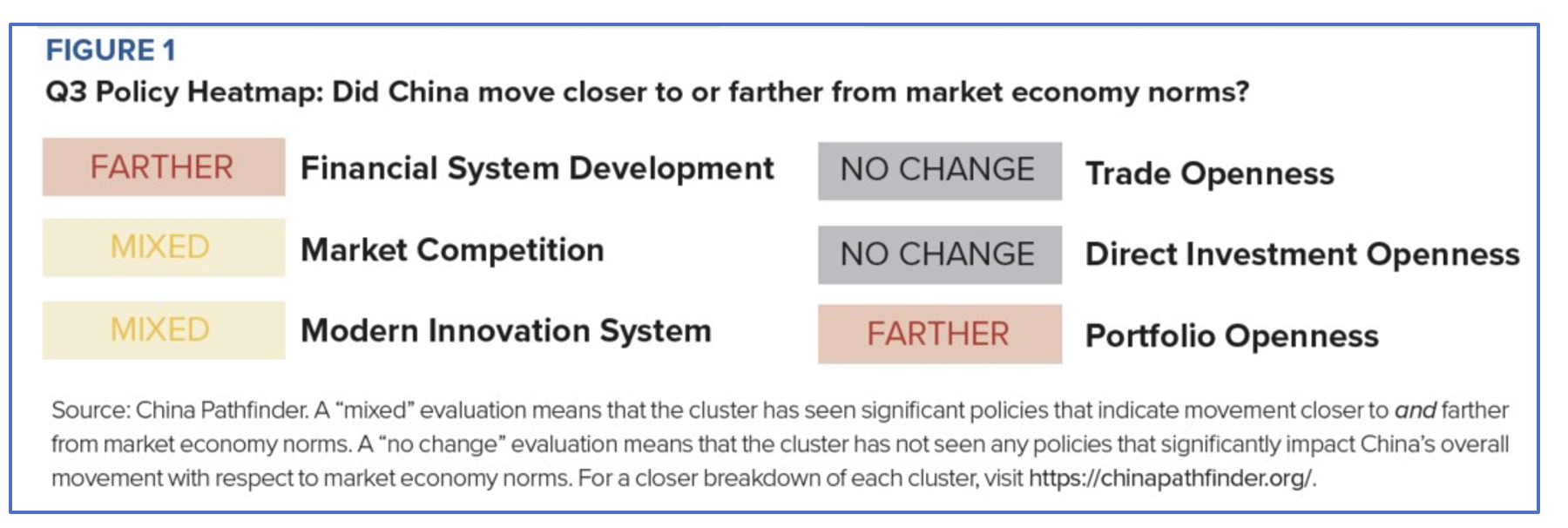
In Q3 2021, Chinese authorities were active in regulating/cracking down on four of six economic clusters that make up the China Pathfinder analytical framework—financial system development, competition policy, innovation, and portfolio investment openness— with fewer developments in the trade and direct investment openness clusters. In assessing whether China’s economic system moved toward or away from market economy norms in this quarter, our analysis shows a mixed-to-negative trendline.
JAPAN:
• War on the Rocks “Japan’s Revolution on Taiwan Affairs”
The most important development for Taiwan’s security might be unfolding right now in Japan. Tokyo’s strategy toward Taiwan is dramatically shifting. Once reluctant to join all but the most anodyne of pro-Taiwan statements with the United States, Japanese officials now increasingly state their desire to “protect Taiwan as a democratic country.” But what does that actually mean? How far will Japan go to stand by this statement?
EU & UK:
• Fortune.com “Not Just Meatballs and DIY Furniture: Ikea Could be Your Next Renewable Energy Supplier”
The world's largest furniture retailer has for decades been a temple of flat-pack bookcases, cook wear, linens, and Swedish meatballs. But in the future, the home goods supplier is planning to take home basics to another level—as a renewable energy supplier.
• The Economist “Last of the Commies”
Even though the Berlin Wall fell in 1989, local politics, force of habit and canny strategy help Europe’s communists cling on.
• Australian Strategic Policy Institute “Why Won’t Eastern Europeans Get Vaccinated?”
In recent weeks, as Europe has again become the global epicenter of the Covid-19 pandemic, the surge in coronavirus cases, hospitalizations and deaths has highlighted the continued vaccine hesitancy of one group of Europeans in particular: those in the formerly communist east. While 75.6% of European Union citizens are fully vaccinated, the share in Bulgaria is 26.2% and it’s 39.6% in Romania. In countries outside the EU, the numbers are even bleaker. Only 20.2% of Ukraine’s population, and 36.3% of Russia’s, are fully vaccinated.
RUSSIA/BELARUS/UKRAINE:
• Der Spiegel “New Details Shed Light on Lukashenko’s Human Trafficking Network” Insiders reveal fresh details about Belarusian dictator Alexander Lukashenko's inhumane smuggling system, comprised of a network of front companies that spreads to Syria, Turkey and Iraq, secret money transfers and the use of soldiers as traffickers.
LATIN AMERICA:
• War on the Rocks “I have Other Data”: the Guardia Nacional and the Entrenchment of Mexico’s Militarization”
On July 5, 2021, journalist Jorge Ramos laid a scathing critique at the feet of Mexico’s president, Andrés Manuel López Obrador. In a morning press conference, Ramos accused the president of misleading the public by claiming Mexico was “a country at peace.” Ramos pointed to data collected throughout AMLO’s presidential term: The homicide rate in 2020 was 29 deaths per 100,000 citizens, a death-per-capita rate higher than at any point in Mexico’s recent history —despite AMLO’s declaration that the war on drugs was over, his pledge to remove the military from the streets, and his campaign promise to end violence through a series of social and economic reforms he marketed as “abrazos no balazos” (hugs, not bullets). In the wake of continually rising violence, Ramos bluntly said the data reflected that AMLO had not made good on his campaign rhetoric. Then he asked the president if abrazos no balazos was a proven failure. AMLO somewhat dismissively replied, “I have other data.”
• Americas Quarterly “Kast and Boric: Explaining the Chilean Paradox”
Chile’s presidential runoff will now be a race to the middle, as most voters want change but not radicalism. Can either candidate deliver?
• Center for Strategic and International Studies “The Development of the ICDT Landscape. In Mexico: Cybersecurity and Opportunities for Investment”
Mexico’s information and communications technology (ICT) sector has witnessed increased competition and investment since 2013’s landmark regulatory reform, which created the Federal Institute of Telecommunications (IFT). Despite the failure of the presidency to push forward with the regulatory opportunities, the sector continues to be a promising one.
UNITED STATES/CANADA:
• National Bureau of Economic Research “Pandemic Schooling Mode and Student Test Scores: Evidence from the US States”
There have been a lot of questions of the impact of COVID on students and learning. The NBER has just released a study looking at Spring 2021 finding the pass rates declined compared to prior years and that these declines were larger in districts with less in-person instruction. Passing rates in math declined by 14.2 percentage points on average; we estimate this decline was 10.1 percentage points smaller for districts fully in-person.
• Interesting Engineering Magazine “Can the US Upgrade Its Infrastructure to Defend Against Drone Attacks?”
In a first-of-its-kind attack on U.S. soil, a drone was used to attack an electrical substation in Pennsylvania in 2020. While the location of the attack wasn't revealed, a new document from the FBI, Department of Homeland Security, and the National Counterterrorism Center are in circulation with U.S. law enforcement agencies, according to a recent New Scientist report. And it turns out we may need an infrastructural overhaul to defend against drone attacks.
• Fulcrum Macro’s Study of US Politics Chart of the Week:

GREATER MIDDLE EAST:
• Brookings Institution “Is Hezbollah Overplaying its Hand Inside Lebanon?”
Lebanese Hezbollah’s role as an Iranian proxy and its provision of significant assistance to its allies in Syria, Yemen, and Iraq has been an area of justified focus for policymakers in many capitals but the organization’s evolving role inside Lebanon merits equal attention. While it is customary to characterize Hezbollah as a “state within a state,” it is more accurate now to define it as a “state within a non-state,” - a devolution of the country largely due to their policies and actions - in view of the sheer inability of the Lebanese government to deliver even the most basic services to a desperate population plunged into its worst economic crisis in over a century.
• Human Rights Watch “Afghanistan: Taliban Crackdown on Media Worsens”
Since the US military withdrawal, Taliban crackdowns on women, media, education, etc. have intensified. This report shares research on how tough the crackdown has become on the local media. One example: One Afghan broadcaster, after a news report, was told by his provisional governor if he ever talked about the subject again “He would find himself hanging from the public square.”
AFRICA:
• Foreign Policy Research Institute “The Time is Right for a US Pivot to Africa”
The author argues President Biden cannot make the previous administration’s mistake of viewing Africa as a battlefield for competition with China and Russia. Instead of playing catch-up to China, Russia, and others, the US should surpass the initiative they have taken in Africa, spot new opportunities, and help make the difference between a green and prosperous future as greater Sub-Saharan Africa is showing tremendous opportunity.

Energy/Climate Change
• Financial Times “Nuclear fusion: Why the race to harness the power of the sun just sped up”
Advances in technology and funding have sparked optimism in an area that has promised much but delivered little in six decades.

Reading Around the World November 19, 2021
Please find our recommended weekend reads covering key issues and events around the world. We hope you find these informative and useful. And please let us know if you want us to add anyone to our mailing list.
Global Issues:
· Bank for International Settlements “Bottlenecks: Causes and Macroeconomic Implications”
The BIS takes a deep dive into the ongoing supply chain crisis and the longer-terms economic implications.
· The New Yorker “How the Week Organizes and Tyrannizes Our Lives”
The Harvard professor and noted author Jill Lepore writes about how our lives – from work schedules to TV seasons to baseball games – has been built around and dominated by the seven-day cycle. She asks the pointed question: Will we ever get rid of it?
· International Monetary Fund “Forecasting Social Unrest: A Machine Learning Approach”
The IMF produced a social unrest risk index for 125 countries from 1996 to 2020. Here, the IMF uses a machine learning model drawing on over 340 indicators to correctly forecast unrest in the following year approximately 2/3 of the time.

· Bloomberg “What’s Wrong with ESG Investing as Explained Through the Medium of Ohio”
No one can quite agree on where companies stand when it comes to the trifecta of ESG concerns — environmental, social and governance — that has morphed into a responsible investing craze worth trillions of dollars. In fact, a quick tour through Ohio — once a major Midwestern manufacturing capital before falling into ‘Rust Belt’ status in the 1980s as factories shifted abroad — can give us a peek into the failure of socially-responsible capitalism to improve society.
China:
· Fortune Magazine “China Launched the New Beijing Stock Exchange to Fund Small Businesses – But it May also ‘Cannibalize’ Existing Bourses”
China’s new Beijing Stock Exchange (BSE) officially opened for business on November 15th in a bid to shore up support for homegrown small to medium-size enterprises (SMEs) during a time of slowing economic growth. But will it have a opposite effect by moving existing listings from other Chinese exchanges?
· Foreign Affairs “China’s Search for Allies: Is Beijing Building a Rival Alliance System?”
China has shied away from formal alliances, based on its supposedly distinct view of international relations and a pragmatic desire to avoid the risks of entanglement. But there are signs that Beijing’s resistance is starting to erode as in recent years it upgraded its strategic partnerships, expanded military exchanges, and joint exercises with various countries – much to the alarm of the US and other countries.
United States:
· War on the Rocks Podcast “Richard Haas is Unhappy”
The podcast looks at and discusses Council on Foreign Relations Richard Haass’ critique of “Washington’s new flawed foreign policy consensus” and laments the bipartisan turn away from the mostly internationalist spirit that has informed U.S. foreign policy since the end of the World War II. Is he right? Does such a consensus exist? And does that explain why successive U.S. presidents seem so skeptical of internationalism?
· Pew Research Center “Where Americans Find Meaning in Life has Changed Over the Past Four Years”
Many things have changed in the United States in the past four years, from a new administration in Washington to the COVID-19 pandemic. Pew has conducted surveys which have revealed six facts about where Americans find meaning in life and how those responses have shifted over the past four years. The analysis also examines how attitudes in the U.S. compare with those in 16 other advanced economies surveyed by the Center in 2021
· The Heritage Foundation “US Military Strength: An Annual Assessment”
Having been engaged in warfare for more than 20 years, many wonder what the strength of the US military is now. The Heritage Foundation provides an expansive overview of strengths and weaknesses, broken down by regions globally.
· Morning Consult “The Private Sector and Federal Government have Begun the Push for 6G Broadband. Much of the Public is Still Behind on 5G”
In a new poll, at least 7 in 10 adults who don’t have a 5G phone said they would not be willing to pay more for one with those capabilities.

Latin America:
· Americas Quarterly “Was the COP26 A Good Deal for Brazil?”
Carbon credits for fighting deforestation were left in flux at Glasgow — but they could be key for the climate and Brazil’s economy. And markets are looking closely at how this will evolve.
· Center for Strategic & International Studies “Panama’s Maritime Business and the Evolving Strategic Landscape”
Panama’s maritime business is being transformed by a number of factors. These include the growing U.S.-China competition in the region, U.S. policies to contain immigration from the Northern Triangle, technology trends, evolution of regional infrastructure, and the restructuring of the maritime shipping industry itself. Demand for the canal and associated ports will likely remain strong, but the composition of that traffic, the routes, the operators, and the role of complementary and competing facilities elsewhere in the region will likely transform dramatically in the coming generation.

EU & Russia:
· Foreign Policy “Even Sweden Doesn’t Want Migrants Anymore”
Sweden’s generous response to the 2015 refugee crisis may have permanently dented its moral worldview.
· Rand Corporation “Analysis of Russian Irregular Threats”
Russian President Putin has been able to exert greater influence globally by deploying a variety of irregular methods – indeed, threats – ranging from information warfare, political subversion, and the use of violent proxies. Rand presents an in-depth study of what exactly those threats are and how they are used.
· European Council on Foreign Relations “Russia’s Military Movements: What They Could Mean for Ukraine, Europe, and NATO”
Russia is mobilizing its forces, but much more covertly than in the past. Moscow’s belief that the EU and US will not step in to protect Ukraine could lead it to take direct military action.
Africa:
· Institute for Security Studies “Climate, Energy, and the African Dilemma”
Fossil fuels and mineral wealth are pivotal to Africa’s geopolitical positioning and strategic importance. With the recent COP26 commitments, how will Africa square a possible large circle?
Middle East:
· The New Statesman “How a Hezbollah-backed Game Show Host Cost Lebanon its Rich Gulf Allies”
George Kordahi’s remarks enraged the Saudis, and ordinary Lebanese are paying the price.
· Brookings Institution “Is Hezbollah Overplaying Its Hand Inside Lebanon?”
Lebanese Hezbollah’s role as an Iranian proxy and its provision of significant assistance to its allies in Syria, Yemen, and Iraq has been a focus for policymakers in many capitals. But the organization’s evolving role inside Lebanon merits equal attention – especially with their sheer inability to help deliver even the most basic services to a desperate population plunged into its worst economic crisis in over a century.
India:
· Foreign Policy “India Needs a Big Nuclear Bet to Keep COP26 Promises”
Indian Prime Minister Narendra Modi drew attention at COP26 when he said India plans to reach net-zero emissions by 2070. But if Modi wants to prove that he’s actually committed to the target, there’s only one way to pull it off: nuclear power.
Japan:
· Council on Foreign Relations Why It Matters Podcast “Japan’s Population Problem”
The U.S.-Japan alliance is at the heart of U.S. security in Asia, and some consider Japan to be the United States’ most important ally. But Japan’s population is aging, and its birth rate is on the decline, a problematic trend given that population size has historically equated to power. Now, the future of the countries’ economic, military, and governance partnerships could be at stake.

Book of the Week: Isolationism - The history of an enduring American Ideology

Isolationism has been at the center of national policy since the founding of the United States. Most of us are familiar with President George Washington's Farewell Address in 1796 when he warned America "to steer clear of permanent alliances with any portion of the foreign world."
Of course, as American history has born out, US foreign policy has swung back and forth ever since, leading the nation into world war and a host of smaller military actions of various degrees of success or failure. Charlies Kupchan has written an important book memorializing the history of isolationism in American policymaking.
What I find remarkable about isolationism - and as Kupchan very ably points out in his book - is the staying power of isolationism as an ideology during the course of American history. Conversely, one could argue, we also see the staying power of an ideology of heavy engagement, of being the world's policeman, and of nation-building. It is not going away anytime soon and with the recent tragedy and leadership failures on how to withdraw from Afghanistan, we are likely to enter a new period of rigorous debate over isolationism. Kupchan's book is a highly useful if not indispensable guide to understanding the historic implications of isolationism.
Subscribe to our newsletter.
Sign up with your email address to receive news and updates.