

Fulcrum Perspectives
An interactive blog sharing the Fulcrum team's policy updates and analysis.
The Crowded Hour (or, How Congress May Miss Christmas)….
December is upon us, the Christmas trees are going up, festive lights are hung, everyone is getting into the holiday cheer, and Congress is risking missing it all. In all my years in Washington, I cannot remember so many critical pieces of legislation Congress is trying to pass in less than 20 legislative days. The impact is truly global, and the markets need to beware.
Here is the quick rundown:
> Funding of the Federal Government: On Friday, December 5th, the Federal government funding dries up and, unless Congress can pass another short-term continuing resolution, we will see the government shut down. The markets have experienced shutdowns before and realize at this point that aside from the embarrassment of a non-functioning US a huge portion of the US government is considered “essential” and therefore is not impacted much (For a good explanation of what and who gets hit by the shutdown, this is a great primer.). Nevertheless, battling over how to deal with the threat of shutdown takes up a lot of political oxygen in Washington – and time, which is the most precious commodity in the nation’s Capitol.
> Raising the Debt Ceiling: Recall Congress grappled with this issue in October (in case you feel like you are having a bad case of déjà vu). They only raised the debt until December 3rd, and Treasury Secretary Janet Yellen has recently sent a letter to Congress stating the limit will be hit again by December 15th. The reality is the ceiling probably will not be hit by the 15th and, via “extraordinary means” – e.g., taking funds from various other funding sources in the US Government – will not be hit until sometime in late January or even February. But like the government funding issue, it takes up a lot of political oxygen and energy.
> The Defense Spending Bill: Formally known as the National Defense Authorization Act (NDAA), it is the funding vehicle for the US Defense Department. It is the one piece of legislation Congress has passed on a timely basis for more than 60 years – until this year. It was supposed to be passed last fiscal year (before October 1st), but it did not happen for various political and policy issues. The pressure to get it done immediately is intense as other NATO countries are complaining about the failure to pass the bill (as they get funding from it), that this is the worst time to be behind schedule as Russia has amassed more than 100,000 troops on Ukraine’s border, as China-Taiwan tensions approach a boiling point, etc., etc. In short: Getting the NDAA REALLY matters and REALLY needs to get done now.
> Confirmation Hearings and vote on Federal Reserve Board Chair Powell and Vice Chair-nominee Brainard: We fully expect both to be confirmed by the Senate. But it will not be fast and clean as we expect Progressive Democrats to put up a fight against Jay Powell’s re-confirmation (led by Senator Elizabeth Warren (D-MA). This will take up precious time on the Senate floor and, like the debt ceiling and federal government funding issues, suck up precious political energy.
> The “Build Back Better” (BBB) Budget Reconciliation: The biggest challenge of all. As we saw over the last three months in the House of Representatives, this is a complicated and politically explosive bill – just among Democrats. Senate Majority Leader Chuck Schumer (D-NY) tells members he hopes to get the estimated $1.8 trillion package wrapped by Christmas or in the week between Christmas and New Year – but that is a hope, not a plan. Already, there is tremendous wrangling over the state and local tax (SALT) provisions in the House version of the bill, which allow $80,000 of deductions. Senate Progressive Democrats – led by Senate Budget Committee Chair Bernie Sanders (I-VT) are adamantly opposed to this provision. They do not want to see any change to the cap on SALT deductions, arguing it only benefits the wealthy.
No matter what happens here, it is highly likely – almost inevitable – the House version of the bill will be altered, thus forcing it to be sent back to the House for consideration and possible further alterations.
This is what we call “legislative ping-pong,” and it takes time and is likely to raise political tensions further – again, just among congressional Democrats as Republicans in the House and Senate are committed to voting against the BBB Budget Reconciliation.
One last critical point: Senator Joe Manchin (D-WV) has long been the critical swing vote here to get BBB done. If he votes no, then it dies. This week, Manchin told reporters he remains unconvinced that the bill is good for the economy with rising inflation. It is necessary to get to a final deal by the end of December – something he has said several times before. Our view: If Congress does not get the BBB done by the end of the month, it is in real trouble. Considering the significant individual and corporate tax increases in the package, no one likes to be on record voting for tax increases in an election year. Moreover, there are no deadlines – artificial or real – next year to get this package done.
Finally, the longer this bill takes to get done, the less impact it will have on voters (such as the child tax credit) by the November 2022 mid-term elections.

Reading Around the World November 26, 2021
CHINA:
• The Straits Times “China Finds 12 million Children that it Didn’t Know Existed” China undercounted the number of children born in 2000 to 2010 by at least 11.6 million - equivalent to Belgium's current population - partly because of its stringent one-child policy. The difference could be the result of some parents failing to register births to avoid punishment if they breached the one-child policy.
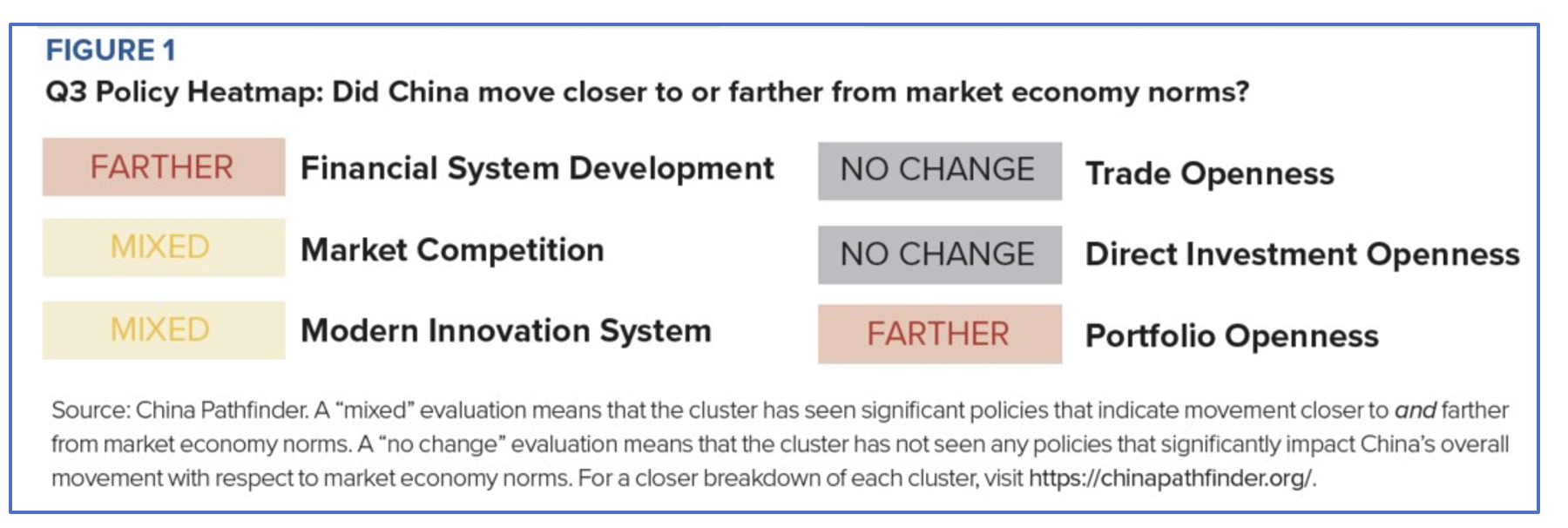
• Rhodium Group “China Pathfinder: Q3 2021 Update”
In Q3 2021, Chinese authorities were active in regulating/cracking down on four of six economic clusters that make up the China Pathfinder analytical framework—financial system development, competition policy, innovation, and portfolio investment openness— with fewer developments in the trade and direct investment openness clusters. In assessing whether China’s economic system moved toward or away from market economy norms in this quarter, our analysis shows a mixed-to-negative trendline.
JAPAN:
• War on the Rocks “Japan’s Revolution on Taiwan Affairs”
The most important development for Taiwan’s security might be unfolding right now in Japan. Tokyo’s strategy toward Taiwan is dramatically shifting. Once reluctant to join all but the most anodyne of pro-Taiwan statements with the United States, Japanese officials now increasingly state their desire to “protect Taiwan as a democratic country.” But what does that actually mean? How far will Japan go to stand by this statement?
EU & UK:
• Fortune.com “Not Just Meatballs and DIY Furniture: Ikea Could be Your Next Renewable Energy Supplier”
The world's largest furniture retailer has for decades been a temple of flat-pack bookcases, cook wear, linens, and Swedish meatballs. But in the future, the home goods supplier is planning to take home basics to another level—as a renewable energy supplier.
• The Economist “Last of the Commies”
Even though the Berlin Wall fell in 1989, local politics, force of habit and canny strategy help Europe’s communists cling on.
• Australian Strategic Policy Institute “Why Won’t Eastern Europeans Get Vaccinated?”
In recent weeks, as Europe has again become the global epicenter of the Covid-19 pandemic, the surge in coronavirus cases, hospitalizations and deaths has highlighted the continued vaccine hesitancy of one group of Europeans in particular: those in the formerly communist east. While 75.6% of European Union citizens are fully vaccinated, the share in Bulgaria is 26.2% and it’s 39.6% in Romania. In countries outside the EU, the numbers are even bleaker. Only 20.2% of Ukraine’s population, and 36.3% of Russia’s, are fully vaccinated.
RUSSIA/BELARUS/UKRAINE:
• Der Spiegel “New Details Shed Light on Lukashenko’s Human Trafficking Network” Insiders reveal fresh details about Belarusian dictator Alexander Lukashenko's inhumane smuggling system, comprised of a network of front companies that spreads to Syria, Turkey and Iraq, secret money transfers and the use of soldiers as traffickers.
LATIN AMERICA:
• War on the Rocks “I have Other Data”: the Guardia Nacional and the Entrenchment of Mexico’s Militarization”
On July 5, 2021, journalist Jorge Ramos laid a scathing critique at the feet of Mexico’s president, Andrés Manuel López Obrador. In a morning press conference, Ramos accused the president of misleading the public by claiming Mexico was “a country at peace.” Ramos pointed to data collected throughout AMLO’s presidential term: The homicide rate in 2020 was 29 deaths per 100,000 citizens, a death-per-capita rate higher than at any point in Mexico’s recent history —despite AMLO’s declaration that the war on drugs was over, his pledge to remove the military from the streets, and his campaign promise to end violence through a series of social and economic reforms he marketed as “abrazos no balazos” (hugs, not bullets). In the wake of continually rising violence, Ramos bluntly said the data reflected that AMLO had not made good on his campaign rhetoric. Then he asked the president if abrazos no balazos was a proven failure. AMLO somewhat dismissively replied, “I have other data.”
• Americas Quarterly “Kast and Boric: Explaining the Chilean Paradox”
Chile’s presidential runoff will now be a race to the middle, as most voters want change but not radicalism. Can either candidate deliver?
• Center for Strategic and International Studies “The Development of the ICDT Landscape. In Mexico: Cybersecurity and Opportunities for Investment”
Mexico’s information and communications technology (ICT) sector has witnessed increased competition and investment since 2013’s landmark regulatory reform, which created the Federal Institute of Telecommunications (IFT). Despite the failure of the presidency to push forward with the regulatory opportunities, the sector continues to be a promising one.
UNITED STATES/CANADA:
• National Bureau of Economic Research “Pandemic Schooling Mode and Student Test Scores: Evidence from the US States”
There have been a lot of questions of the impact of COVID on students and learning. The NBER has just released a study looking at Spring 2021 finding the pass rates declined compared to prior years and that these declines were larger in districts with less in-person instruction. Passing rates in math declined by 14.2 percentage points on average; we estimate this decline was 10.1 percentage points smaller for districts fully in-person.
• Interesting Engineering Magazine “Can the US Upgrade Its Infrastructure to Defend Against Drone Attacks?”
In a first-of-its-kind attack on U.S. soil, a drone was used to attack an electrical substation in Pennsylvania in 2020. While the location of the attack wasn't revealed, a new document from the FBI, Department of Homeland Security, and the National Counterterrorism Center are in circulation with U.S. law enforcement agencies, according to a recent New Scientist report. And it turns out we may need an infrastructural overhaul to defend against drone attacks.
• Fulcrum Macro’s Study of US Politics Chart of the Week:

GREATER MIDDLE EAST:
• Brookings Institution “Is Hezbollah Overplaying its Hand Inside Lebanon?”
Lebanese Hezbollah’s role as an Iranian proxy and its provision of significant assistance to its allies in Syria, Yemen, and Iraq has been an area of justified focus for policymakers in many capitals but the organization’s evolving role inside Lebanon merits equal attention. While it is customary to characterize Hezbollah as a “state within a state,” it is more accurate now to define it as a “state within a non-state,” - a devolution of the country largely due to their policies and actions - in view of the sheer inability of the Lebanese government to deliver even the most basic services to a desperate population plunged into its worst economic crisis in over a century.
• Human Rights Watch “Afghanistan: Taliban Crackdown on Media Worsens”
Since the US military withdrawal, Taliban crackdowns on women, media, education, etc. have intensified. This report shares research on how tough the crackdown has become on the local media. One example: One Afghan broadcaster, after a news report, was told by his provisional governor if he ever talked about the subject again “He would find himself hanging from the public square.”
AFRICA:
• Foreign Policy Research Institute “The Time is Right for a US Pivot to Africa”
The author argues President Biden cannot make the previous administration’s mistake of viewing Africa as a battlefield for competition with China and Russia. Instead of playing catch-up to China, Russia, and others, the US should surpass the initiative they have taken in Africa, spot new opportunities, and help make the difference between a green and prosperous future as greater Sub-Saharan Africa is showing tremendous opportunity.

Energy/Climate Change
• Financial Times “Nuclear fusion: Why the race to harness the power of the sun just sped up”
Advances in technology and funding have sparked optimism in an area that has promised much but delivered little in six decades.

Reading Around the World November 19, 2021
Please find our recommended weekend reads covering key issues and events around the world. We hope you find these informative and useful. And please let us know if you want us to add anyone to our mailing list.
Global Issues:
· Bank for International Settlements “Bottlenecks: Causes and Macroeconomic Implications”
The BIS takes a deep dive into the ongoing supply chain crisis and the longer-terms economic implications.
· The New Yorker “How the Week Organizes and Tyrannizes Our Lives”
The Harvard professor and noted author Jill Lepore writes about how our lives – from work schedules to TV seasons to baseball games – has been built around and dominated by the seven-day cycle. She asks the pointed question: Will we ever get rid of it?
· International Monetary Fund “Forecasting Social Unrest: A Machine Learning Approach”
The IMF produced a social unrest risk index for 125 countries from 1996 to 2020. Here, the IMF uses a machine learning model drawing on over 340 indicators to correctly forecast unrest in the following year approximately 2/3 of the time.

· Bloomberg “What’s Wrong with ESG Investing as Explained Through the Medium of Ohio”
No one can quite agree on where companies stand when it comes to the trifecta of ESG concerns — environmental, social and governance — that has morphed into a responsible investing craze worth trillions of dollars. In fact, a quick tour through Ohio — once a major Midwestern manufacturing capital before falling into ‘Rust Belt’ status in the 1980s as factories shifted abroad — can give us a peek into the failure of socially-responsible capitalism to improve society.
China:
· Fortune Magazine “China Launched the New Beijing Stock Exchange to Fund Small Businesses – But it May also ‘Cannibalize’ Existing Bourses”
China’s new Beijing Stock Exchange (BSE) officially opened for business on November 15th in a bid to shore up support for homegrown small to medium-size enterprises (SMEs) during a time of slowing economic growth. But will it have a opposite effect by moving existing listings from other Chinese exchanges?
· Foreign Affairs “China’s Search for Allies: Is Beijing Building a Rival Alliance System?”
China has shied away from formal alliances, based on its supposedly distinct view of international relations and a pragmatic desire to avoid the risks of entanglement. But there are signs that Beijing’s resistance is starting to erode as in recent years it upgraded its strategic partnerships, expanded military exchanges, and joint exercises with various countries – much to the alarm of the US and other countries.
United States:
· War on the Rocks Podcast “Richard Haas is Unhappy”
The podcast looks at and discusses Council on Foreign Relations Richard Haass’ critique of “Washington’s new flawed foreign policy consensus” and laments the bipartisan turn away from the mostly internationalist spirit that has informed U.S. foreign policy since the end of the World War II. Is he right? Does such a consensus exist? And does that explain why successive U.S. presidents seem so skeptical of internationalism?
· Pew Research Center “Where Americans Find Meaning in Life has Changed Over the Past Four Years”
Many things have changed in the United States in the past four years, from a new administration in Washington to the COVID-19 pandemic. Pew has conducted surveys which have revealed six facts about where Americans find meaning in life and how those responses have shifted over the past four years. The analysis also examines how attitudes in the U.S. compare with those in 16 other advanced economies surveyed by the Center in 2021
· The Heritage Foundation “US Military Strength: An Annual Assessment”
Having been engaged in warfare for more than 20 years, many wonder what the strength of the US military is now. The Heritage Foundation provides an expansive overview of strengths and weaknesses, broken down by regions globally.
· Morning Consult “The Private Sector and Federal Government have Begun the Push for 6G Broadband. Much of the Public is Still Behind on 5G”
In a new poll, at least 7 in 10 adults who don’t have a 5G phone said they would not be willing to pay more for one with those capabilities.

Latin America:
· Americas Quarterly “Was the COP26 A Good Deal for Brazil?”
Carbon credits for fighting deforestation were left in flux at Glasgow — but they could be key for the climate and Brazil’s economy. And markets are looking closely at how this will evolve.
· Center for Strategic & International Studies “Panama’s Maritime Business and the Evolving Strategic Landscape”
Panama’s maritime business is being transformed by a number of factors. These include the growing U.S.-China competition in the region, U.S. policies to contain immigration from the Northern Triangle, technology trends, evolution of regional infrastructure, and the restructuring of the maritime shipping industry itself. Demand for the canal and associated ports will likely remain strong, but the composition of that traffic, the routes, the operators, and the role of complementary and competing facilities elsewhere in the region will likely transform dramatically in the coming generation.

EU & Russia:
· Foreign Policy “Even Sweden Doesn’t Want Migrants Anymore”
Sweden’s generous response to the 2015 refugee crisis may have permanently dented its moral worldview.
· Rand Corporation “Analysis of Russian Irregular Threats”
Russian President Putin has been able to exert greater influence globally by deploying a variety of irregular methods – indeed, threats – ranging from information warfare, political subversion, and the use of violent proxies. Rand presents an in-depth study of what exactly those threats are and how they are used.
· European Council on Foreign Relations “Russia’s Military Movements: What They Could Mean for Ukraine, Europe, and NATO”
Russia is mobilizing its forces, but much more covertly than in the past. Moscow’s belief that the EU and US will not step in to protect Ukraine could lead it to take direct military action.
Africa:
· Institute for Security Studies “Climate, Energy, and the African Dilemma”
Fossil fuels and mineral wealth are pivotal to Africa’s geopolitical positioning and strategic importance. With the recent COP26 commitments, how will Africa square a possible large circle?
Middle East:
· The New Statesman “How a Hezbollah-backed Game Show Host Cost Lebanon its Rich Gulf Allies”
George Kordahi’s remarks enraged the Saudis, and ordinary Lebanese are paying the price.
· Brookings Institution “Is Hezbollah Overplaying Its Hand Inside Lebanon?”
Lebanese Hezbollah’s role as an Iranian proxy and its provision of significant assistance to its allies in Syria, Yemen, and Iraq has been a focus for policymakers in many capitals. But the organization’s evolving role inside Lebanon merits equal attention – especially with their sheer inability to help deliver even the most basic services to a desperate population plunged into its worst economic crisis in over a century.
India:
· Foreign Policy “India Needs a Big Nuclear Bet to Keep COP26 Promises”
Indian Prime Minister Narendra Modi drew attention at COP26 when he said India plans to reach net-zero emissions by 2070. But if Modi wants to prove that he’s actually committed to the target, there’s only one way to pull it off: nuclear power.
Japan:
· Council on Foreign Relations Why It Matters Podcast “Japan’s Population Problem”
The U.S.-Japan alliance is at the heart of U.S. security in Asia, and some consider Japan to be the United States’ most important ally. But Japan’s population is aging, and its birth rate is on the decline, a problematic trend given that population size has historically equated to power. Now, the future of the countries’ economic, military, and governance partnerships could be at stake.

Book of the Week: Isolationism - The history of an enduring American Ideology

Isolationism has been at the center of national policy since the founding of the United States. Most of us are familiar with President George Washington's Farewell Address in 1796 when he warned America "to steer clear of permanent alliances with any portion of the foreign world."
Of course, as American history has born out, US foreign policy has swung back and forth ever since, leading the nation into world war and a host of smaller military actions of various degrees of success or failure. Charlies Kupchan has written an important book memorializing the history of isolationism in American policymaking.
What I find remarkable about isolationism - and as Kupchan very ably points out in his book - is the staying power of isolationism as an ideology during the course of American history. Conversely, one could argue, we also see the staying power of an ideology of heavy engagement, of being the world's policeman, and of nation-building. It is not going away anytime soon and with the recent tragedy and leadership failures on how to withdraw from Afghanistan, we are likely to enter a new period of rigorous debate over isolationism. Kupchan's book is a highly useful if not indispensable guide to understanding the historic implications of isolationism.
NBC’s Latest Presidential Polls: A Giant Slide
NBC News release today new polling data on President Biden’s approval ratings overall and his handling of Afghanistan, COVID, and the economy. In short, these numbers are, to be blunt, brutal - especially his handling of the Afghanistan withdrawal. While most observers say this will have little impact on his ambitious domestic agenda this fall, I think it may be too early to make that call. Let’s see where these numbers are a month a month from now:


Afghanistan’s Massive Migration Problem
As the Taliban consolidate power in Afghanistan, its citizens are now on the move to flee the violence and despotic rule. The Financial Times shows the initial estimates of movement.. The next big issue will be how many of them make a move to get to the EU, potentially setting off another immigration crisis like we saw in 2015.


Wall Street’s Prudent Powerhouse
Wall Street both fascinates and repulses we Americans. The glowing power and the staggering flows of money, its ability to shape or destroy not only industry but entire countries. As a result – and depending on economic and social conditions – we have had a long episodic relationship with our financial titans, at times adulating them, at times seeing them as the fonts of all corruption and needing to be broken apart and controlled like dangerous animals.
We are vividly reminded of this odd and uneven relationship in Zachary Karabell’s richly absorbing and truly fascinating new book, “Inside Money: Brown Brothers Harriman and the American Way of Power . Using the long, storied history of Brown Brothers Harriman and its two antecedent firms, Brown Brothers and H.E. Harriman, we give both a grand and at times poignant tour of American finance and the massive role it has played in building our nation. Moreover, as a critical sub-theme of his book, we are shown that not all Wall Street investment houses of uncontrolled greed and fiscal imprudence. Case in point: Brown Brothers Harriman.
Of the two firms, Brown Brothers is the oldest, tracing its history back to late 1700’s Ireland where we find Alexander Brown launching a successful business as a linen merchant. But Ireland was a troubled place then and, as a result of the Irish Rebellion of 1789, Brown was forced to flee the Emerald Island for Baltimore, Maryland with his wife and his youngest son (the three elder ones being in schools in England) to re-launch his firm. Baltimore was at that time the major trade port in the US, as southern states sent their goods north as well as Europe while in return being voracious consumers of fine Irish linen.
Brown was soon joined by other sons and within a few years had dispatched them to set up outposts in Philadelphia, New York, and Liverpool, England. As the years rolled by, Brown Brothers became a major – if not a dominant - financial force in the young United States and England, expanding beyond linen to corporate finance including sponsoring the first initial public offering in the US in 1808.
Yet – and here is that persistent sub-theme of the book - Alexander Brown did not let the business grow too fast. Prudence was the order of the day, every day for Alexander Brown. He demanded this of his sons in numerous letters preaching careful analysis of any new business proposition. Greed and ostentatious living were the greatest sin a Brown could commit, and, in its place, he demanded a strong sense of service to community and nation. As Karabell carefully documents, it seems Brown Brothers declined more opportunities than embraced which resulted in the firm not only surviving but thriving through numerous economic and financial crisis’ in the first half of the 1800s. These crises created the Progressive firebrands of the day, the biggest and most powerful being President Andrew Jackson who denounced the big financial firms as being a relic of “nobility systems that enabled a few and rich intelligent men to live upon the labor of many.”
It is not until the latter half of the 1800’s that we meet E.H. Harriman. Born in 1848 the son of an Episcopal pastor, Harriman was a slight, slender man who – to the horror of his father - abandoned schooling at the age of 14 to work as a runner for a New York brokerage. He was a keen learner and showed a genius for finance which, at the age of 34, he unleashed by making his first big acquisition: The Illinois Central Railroad. America was rapidly expanding West and the “iron horse” was the greatest and fastest way to make that expansion happen. Harriman’s acquisition instantly become a national railroad baron. (Interestingly and conversely, Brown Brothers took a hard pass on investing in railroads, believing it too speculative and not prudent). Despite that slight physique, Harriman proved to be an extraordinarily steely businessman. The author offers a fantastic look into how Harriman soon took on legendary financiers/railroad barons J.P. Morgan and Jacob Schiff (head of Kuhn, Loeb & Co., the forerunner of Lehman Brothers), beating them at their own game and bending them to his vision.
E.H. Harriman was now a major financial power, and it was not long before the two firms of Brown Brothers and H.E. Harriman were working in tandem on bond deals not only in the US but in Latin America and across Europe. But Harriman, like Alexander Brown, was a man also reliant on prudence to build out his business. Despite plunging into the go-go, boom-or-bust world of railroads at the time, it was his prudent, careful management of business that made him a success, and which ultimately won him the support of Morgan and Schiff. And, like Alexander Brown Harriman produced and carefully cultivated and trained heirs to join him at the firm and eventually succeed him: Averell and Roland.
Averell would, of course, go on to be Governor of New York and something of a legendary diplomat. He was the big idea guy, less so the day-to-day manager type. That was Roland’s forte. A prudent (there is that word again) and a strong manager who helped assemble a team of brilliant bankers who shared a nose for smart, careful yet financially rewarding deals.
The rise of Averell and Roland as leaders of H.E. Harriman in the 1920’s brought the most natural alignment with the men leading Brown Brothers. The bond was school, specifically Yale University where they all seemed to be members of the elite Skull & Bones Society or other elite societies and where their friendships for life were bonded and marriages even made them relatives (Alex. Brown in Baltimore along with the other affiliate set up in Liverpool nearly a century before, Brown Shipley, had effectively split off decades before due to US tax law changes).
It is here that Karabell demystifies – and also confirms – the clubby world of early 20th century Wall Street. Indeed, the belief in the US at that time that “…a small clique of elites pull[ed] the strings…usually centered on coastal elites that the Browns and Harriman’s epitomized” was strongly held by much of the country. In 1930, that opinion only grew as the boys from Yale were not only financing the biggest companies in America, quietly making big fees despite the stock market crash and resulting Great Depression but were now going to merge.
And where and how was the merger arranged? On a private train going from New York to New Haven, Connecticut to attend the Yale football homecoming game. Of course. Over fine scotch and good cigars, they worked out the details, smoothly bringing together the great financial houses into one. The result would have a much bigger impact on US and world history: The merger elevated a young Prescott Bush – father and grandfather to future US Presidents – as leader of the combined firms.
Today, the firm’s history and culture speak for itself. Yet, in today’s modern financial world, Brown Brothers Harriman stands as a stark anomaly to other firms. Too many on Wall Street, it is somehow seen as shrinking, fading business. But this is factually incorrect. It is still run as a partnership, having eschewed the big money the other large firms grabbed via listing themselves on the stock market. It is indeed a successful firm, and it is successful in the businesses it has chosen to pursue. Moreover, unlike virtually every other large investment bank and brokerage, Brown Brothers Harriman is never in the news, never engulfed in intense regulatory scandals that has hit every big-name financial house over the course of the last 30 years.
Karabell argues that over the years we seem to have quietly changed the definition of capitalism and what constitutes success in financial markets. “In what universe does surviving and thriving for over the course of more than two hundred years constitute failure? In what healthy system does never becoming too big to fail get judged negatively? Why is sustaining a culture that shuns the spotlight and remains both viable and modest not valued, while becoming a behemoth is celebrated and reviled? Why is Michael Milken a parable, while Brown Brothers a faint echo?... Over the centuries, they [Brown Brothers Harriman] made considerable money, and much of that money made America. For two hundred years, the firm stuck to its last.”
Karabell is spot on in his challenge, one all of today’s titans of Wall Street should pause to consider as we enter a rapidly changing and increasingly turbulent world.

American Institute for Contemporary German Studies: A Reflection on German Chancellor Angela Merkel’s Impact on the Global Economy
Eighteen years ago in Berlin, I attended a business reception at the Staatliche Museums. As I chatted with a small group of German CEOs, I was introduced to the then opposition leader, Angela Merkel…
Note: the following is a contribution to an anthology of views collected by the American Institute for Contemporary German Studies (AICGS) as German Chancellor Angela Merkel prepares to step down as Germany’s leader after more than 6 years in office.
Eighteen years ago in Berlin, I attended a business reception at the Staatliche Museums. As I chatted with a small group of German CEOs, I was introduced to the then opposition leader, Angela Merkel. She was then as she is now: subdued, hands clasped together with her intense gaze sizing up whomever she was talking to but also with that smile that radiates a genuine warmth and deep emotional intelligence. I was charmed as she asked me a few incisive questions about the political situation in Washington at the time before quickly moving on to greet another cluster of business leaders.
When she was out of earshot, one of the CEOs quietly explained to me – while all the other CEOs heads bobbed up and down in agreement -- “She is likely going to be the next Chancellor but I don’t know how long she will last. She really doesn’t understand global markets or the big economic issues.” Flash forward to today: Each of those CEOs is gone and she is still Chancellor, having guided Germany, the European Union and, in a real way, the rest of the world through the largest global economic challenges and crises of the last century.
Chancellor Merkel is nothing if not a superb crisis manager: From the global financial crisis of 2008 which led to the sovereign debt crisis that gripped the Eurozone, to the storm of Brexit, she handled them all. Having sat in a large global investment bank through all this tumult, I can attest it was Merkel’s constantly calm yet steely demeanor that assured the markets – the very markets those CEOs had told me she really did not understand – that she had a firm grasp on each of these situations and somehow, some way, she knew how to solve them.
So, without doubt, the legacy of Merkel’s global economic crisis leadership is assured. Looking to the future, first and foremost the question is how will Germany and the EU deal with China. Merkel has uniquely stood out in her efforts to develop stronger trade relations with China, but understands (and hopefully whoever her successor does as well) that it is not a one-way street with China. It desperately needs what Germany’s advanced industries have to offer. And that gives Germany leverage to push China to turn away from their vile human rights policies as well as more fully respect international trade rules. It will be critical for Merkel to set the tone on how to tackle the China challenge for her successors.
Closer to home, her crisis management achievements include her careful navigation through the always chaotic and occasionally minacious Trump Administration’s trade policy toward the EU in general and Germany in particular. Many in the business community today worry that we risk the election of a Republican to the White House in four years who quickly begins echoing the Trump EU trade policy. The simple fact is the Biden Administration can only do so much to try to assure businesses on both sides of the Atlantic that will not happen. What Chancellor Merkel says and does now will ultimately be that most critical assurance sought by business.
I have no doubt history will deem her leadership as extraordinary by any measure – particularly her global economic leadership. What I do fear, however, is we will all acutely best understand just how powerful and impactful she has been when she is gone from office and the next crisis is upon us. That is when those former CEOs I stood with eighteen years ago and their many successors will hail Chancellor Angela Merkel as having positively led the global economy like very few other world leaders we have seen in more than half a century.
Subscribe to our newsletter.
Sign up with your email address to receive news and updates.