

October 16 - 18, 2026
The Crumbling of European Defenses, China Helps Russia Bust Through Sanctions, Navigating Geoeconomic Risk in the Stock Market, and Chasing El Dorado: Gold During Geopolitical Shocks
Below are various reports and articles we read this past week that we found particularly interesting. Hopefully, you will find all or at least some of these pieces of interest and useful. Have a great weekend.
NATO, Failing Russian Sanctions, and the Future of EU Trade Policy
The Crumbling Defense of Europe Franklin Miller, Eric Edelman, and Walter Slocombe/Foreign Affairs
The United States appears ready to pull much of its military from Europe. The Trump administration’s 2025 National Security Strategy, a key policy document, declared that it was time for the continent to “stand on its own feet” and take “primary responsibility for its own conventional defense”—or, put differently, that it needs to get ready for when Washington withdraws. At a June 2026 meeting of NATO’s defense ministers, U.S. Secretary of Defense Pete Hegseth announced that the Pentagon was “moving fast and irreversibly toward Europe stepping up to take primary responsibility for the defense of Europe.” Two months later, in August, U.S. Undersecretary of Defense Elbridge Colby said that NATO would transition to what he called “a stronger, more equitable and sustainable alliance,” or one in which the continent would do most of the work of defending itself.
The administration followed up by sending a questionnaire to all NATO allies, seeking to elicit whether they were aligned with President Donald Trump’s policies and priorities; unspoken was the clear threat that those who were not would face decreased U.S. support. Purportedly, the Pentagon is working on a study to determine the optimal level of U.S. forces in NATO, but it is clear that the study’s task is merely to provide a cover story for the course already chosen by Trump, Hegseth, and Colby. To Trump and his officials, withdrawing from Europe makes perfect sense. The continent, they argue, is rich and powerful enough to fully defend itself. Washington, meanwhile, must spend its military resources on growing challenges in Asia and the Middle East.
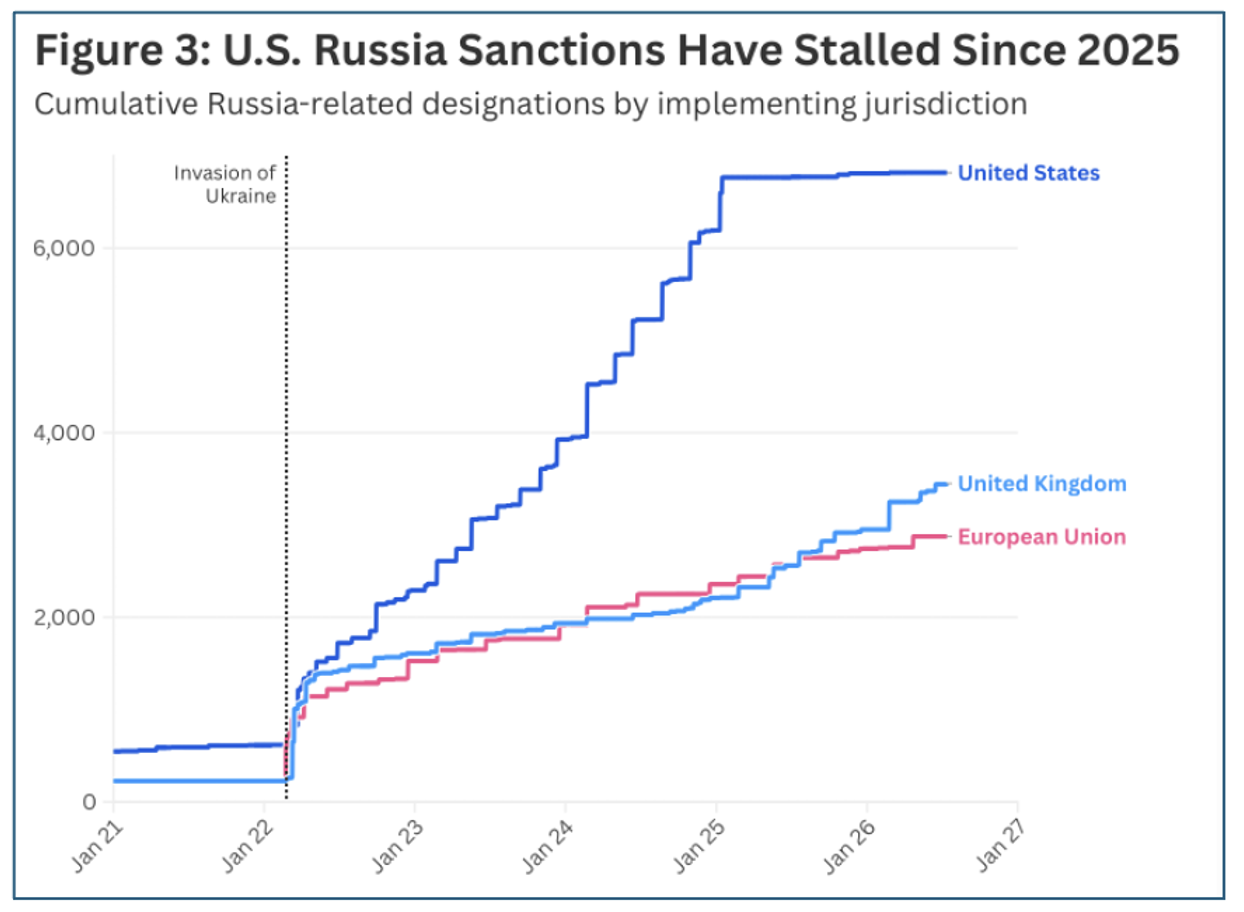
Russia’s Turn to China Under Sanctions: Sanctions Decay, Substitution Elasticity, and the Challenge of Sustaining Pressure Damien Spleeters/Center for Strategic and International Studies
In May 2026, Ukraine’s sanctions commissioner, Vladyslav Vlasiuk, offered an apparently encouraging assessment of export controls. Standing beside components recovered from Russian missiles and drones, he described the forced shift from some Western components to Chinese alternatives as evidence that sanctions were working. In the same briefing, however, he noted that Russia’s use of missiles and drones had increased compared to the same period a year earlier. Both observations, reported by the Office of the President of Ukraine, can be true. Controls may displace Western components and impose real costs without sufficiently reducing Russia’s ability to produce and deploy weapons. That tension exposes a central weakness in the way sanctions and export controls are often evaluated. A reduction in Western components is treated as success, while the appearance of Chinese substitutes is treated as a secondary problem. But if the targeted capability survives, production continues, and investigators lose visibility into the new supply chain, the result may be less decisive than the component count suggests.
A divided southern flank faces Trump 2.0 and NATO 3.0 Bruno Cardoso Reis/Brookings Institution
The Trump administration and some Northern and Eastern European allies have criticized southern NATO members for not taking the Russian threat—and the demands of alliance solidarity—seriously. This criticism matters more as NATO becomes, in Secretary General Mark Rutte’s words, “more European”: a “NATO 3.0” in which European allies are expected to do more while the United States does less. Yet every NATO member on the southern flank has increased defense spending since 2016, and even more since 2022. Even Spain, the only member to resist NATO’s new target of spending at least 5% of GDP on defense and defense-related investments, has nearly doubled defense spending as a share of GDP since 2022, despite Prime Minister Pedro Sánchez’s public defiance of U.S. President Donald Trump. The focus on how much southern NATO members spend, however, risks obscuring a more important question: how effectively are they contributing to regional security?
A French-German non-paper could be a turning point in EU trade defense The Atlantic Council
France and Germany this week released an informal diplomatic document known as a non-paper that could redirect the continent’s approach to trade. Released just days before EU Trade Commissioner Maroš Sefčovič touched down in Beijing for talks with his Chinese counterpart and a week before EU leaders were slated to debate potential new protective measures, the paper urges the EU to strengthen its trade-defense, economic security, and industrial-policy toolbox in response to global imbalances and market distortions. Though unspecified, the context is clear. The EU’s trade deficit with China reached an estimated one billion euros per day in 2025, making Beijing the most obvious target. But the paper’s country-neutral language leaves open how broadly the tools could be used, and against which trading partners. The fact that France and Germany are making the case together is itself significant. Just two years ago, the EU imposed anti-subsidy duties on Chinese electric vehicles (EVs) of up to 35 percent. These duties were the outcome of a long-established investigative process sanctioned by the World Trade Organization (WTO) aimed at countervailing WTO-inconsistent subsidies.
Understanding Geopolitical Shocks to Stock Markets, Gold, and Oil
·Navigating Geoeconomic Risk in the U.S. Stock Market Matteo Crosignani, Lina Han, and Marco Macchiavelli/Federal Reserve Bank of New York
Geoeconomic risk—the risk that firms incur valuation losses when countries deploy economic, trade, or financial leverage for geopolitical aims—has become a first-order concern for investors. In this post, based on our recent Staff Report, we document that domestic U.S. stocks expose investors to substantial geoeconomic risk through firms’ global supply-chain relationships, affecting investors’ returns and portfolio allocation. We also find that investors are compensated for bearing geoeconomic risk through higher risk premia.
Chasing El Dorado: Gold Under Shifting Geopolitical and Financial Conditions Rafael Guerra and Gabriel Zelpo/Bank for International Settlements
Abstract: This paper analyses the state-dependent effects of geopolitical risks on gold prices (i.e., the safe-haven role of gold), conditional on financial conditions. Geopolitical risks are often associated with tighter financial conditions. However, recent data reveal a decoupling between such shocks and more restrictive financial conditions, raising the question of how gold returns are affected by geopolitical shocks, conditional on the macro-financial environment. Using monthly data from 1990 to 2026, we find that increases in geopolitical risks – both geopolitical threats and realized events – increase gold returns, with stronger effects observed during periods of loose financial conditions. We decompose this relationship into two mechanisms: (i) the credit and liquidity risk channel and (ii) the opportunity cost channel. Our findings indicate that the relationship operates most clearly through the first channel, suggesting that the key factor is investors’ capacity to rebalance, while the evidence for the second channel is less conclusive. Finally, we also find that the largest impact occurs when loose financial conditions coincide with periods of geopolitical escalations, as seen in 2024–26. These insights highlight the relevance of understanding gold as a safe-haven asset amid complex macro-financial conditions.
From Importer to Exporter: Oil Shocks and the U.S. Economy Diego Känzig, James Stock and Luca Zanotti/National Bureau of Economic Research
U.S. crude oil production rose from about 5m barrels per day in the late 2000s to nearly 14m by 2025, turning the country from a major petroleum importer into a net exporter. The authors estimate that adverse oil supply news shocks, which once contracted industrial production, now expand it. The US shifted from a large net oil importer to a net exporter around 2010. Computing separate impulse responses pre-and post-2010, Känzig, et al find that adverse global oil-supply news switches from reducing U.S. industrial production to raising it by a similar magnitude.