

Fulcrum Perspectives
An interactive blog sharing the Fulcrum team's policy updates and analysis.
Recommended Weekend Reads
Can Latin America Become a Data Center Powerhouse? The Investment Frenzy in Paraguay, What’s The Matter with France? And How the Truth About Living on $11 a Day May Surprise You
October 9 - 11, 2026
Below are various reports and articles we read this past week that we found particularly interesting. Hopefully, you will find all or at least some of these pieces of interest and useful. Have a great weekend.
Latin America
Brazil’s Right Will Have Power Beyond the Presidency Americas Quarterly
The surprise results of Brazil’s general election on Sunday revealed a country where the right will increasingly set the terms of politics, regardless of who wins the presidency on October 25. The country’s right has built a broader base across institutions, sharing Trumpism’s ability to mobilize political identity but depending less on a single leader’s authority. Across Latin America, right-wing leaders have struggled to translate electoral mandates into governing power or concentrate that power around themselves, and in Brazil, this reality is about to be tested.
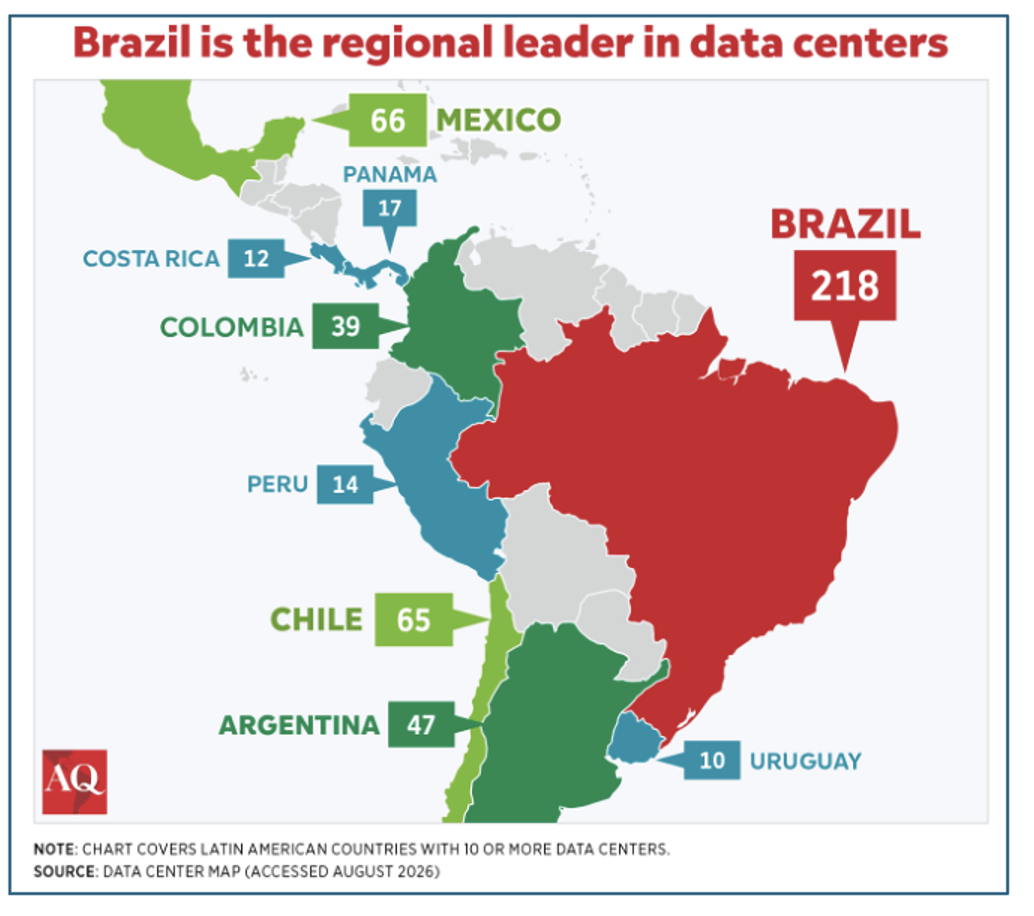
Can Latin America Become a Data Center Powerhouse? Andres Oppenheimer, “CNN’s Oppenheimer Presenta”
Argentinian President Javier Milei told the author that “data centers will generate a phenomenal acceleration of economic growth” in his country.. A few months after our interview, Milei doubled down in a Financial Times op-ed, announcing that he had submitted a bill to establish a new legal framework for AI that includes “a commitment to keep AI unregulated.” The proposed legislation even includes a headline-grabbing provision creating a new business category: “the non-human corporation,” for companies operated by AI agents. The momentum is real; the Inter-American Development Bank reported last year that Latin America is already experiencing “a significant boom in data center investment.” And as global demand for data continues to grow by about 20% annually, countries across the region are emerging as attractive tech hubs.
Financing Latin America’s long-term transition Sarah Molony/OMFIF
As a region rich in natural capital and sources of clean energy, Latin America has the potential to become a global leader in the transition to a sustainable economy. But for this potential to become a reality, countries in Latin America must address structural challenges to attract investment, close financing gaps and safeguard the region’s future. This was the impetus behind the Americas Transition Finance Summit, organized in Mexico City by OMFIF and Bolsa Institucional de Valores, Mexico’s institutional stock exchange. The two-day event brought together investors, banks, ratings agencies, corporates, multilateral development institutions and policy-makers to discuss how to unlock investment opportunities within the region and the policy and market architecture required to build credibility and attract capital.
The investment frenzy gripping Paraguay The Economist
After decades of steady macroeconomic management, the country has won a reputation for stability. Following a financial crisis in 2003, policymakers tightened fiscal policy, beefed up the central bank and tamed inflation, points out Alonso Chaverri Suárez of the Inter-American Development Bank. Ratings agencies have declared its debt to be investment grade, an accolade granted to only six countries in Latin America. Since taking office in 2023, Santiago Peña, the president, has set out to turn Paraguay into an export-oriented manufacturing hub. He has eased red tape and expanded the “maquila regime”, under which firms can import materials duty-free and pay only 1% tax on value added, making Paraguay attractive for manufacturers. Exports of goods such as car parts, clothing and textiles were 25% higher last year than in 2019 in real terms, helping propel economic growth to 6.6%. So far, investment has come mainly from domestic firms—expanding at home as confidence in the economy grows—and neighboring countries. Paraguay’s membership of Mercosur, a trade bloc with Argentina, Brazil, Bolivia and Uruguay, gives manufacturers tariff-free access to a market of more than 260m people. A trade deal between the bloc and the European Union should further boost exports. Manufacturers from Brazil and Argentina, facing higher taxes and heavier regulation at home, are shifting production across the border.
With U.S. backing, a democratic breakthrough in Venezuela may be within reach Atlantic Council Dispatches
Venezuela’s political opening may be entering a new phase: Delcy Rodríguez has pledged elections, while recent talks saw movement on judicial reform and civil liberties. But the government must show a public frustrated by years of authoritarianism and economic stagnation that commitments made will not be left at the table. Washington’s influence in Caracas has raised hopes among government and opposition figures that the next round of talks, expected in mid-October, can deliver more than past dialogues.
Europe
Euronomics: Rising global yields and the fiscal challenge for Europe Rolf Strauch/European Stability Mechanism Blog
This summer’s rise in long-term interest rates marks a sharp acceleration in the broader repricing of government bonds under way since late 2021. In the euro area, 10-year government bond yields reached nearly 4% on average in September 2026, their highest level in more than a decade. The synchronized rise in yields across major economies reflects global factors, which are changing expectations for monetary policy. At the same time, structural shifts in sovereign supply and investor demand could keep yields elevated or even push them to new peaks. The fiscal consequences are likely to emerge gradually and vary across countries as government debt is rolled over at higher interest rates. Highly indebted economies, particularly those with greater rollover needs, weaker fiscal positions, and lower growth prospects, are the most exposed. While governments cannot control the global forces pushing yields higher, credible fiscal plans, prudent debt management, and measures to strengthen potential growth can help prevent higher yields from translating into wider sovereign risk premia.
What’s the Matter With France? Paul Krugman, Krugman Wonks Out
The sharp rise in the price of credit default swaps on French government debt implies a 1.2% probability of default over the next 5 years, which Krugman thinks “is too low”, cautioning that “France may have crossed the line from too big to fail to too big to save.” France does stand out, even among fiscally troubled nations, in one main way: its persistent inability to get realistic about retirement. The official French retirement age — the age at which workers can collect full benefits — was only 62 in 2023. By comparison, the retirement age in Denmark was 67 (which is also the age in the U.S.). The average actual age of retirement, which is always lower than the statutory age because some people choose to accept reduced benefits, was lower in France than anywhere else in Western Europe. You don’t have to be a conservative to see France’s early retirement as unsustainable, especially given that French life expectancy at age 65 is about 87 years of age, 2 years longer than in the U.S.. France’s reliance on the euro means that it’s all too easy to see how this loss of confidence could turn into an ugly crisis.
Economics, Trade, and Crypto
Terra Incognita: The Economics of a Shrinking World Jesus Fernandez-Villaverde & Patrick Norrick/National Bureau of Economic Research
As of 2026, humanity is likely below replacement fertility. That has never happened before, not in wars or pandemics. But the real surprise is that the decline has been concentrated in low-and middle-income countries and among poorer, less educated women. We fit a single-factor model to 236 countries since 1950: the common component peaked in 1978, and what drives fertility down today are country-specific trends, 219 of them negative and not one leveling off. None of the commonly cited mechanisms can account for this pattern, so we offer a conjecture: modernity itself, which makes a third child expensive and childlessness cheap. Children come in integers, so it takes very little to move a cohort’s fertility rate from 1.8 to 1.3. And nothing in an economy pushes fertility back to 2.1. We close with the main economic consequences, in particular slow growth.
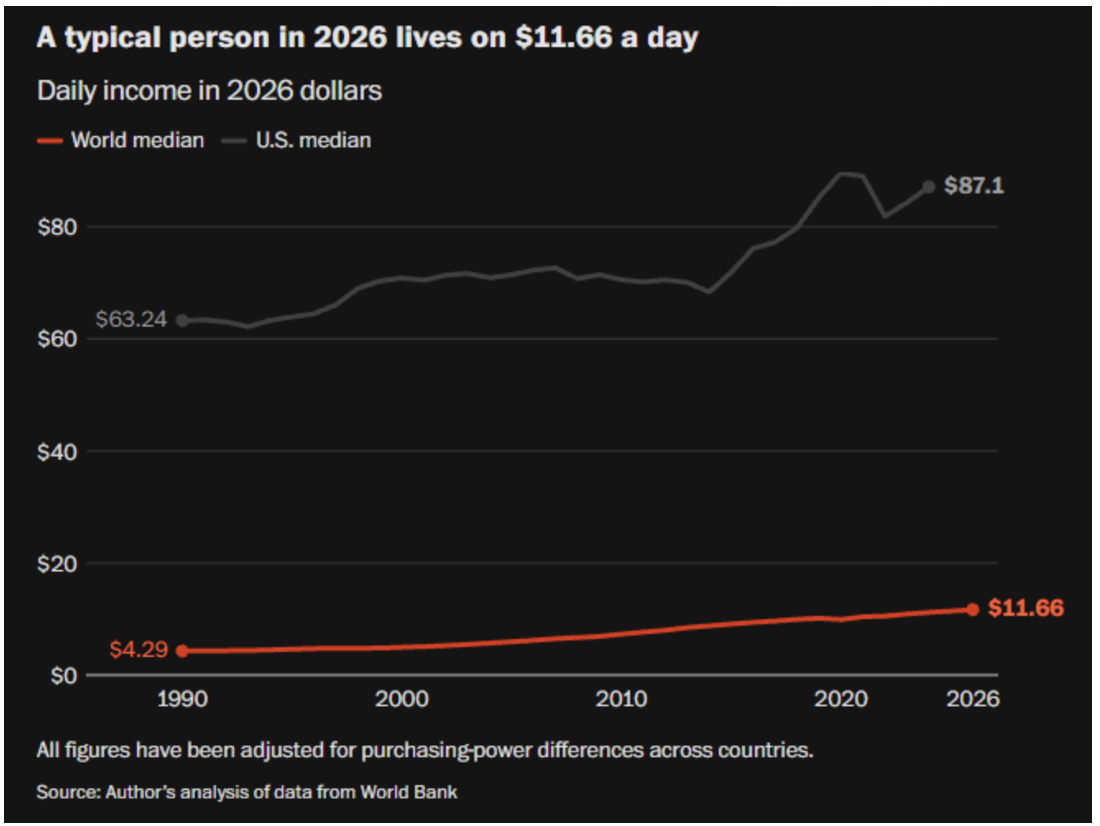
The Truth About $11 a Day Might Surprise You Jesus Fernandez-Villaverde/The Washington Post
In 1990, practically yesterday for an economic historian, the median person on Earth lived on $4.29 a day. Two centuries earlier, it was roughly $2 a day—a figure that had changed little for millennia. But in 2026, the median person lives on about $11.66 a day. That might not sound like much. After all, the median American lives on a much more robust $87.10 a day. But historically speaking, it represents an extraordinary level of prosperity. More important, the number of people living in extreme poverty, defined by the World Bank (not very generously) as less than $3.60 a day when adjusted to 2026 prices, has fallen from 2.3 billion in 1990 to 826 million in 2026, even as the world population has grown from 5.3 billion to 8.2 billion.
The Anatomy of Tariff Pass-Through into Consumer Prices Mary Amiti, Sebastian, Heise and David Weinstein / Federal Reserve Bank of New York
A trio of New York Federal Reserve Bank economists found in a recent study that a uniform 10% tariff raised consumer-goods prices 2.6% after 12 months: 1.7pp directly via imported final goods, and 0.9pp mainly via higher imported-input costs for domestically produced goods, with the latter effect building over 9–12 months.
Will U.S. Firms Adopt Stablecoins? Survey Says They’re Not Enthusiastic Federal Reserve Bank of Cleveland
The Cleveland Fed surveyed 148 firms about whether they had plans to use stablecoins. Responses were overwhelmingly negative, with only eight contacts expressing any such plans. Asked why they did not plan to use stablecoins, respondents cited satisfaction with existing payment methods, unfamiliarity with the new technology, and a lack of demand from clients and suppliers to pay using stablecoins.
Subscribe to our newsletter.
Sign up with your email address to receive news and updates.