

Recommended Weekend Reads
Are Central Banks Moving Out of Dollar Assets? China’s Great Power Vision Comes Into Focus, Bearing the Cost of the Global Trade Rebalancing, and How Merkel and Merz Lost East Germany
September 4 -6, 2026
Below are a number of reports and articles we read this past week and found particularly interesting. Hopefully, you will find them of interest and useful as well. Have a great weekend.
The Great Rebalancing
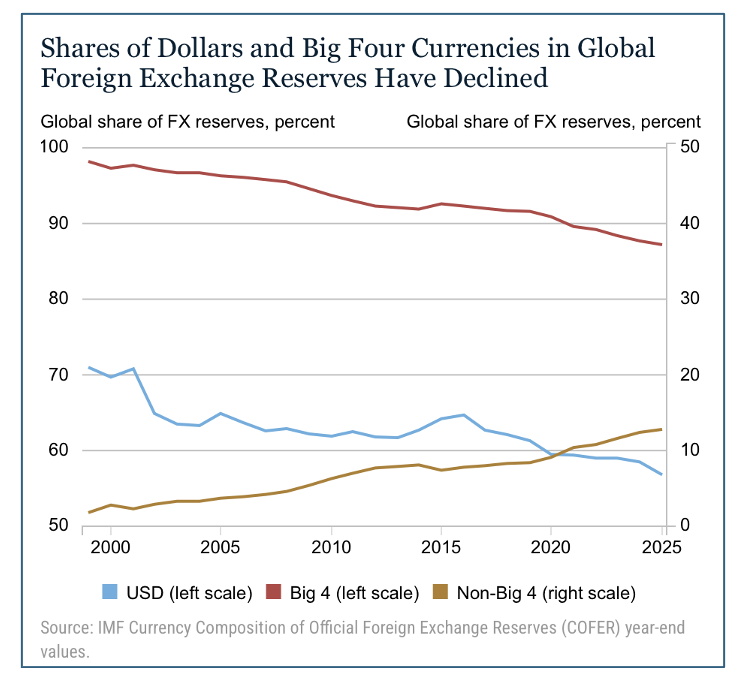
Are Central Banks Moving Out of Dollar Assets? Federal Reserve of New York’s Liberty Street Economics
The fall of the dollar’s share of global official foreign exchange reserves is sometimes read as evidence that the dollar’s role in international financial markets is eroding. However, the authors show that the aggregate decline is not a systematic global shift away from dollar assets. Rather, the aggregate decline reflects the actions of a handful of large reserve holders, changing both their currency preferences and the size of their reserve portfolio.
The Great Rebalancing: Who Will Bear the Costs of a Global Trade Adjustment? Michael Pettis/Foreign Affairs
The eurozone is the world’s third-largest economy and its second-largest source of demand; it has economic power at its disposal, but [likely not] the political ability to exercise this power, given its fragmented policymaking institutions and the often divergent interests of its member states. If the United States is able to reduce its trade deficit and expand its share of global manufacturing while China resists an equivalent contraction in its surpluses, a politically divided Europe could be forced to take on larger deficits almost by default. The costs could include deindustrialization, rising debt, and weaker growth. This process may have begun already.
China
China’s Great Power Vision Comes into Focus Ryan Hass/China Leadership Monitor
History may record the 2020s as the period during which China’s vision for updating the international political order came into focus. Chinese leaders and experts have laid their cards on the table, arguing that the era of “hegemonic politics” needs to be replaced by a new order that redistributes power away from its concentration in liberal democracies toward a more equal distribution among states, while protecting the inviolability of sovereign states to govern their populations as they see fit. Beijing views America as declining but dangerous. Rather than confront the United States in a contest for leadership, China is content to patiently accumulate power and influence until such time as the country becomes broadly recognized as leader of a new political order. Such an outcome is possible but not preordained. A core tension is whether China will match its expansive vision with a willingness to pay the costs of leadership. Rhetoric without the backing of economic resources is an expression of ambition, not a plan for realizing it.
Lost in Translation: Decoding Chinese Strategic Narrative Series - Turning the tide: China seeks to set the rules at sea Brookings Institution
China’s thought leaders see a window of opportunity to advance China’s maritime interests and assert greater leadership over international law of the sea on both a regional and a global basis. China’s legal activism is being paired with its increased operational maritime activism, especially in the South China Sea. But if China’s campaign is to be successful, China’s leaders will need to articulate a vision of international maritime law that is consistent, fair, and repeatable by other countries.
How Does the World Really View China? Adam Liu/Foreign Affairs
In July, the Pew Research Center found that for the first time in roughly two decades of global polling, the world now views China more favorably than the United States. The sentiment was not universal, but in 25 of the 36 countries surveyed this year, the percentage of respondents who gave favorable marks to China exceeded that for the United States, including several close U.S. allies. Some analysts have taken these findings as confirmation that the golden era of American soft power is over and China is ascendant. According to them, Trump’s policies on tariffs, aid, and allies have eroded the United States’ standing, opening the door for people across the world to switch their allegiance to China. But this interpretation, convenient as it may be, deserves more scrutiny. A closer examination of the data reveals that although global opinion of the United States has indeed plummeted and opinion of China has risen since 2022, most of the world still prefers the United States as an economic partner—including most of the countries that now view China in a more positive light. This is a critical distinction, since economic partnerships and interests tend to drive national policies. Indeed, it signals something more nuanced is happening than simply the end of American hegemony and an imminent age of Chinese global supremacy.
Europe’s Future and Germany’s Seminal Elections
How Merkel and Merz lost eastern Germany to the AfD PoliticoEU
East Germany formally dissolved in 1990, but it did not disappear. Its struggles for identity within the sprawling German federal system, with power concentrated in Berlin, have fueled the ascent of the far right. If the AfD does secure an outright victory this weekend, it will raise profound questions about how chancellors such as Helmut Kohl, Angela Merkel and Friedrich Merz failed to manage the post-unification transition and prevent large parts of the east from veering off on a political trajectory toward the far right.
What’s at stake for the AfD and Merz in Germany’s three September elections The Atlantic Council
State elections this month in Germany will almost certainly weaken Chancellor Friedrich Merz’s federal coalition and raise new obstacles to his promised reforms. Merz’s Christian Democratic Union (CDU) and his coalition partner, the Social Democratic Party (SPD) are facing significant losses in the three state elections. Meanwhile, the most consequential state election comes first: in Sachsen-Anhalt, the right-wing nativist Alternative for Germany (AfD) is within reach of a parliamentary majority.German voters go to the polls in Sachsen-Anhalt on September 6, with elections in Berlin and Mecklenburg-Vorpommern (also in eastern Germany) two weeks later. An AfD parliamentary majority in Sachsen-Anhalt would almost certainly consume German politics for the coming months and fuel existing speculation that Merz’s chancellorship is in danger.
Europe’s Self-Confidence Problem Carnegie Europe
Many European leaders are still not playing in the geopolitical big league. Just look at their subpar responses to the mass influx of migrants from Morocco to the Spanish exclave of Ceuta in July and to Russia’s attempted armed drone attack on a Romanian gas project in August. The sustained unconventional warfare being waged against the EU underscores a core paradox. Brussels and individual EU members are targets both because they are seen as acting resolutely in defense of their interests and way of life and because they are seen as vulnerable and eschewing confrontation. Two fears cripple Europe’s responses and undercut some of the unprecedented military and financial moves it has made: the appeal of the far right for a rising portion of voters and the need to confront a major power. Both are stoked by vast swaths of the media that lean into populist clickbait instead of equipping voters with the necessary strategic context to mount a defense.
Life With AI
Job postings show early signs of AI automation impact Federal Reserve Bank of Dallas
Texas firms are increasingly integrating generative artificial intelligence (GenAI) into their business processes. Two-thirds of firms surveyed in the May 2026 Texas Business Outlook Survey reported using AI, up from 40 percent two years prior. The rapid adoption of GenAI tools, which iteratively refine their capabilities based on tasks assigned, raises concerns of labor market disruption as the new technology automates work humans previously performed. While it increases worker productivity, it may also reduce the demand for certain types of labor. A new analysis, using data from millions of online job postings, shows GenAI is reshaping labor demand in Texas. We measure the exposure of individual occupations to automation based on observed capabilities of GenAI tools to perform particular tasks.
The AI Re-Acceleration That Wasn’t Paul Kedrosky’s Applied Complexity Substack
Kedrosky argues AI capabilities continue to improve, but “the full composite data shows flattening relative gains, not acceleration…rolling relative model gains have fallen from their 2024 peak, while model dispersion has narrowed sharply. In short, the maths shows there is no model acceleration, contrary to claims, and as expected. The result comes from selecting frontier observations only, choosing a breakpoint, ignoring variance collapse, and fitting separate lines on either side.