Recommended Weekend Reads
After the AI Crash, Can Mexico Avoid Confrontation With the US?, The Security Implications of China’s Aging Population, and Mexico’s Monarch Butterfly Population Jumps 64%, Offering Hope To An At-Risk Species
March 27 - 29, 2026
Below are a number of reports and articles we read this past week and found particularly interesting. Hopefully, you will find them of interest and useful as well. Have a great weekend.
Latin America
Can Mexico Avoid a Confrontation with the United States? Arturo Saraukhan/Foreign Affairs
Longtime Washington observers long believed that the most dangerous moment in U.S.-Mexican security relations would arise not from a spike in violence in Mexico but rather if and when Washington concluded that Mexico could not or would not solve the problem on its own terms —if it perceived Mexico City to have made a separate peace with the cartels, either tacitly tolerating them or directly negotiating with them. That moment has now arrived—in dramatic fashion and after a long buildup. For six years, beginning in 2018, former Mexican President Andrés Manuel López Obrador approached criminal organizations with the mantra “hugs, not bullets”—which I would better characterize as “hugs for thugs.” This policy led to a de facto pax narca that today hangs around the neck of his successor, President Claudia Sheinbaum. And it has provoked U.S. President Donald Trump who said in November, “Would I launch strikes in Mexico to stop drugs? OK with me, whatever we have to do to stop drugs.” He has continued, on multiple occasions, to say that cartels, and not Sheinbaum, “run” Mexico, reaching for unilateral tools such as sanctions and formal designations of cartels as foreign terrorist organizations to address the problem. This in turn helps explain why Sheinbaum decided in February to launch unprecedented attacks on cartels. But will it be enough?
Cubans at their limit: “How is it possible that in my country they listen to anyone but the people?” El País
Many Cubans on the island, struggling with daily blackouts or shortages of food and transportation, are urging Donald Trump to act soon. Until now, it was assumed that this was not what was going to happen. That is, that Trump — who went from attacking Venezuela to waging war in Iran — only intended to bring about economic change on the island. Even his Secretary of State Marco Rubio, the son of Cuban immigrants, had said on several occasions that before any political change, Cuba needed economic change. But Trump’s recent statements hint at Washington’s plan toward Havana. This Monday, from the Oval Office, Trump asserted that it would be “an honor” for him to “take Cuba.”
The Mexican Left’s War on NGOs Compact
Last weekend, Mexico’s Internal Revenue Service (SAT) rescinded tax permits for more than 100 NGOs, terminating their ability to receive donations and qualify for tax exemptions. Many have a path to restoring their NGO status, but around a dozen were liquidated outright for failing to comply with fiscal rules. These moves form part of a broad crackdown on waste and foreign interference in Mexico by the ruling left-wing Morena party under President Claudia Sheinbaum and her predecessor Andrés Manuel López Obrador (AMLO).
Tackling Chinese criminal networks in Latin America Vanda Felbab-Brown/Brookings Institution
Over the past two decades, Chinese criminal networks have expanded in Latin America and the Caribbean, just like in other regions of the world, alongside China’s legal trade and investment expansion in the region. Their activities span the trafficking of drugs and their precursors; money laundering; illegal, unreported, and unregulated (IUU) fishing; wildlife trafficking; illegal logging and mining; and human smuggling. All of these illicit economies and this highly violent criminality long predate the arrival of Chinese criminal groups. But the presence of Chinese criminal groups often leads to a dramatic increase and diversification in illicit extraction and smuggling, such as in natural resources contraband, because the demand for such products in China is very large. By connecting local illicit economies to global markets and increasing the value of commodities, Chinese criminal groups also motivate local criminal actors to expand and diversify their illicit activities.
Mexico’s monarch butterfly population jumps 64%, offering hope for at-risk species The Guardian
The population of monarch butterflies in Mexico increased 64% this winter, compared with the same period in 2025, offering a glimmer of hope for an insect considered at risk of extinction. The figures, released this week by the World Wildlife Fund (WWF) Mexico, showed that the area occupied by monarchs expanded to 2.93 hectares (7.24 acres) of forest from 1.79 hectares (4.42 acres) the previous winter, the largest coverage since 2018. “The monarch butterfly is the symbol of the trilateral relationship between Mexico, the United States and Canada,” Mexican environment minister Alicia Bárcena Ibarra said at a news conference on Tuesday. “Its conservation is a collective commitment we must maintain for the future.” Every fall, tens of millions of the butterflies travel nearly 3,000 miles from Canada, across the US and finally to the forests of western Mexico. There, the orange insects cover entire trees and flutter through the air in spectacular fashion.
Geoeconomics & Technology
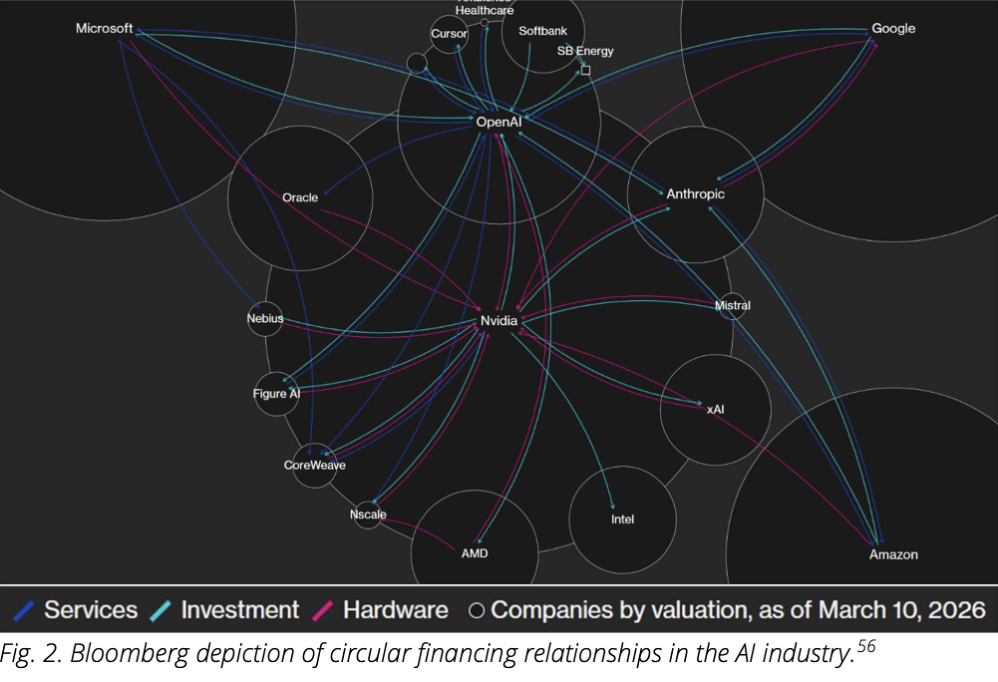
After the AI Crash Vanderbilt Policy Accelerator/Vanderbilt University
Public concern about the level of AI investment is everywhere. While some compare today’s scenario to the dot-com bubble, the economy’s overreliance on AI investment, coupled with opaque financial engineering, means that a market correction could look more like the 2008 Great Recession, an economy-wide crash with systemic consequences. After such a crash, Congress will scramble to identify a reform agenda. In a rush, broader reforms that take time to formulate get shelved for quick action. It doesn’t have to be so. This paper describes how a crash might occur and outlines policies for Congress to consider in response.
How Much AI-Driven Productivity Growth Do We Want? Michael Strain/Project Syndicate
As AI advances, societies must consider how to strike a balance between the disruption caused by rapid productivity growth and its many benefits, including rising incomes and living standards. Fortunately, most advanced economies are well equipped to absorb the shocks associated with breakthrough technologies.
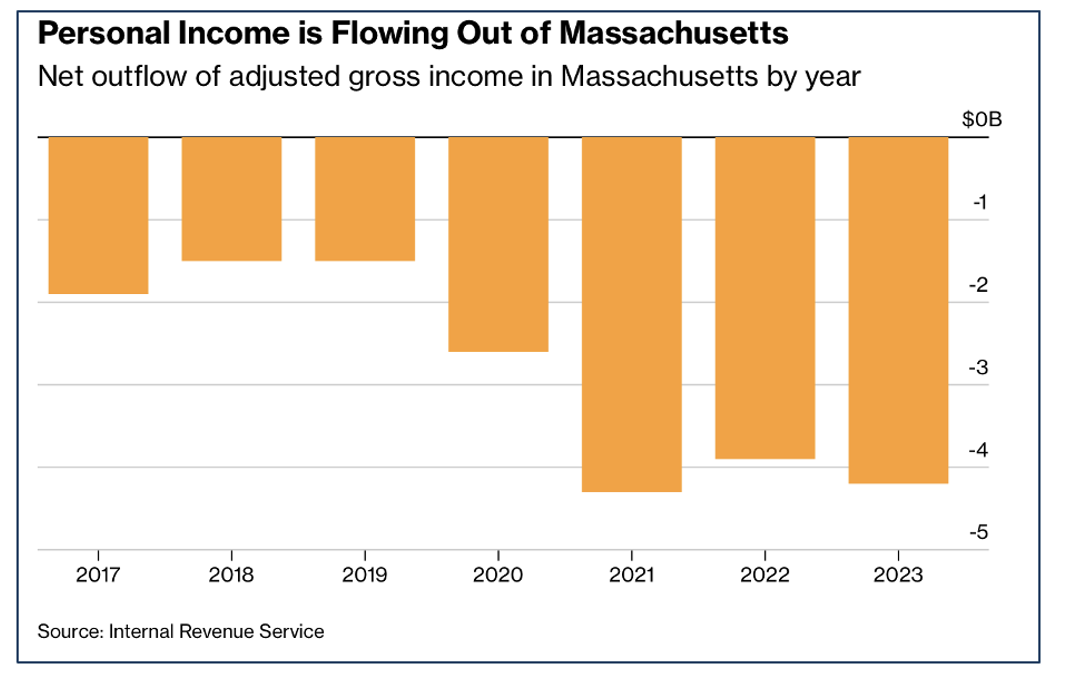
Massachusetts Loses Billions in Income After Millionaire Tax Greg Ryan Bloomberg
Residents exiting Massachusetts took a net of $4.2 billion in adjusted gross income with them in 2023, one of the largest totals in the country, after a tax on millionaires took effect. The amount was an 8% year-over-year increase, according to Internal Revenue Service data, even as the total number of taxpayers leaving the state slowed. This was the first year that residents were subject to a 4% surtax on incomes over $1 million after voters approved the levy in 2022 to fund schools and transportation. Despite the tax’s implementation, the number of residents moving out of Massachusetts who reported income of $200,000 or more — the top bracket tracked in the IRS data — fell year-over-year. Net outflows from Massachusetts long predate the millionaire’s tax, especially to Florida and New Hampshire, its northern neighbor, which has no tax on wages or capital gains. Total lost income was also higher in 2021 than 2023. The state’s millionaires-tax collections have increased every year since 2023 and so far in fiscal 2026 have jumped 19% year-over-year to $1.3 billion.
China
China’s Aging Population and the Implications for China’s Security Rand Corporation
China is facing a population upheaval that could reshape its future. By 2050, China’s population could lose 250 million people. Falling birth rates and rising life expectancy mean that China's population is also aging fast. The number of working-age people peaked in 2015 and has been decreasing ever since. By 2050, there will be fewer than two working-age adults for every person ages 65 and older, compared with more than two and a half working-age adults per older adult projected for the United States. This trend threatens to upend China's ability to grow its economy, strain its pension and health care systems, and threaten its national security. In the first RAND report on this topic, the authors consider the significance of rapid population aging on China's national security.
China Is Wrestling With A Novel Phenomenon: Inherited Wealth The Economist
Many Chinese once viewed wealth and success as reflections of hard work or intelligence. The rich were an advertisement for the dream of advancement. In 2004, according to a paper by Michael Alisky, Scott Rozelle and Martin Whyte, 62% of Chinese felt that “effort is always rewarded” and blamed poverty on lack of ability. But in recent years economic growth has slowed sharply and ordinary Chinese have become gloomy about their prospects. The proportion who think hard work pays off fell to 28% in 2023. People now see unequal opportunity as the biggest factor contributing to poverty; connections and being born rich are considered the keys to wealth. They think mobility has slowed. From 2004 to 2014 70% of respondents thought their family situation was better or much better than five years before. In 2023 only 39% thought so.
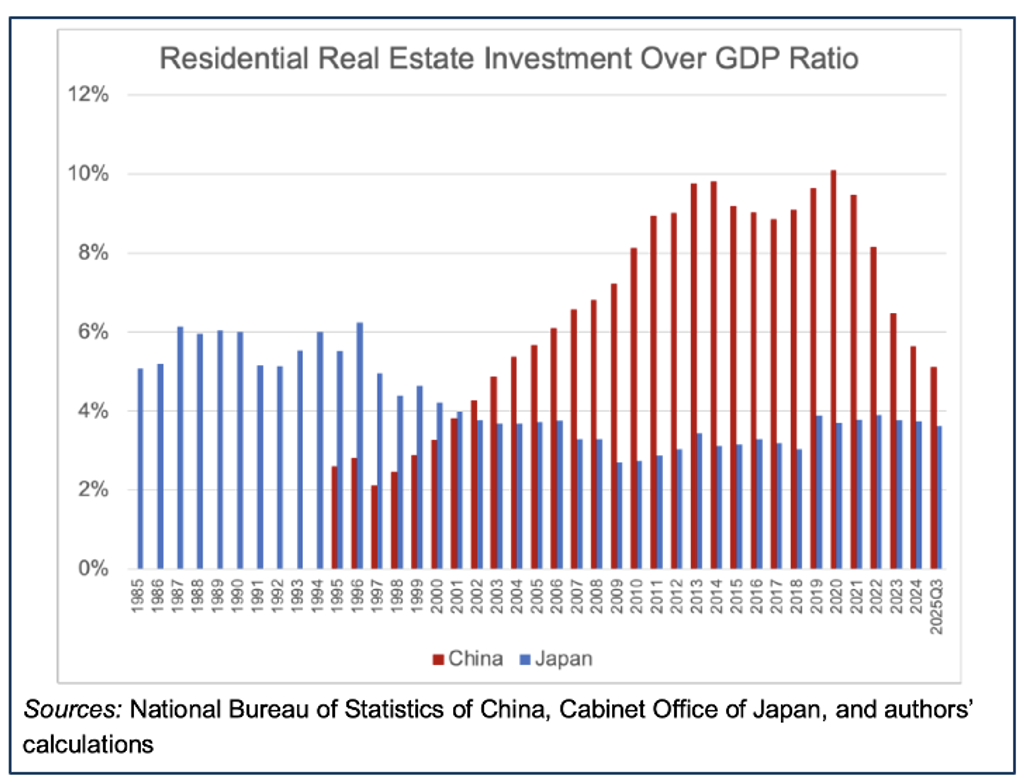
A Tale of Two Countries: The Real Estate Crises in 1990s Japan and Contemporary China Kenneth Rogoff and Yuanchen Yang Brookings Papers On Economic Activity
Japan’s prolonged recession was likely driven by the interplay of slowing returns to investment, soft consumption, and negative sentiment that reinforced these weaknesses. With some structural and cyclical characteristics closely resembling Japan’s pre- and post-bubble conditions, China appears to be in the middle stages of a multi-year correction. China’s post-boom adjustment is unfolding in a more difficult macroeconomic and demographic context than Japan’s. That said, China still possesses several economic and institutional advantages that could help cushion the blow of a prolonged real estate downturn. In Japan’s post-bubble era, the country’s productivity growth was considered a binding constraint, a factor that does not appear to limit China in the same way. Most crucially, China possesses a state-dominated financial system backed by implicit government guarantees and a highly proactive policymaking apparatus capable of large-scale interventions, which have thus far prevented the crisis from precipitating a financial sector breakdown.