October 23 - 25, 2026
Germany’s Military Keynesianism, Why Europe’s Right is Breaking Up with MAGA, What a Global Debt Crisis Looks Like, and How American Firms Are Retreating from China
Below are various reports and articles we read this past week we found particularly interesting. Hopefully, you will find all or at least some of these pieces of interest and useful. Have a great weekend.
Europe Evolving
Guns, Growth, and the German Reinvention of Military Keynesianism Marina Henke & Jack Snyder/War on the Rocks
In March 2025, Germany did more than loosen a fiscal rule. It fused two national emergencies — a deteriorating European security order and a deteriorating industrial model — into a single constitutional bargain. The reform de facto exempted German defense expenditure from any domestic budgetary ceiling — as the German Bundesbank itself has acknowledged — and enabled a military expansion of extraordinary proportions. EU debt rules of 3 percent of GDP for annual government deficits and 60 percent for public debt technically still apply — though 14 out of the 27 Eurozone countries are not expected to meet these rules in 2026. The European Union is also in the process of loosening them. During 2025 to 2028, a Eurozone country with an approved defense escape clause can get away with a 4.5 percent annual deficit if its other fiscal commitment conditions are met. The conventional explanation points to Russian military aggression and doubts about American support for European allies as the key drivers of this monumental turnaround. But this is only half of the story. The much less discussed part is Berlin’s attempt to use this vast, deficit-financed military expansion to revive its stagnating economy — an extraordinary experiment in military Keynesianism.
Why Europe’s Right Is Breaking Up With MAGA Jenny Strasburg & Bertrand Benoit/Wall Street Journal
All over Europe, Nationalist parties are notching election victories and leading in the polls. One recipe for their success: keeping their distance from Trump and his MAGA allies. The absence of the American allies in recent campaigns marked a contrast from the early days of the Trump administration, when MAGA and European nationalists showed a united front. This year, however, Trump’s popularity has slipped in polls and with it positive views of the U.S. An increasing number of countries view China more favorably than the U.S., and Xi Jinping as a more credible leader in managing world affairs, according to a Pew Research Center report in mid-July based on a 36-country survey. Polls show many right-wing Europeans share unfavorable views of Trump.
What a Global Debt Crisis Looks Like Robin Brooks Substack
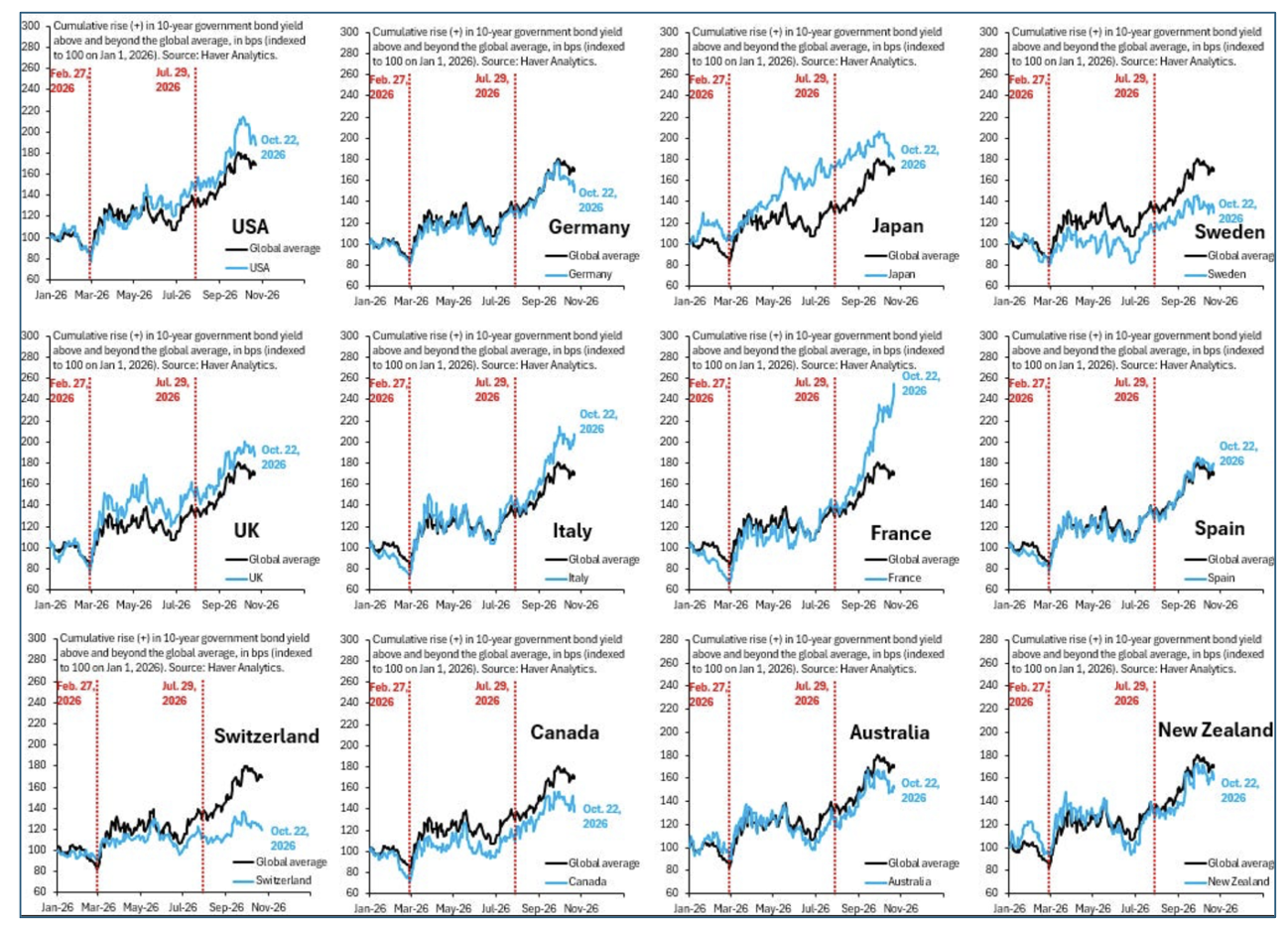
This post is a summary of everything we’re seeing in global bond markets as the crisis in France intensifies. The blue lines in the charts show how 10-year government bond yields have evolved so far this year. I’ve indexed them to 100 on January 1, 2026, and cumulate the rise in basis points from that day to yesterday. If you’re at 200 as of yesterday, that means your ten-year yield is up 100 basis points since the start of 2026. The black line in each chart is the same and is the equal-weighted average of daily changes in all of these yields. I cumulate this up to show who’s better or who’s worse than average. We’re seeing three distinct phenomena: (i) contagion to the rest of the high-debt Eurozone, including Italy and Spain; (ii) a flight to safety into the US, so - when push comes to shove - markets still pile into Treasuries when the going gets tough; and (iii) low-debt safe havens like Germany, Sweden and Switzerland extend their outperformance that’s been a reliable trend this year.
·Merz’ Waning Foreign Policy Clout Josef Janning/Internationale Politik Quarterly
Losses by Germany’s ruling Christian Democratic Union in the most recent state elections have plunged German Chancellor Friedrich Merz’ government into an existential crisis. This will significantly weaken Germany’s foreign and European policy. In short, the Merz administration will devote its full attention to domestic policy; there is neither the time nor energy left for international affairs or Europe. Foreign policy will not save this government; as Außenkanzler (“foreign policy chancellor”), a term often used to characterize his first months in office, Merz is history.
China and the Global Economy
Decoupling Direct Investment: American Firms’ Retreat from China Cody Kallen/FEDS Notes (Federal Reserve Board Economic Research)
For decades, China was a major destination for foreign direct investment (FDI) by U.S. companies. In the last decade, however, trade tensions, geopolitical risks, and investment screening have interrupted these FDI flows and led firms to shift production toward third countries (Reyes-Heroles et al., 2020). Recent research has documented preliminary signs of FDI fragmentation—the reorientation of investment away from geopolitically or geographically distant countries—worldwide, and with emphasis on the relationship between the U.S. and China (Kallen, 2025; Aiyar et al., 2023; Gopinath et al., 2025). By comparison, this note focuses specifically on U.S. investment in China and comprehensively examines different forms of investment. Official bilateral FDI statistics show a modest reduction of U.S.-to-China FDI flows. However, these official statistics understate the true exposure of U.S. firms and investors to China due to investment routing through Hong Kong and other investment hubs. To correct for this mismeasurement and provide a comprehensive picture of U.S. investments into China, I complement the official data with data on individual FDI projects, deals, and subsidiary investments. This approach allows us to look through investment hubs, decompose FDI by type, and track developments through 2025. I find broad-based declines in U.S.-to-China greenfield FDI, U.S. acquisitions of Chinese firms, and the capital investments by Chinese subsidiaries of U.S. multinationals. Moreover, U.S. multinationals are reducing their existing footprints in China, with rising dividend payout rates (retaining less earnings) and increasingly reporting sales of physical capital or negative capital stock growth. These developments have begun to reverse decades of deepening integration between the U.S. and China, especially through the Chinese operations of American companies
Surging Export Similarity is Fueling Advanced Economy Trade Tensions With China Benn Steil & Yuma Schuster/Council on Foreign Relations
China’s export basket increasingly overlaps with that of advanced economies. By CFR’s measure, the export similarity index has risen ~6 percentage points since 2007, driven by growing overlap in chemicals since 2016 and in machinery and transport equipment, notably EVs, since 2023.
Trade leverage between the major economies involves very different kinds of disruption Michael Pettis/China Financial Markets
Reduced Chinese supply raises costs for American and European consumers and firms immediately. Reduced American and European demand forces China to compensate through additional fiscal and credit expansion. Each side can impose meaningful costs on the other, but their leverage operates on different time scales. China can disrupt American and European supply relatively quickly. The US and Europe can disrupt Chinese production in ways that can be offset in the short term but become progressively harder to manage. A temporary agreement can reduce immediate costs and may be economically valuable to both sides, but it does not eliminate the underlying problem. The question is not which side has more leverage, but which side can sustain its leverage as the adjustment unfolds — whether the US and Europe can tolerate higher prices and supply disruption longer than China can tolerate an acceleration in its debt burden.
China’s Growth Machines Robin Rivaton & Ben Southwood/Works in Progress
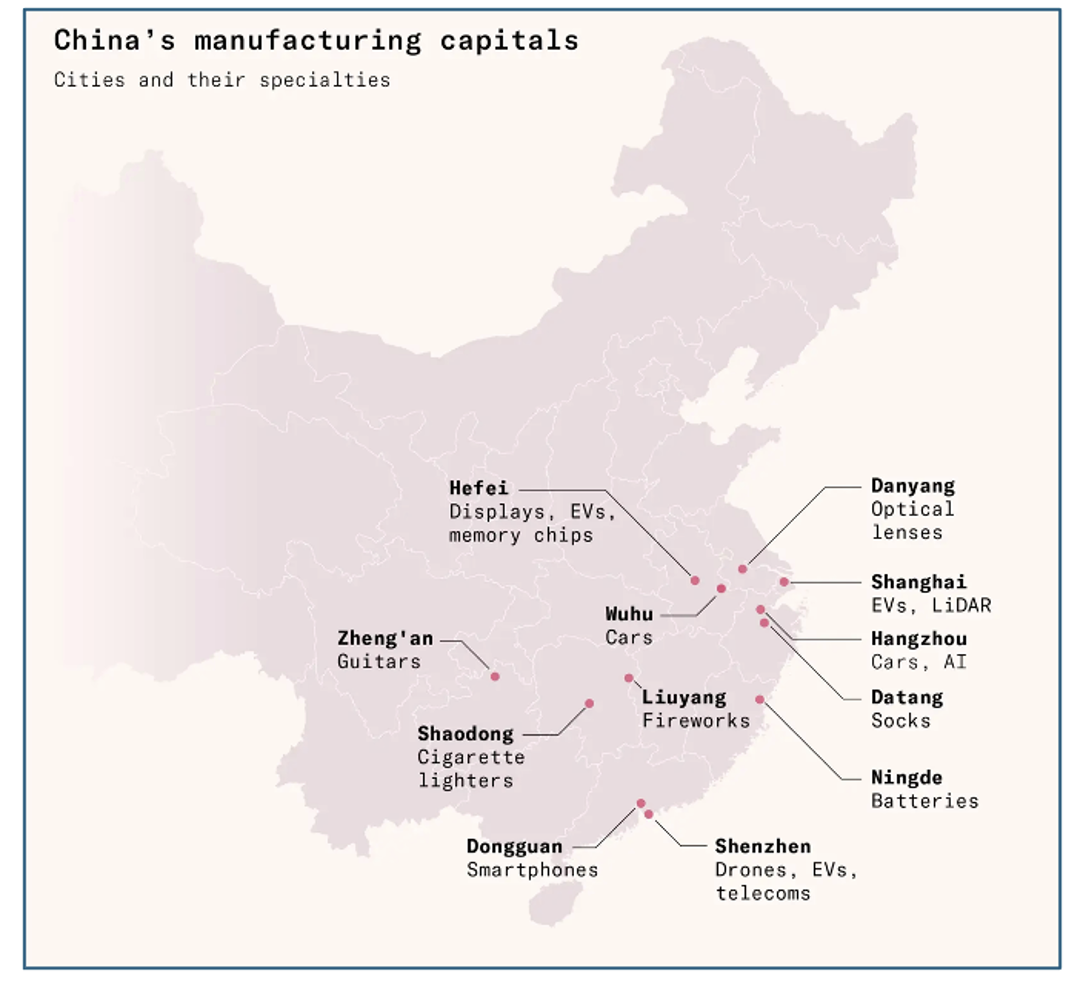
China is not the world’s largest command economy. It is a continent-sized Silicon Valley. Imagine if Y Combinator owned and ran San Francisco. Too much traffic? That’s bad for business. Highway 101 would be triple- or quadruple-deckered, and the metropolitan area might have a dozen subway lines, more like Madrid’s or Osaka’s networks than the BART as it stands. Heritage buildings? They’re nice, but this is a tech town. Skyscrapers would fill the entire peninsula. Instead of wealth taxes on billionaires, the city might even cut taxes to encourage more founders and companies to move there. This is only a slight caricature of how city government works in China. Provincial cities like Hefei and Hangzhou have become world-leading centers of commerce in electric vehicles, consumer electronics, solar panels, batteries, and AI, steered by mayors whose career incentives are similar to those of partners in a venture capital firm, getting promoted if their portfolio grows and fired if it fails. The cities they run function as vertically integrated conglomerates that benefit not just from the success of their local champions, but also from the broader growth generated by masses of companies in their slipstream.