Recommended Weekend Reads
How AI and Quantum Are Used By Criminal State Actors, Will Germany’s AfD Actually Come to Power?, and Canada At An Inflection Point with the US and EU
September 11 - 13, 2026
Below are a number of reports and articles we read this past week and found particularly interesting. Hopefully, you will find them of interest and useful as well. Have a great weekend.
How Global State Actors and Terrorists Are Using AI
For North Korea, AI is a cybercrime force multiplier The Strategist
AI is changing how states operationalize their cyber capabilities. In North Korea’s case, it’s transforming the country into a bigger cyber power by helping Pyongyang expand what it already does: generate revenue, obtain trusted access, and collect intelligence at extraordinary scale. North Korea has built one of the world’s most unusual state cyber programs, treating hacking not only as an instrument of statecraft but as an industry. Its operations combine cryptocurrency theft, fraudulent overseas IT employment and other forms of cybercrime with longstanding espionage against foreign Defence, aerospace, government and policy targets. AI fits naturally into this model because its greatest value is in lowering the cost of running existing fraudulent models.
Users in Houthi-held Yemen tried to develop advanced weapons with AI, Anthropic says Associated Press
Anthropic says Claude users in northern Yemen, territory controlled by Iran-backed Houthi rebels, tried to use the AI model to develop advanced missiles. AI is already transforming warfare from Ukraine to Gaza, and its use on a rugged and remote battlefield is likely to increase concerns about its rapid spread. Anthropic said the users of the accounts, which it blocked after identifying them, did not succeed in “fielding an operational device” but did carry out a failed test of a guided rocket. It said it knows that because the users returned to its Claude chatbot to find out why it failed. In a report released Thursday, the company did not identify the users. But mountainous northern Yemen is controlled by Houthis, suggesting that the rebels are pursuing more sophisticated weapons at a time when they are already wielding an array of drones, missiles and other munitions in their campaign to seize more territory in Yemen and damage Saudi Arabia’s oil exports. You can find and read the Anthropic report HERE.
FBI unveils Cyber Strategy as state-backed actors target critical infrastructure and ransomware threats escalate Industrial Cyber
The Federal Bureau of Investigation (FBI) unveiled a new Cyber Strategy to defend Americans and U.S. critical infrastructure in cyberspace, outlining four pillars focused on disrupting adversaries, supporting victims, strengthening partnerships and building the capabilities needed to carry out the mission. Recognizing that the nation’s cyber threat is escalating in both scale and sophistication, the FBI Cyber Strategy noted that state-sponsored cyber actors collect intelligence, steal proprietary data, and pre-position access to disrupt the nation’s critical infrastructure. “Ransomware groups paralyze companies and trigger cascading effects across industries. These actors operate within an increasingly professionalized ecosystem of developers, affiliates, and service providers. AI-enabled tools and social engineering amplify these threats, compressing intrusion timelines and lowering barriers to entry for less sophisticated actors.” You can read the FBI Cyber Strategy HERE.
The war before the war: quantum, strategy and a closing window The Strategist
Militaries rarely lose because they lack courage; they lose because they misread a moment. They lose because they categorize a disruptive technology as an incremental one, and by the time they see the error, the strategic advantage has already been transferred to someone else. Consider radar, precision-guided munitions and cyber. In each case, there was a window (between technological maturity and operational effectiveness) where the military that first grasped the disruption gained a structural advantage that proved very difficult to reverse. Its opponents eventually caught up on the technology. However, they rarely recovered the strategic position. Quantum technology is in that window now. And the window is closing faster than Australia’s strategic policy has absorbed.
German Elections: What Happened And What Next?
Merz has no good answers as the far right targets his downfall PoliticoEU
Germany’s far right is moving to turn its landslide election victory into a knockout blow against Chancellor Friedrich Merz and his beleaguered conservatives — and the chancellor appears at a loss over how to respond. Merz seemed to have no clear plan for saving himself and his party as his government confronted its biggest political crisis yet, beyond ambiguous promises to become a better, more empathetic politician 16 months into his chancellorship.
New attempts to ban the AfD will only boost its support Wolfgang Munchau/UnHerd
It took Germany’s conservative political establishment two days to come up with what it thought was the resounding answer to the AfD’s victory in Saxony-Anhalt on Sunday night. Hendrik Wüst, the state premier of North Rhine-Westphalia and the man most likely to succeed Friedrich Merz as Christian Democratic Union leader and chancellor, has now joined a chorus of center-left politicians by calling for a ban on the AfD. What is happening here is that the German center-right is panicking. The chance of a ban is close to 0%, as this is something only the constitutional court can do and the hurdles for any such action are high. The legal precedent for this was the failed attempt a decade ago to ban the National Democratic Party (now The Homeland), a genuinely neo-Nazi group. The AfD leadership has gone to extremes to comply with the constitutionally mandated requirements, implementing procedures to weed out neo-Nazis. When 44% of an electorate supports a party, a rarity in modern, fragmented politics, they’re not likely to all be extremists.
Germany’s democratic earthquake: the AfD breakthrough in Sachsen-Anhalt and the question of an “alternative to the Alternative” Adam Tooze’s Chartbook
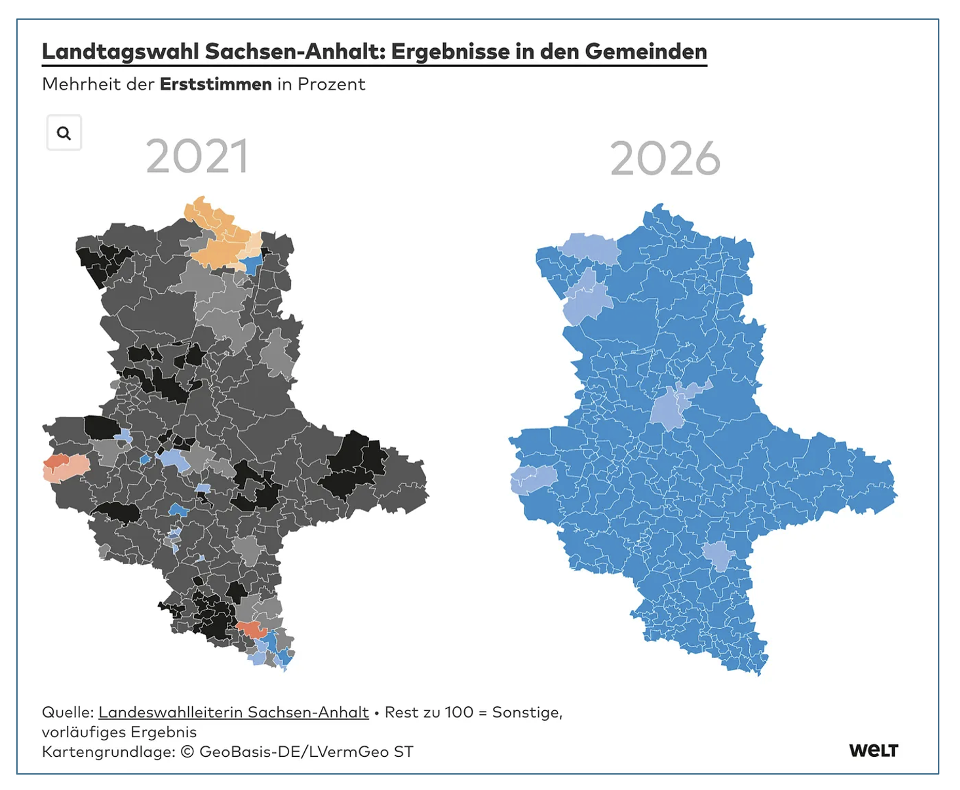
Germany’s democracy has suffered an earthquake. In its regional elections last weekend, the tiny state of Sachsen-Anhalt - population of just over 2 million souls - gave a stonking 44 percent plurality to the AfD (Alternative für Deutschland). The AfD has pulled off an astonishing transformation of the electoral map. Despite their remarkable showing, it is not obvious that the AfD will form the next government in Sachsen-Anhalt. The other parties may arrange themselves to keep the AfD out of power. At the national level, the AfD are even further from government. Nevertheless, this result shakes Germany’s political system. It shows how far the familiar political norms of the Federal Republic have disintegrated. Mecklenburg Vorpommern, another small East German state, will vote on September 20th and the outcome may well be similar. The crisis of German democracy has long been forecast. It now seems to be upon us. The AfD comes in political different shades. In Sachsen-Anhalt it has been officially classified by the German authorities as right-wing extremist. The AfD’s candidate, Ulrich Siegmund, is a charismatic former corporate scent salesman who once tried to convince the government of Berlin that perfuming underground stations with the scent of vanilla would reduce crime. You can’t make this stuff up!
How Did Germany’s Anti-AfD “Firewall” Hold? Transatlantic Intelligencer
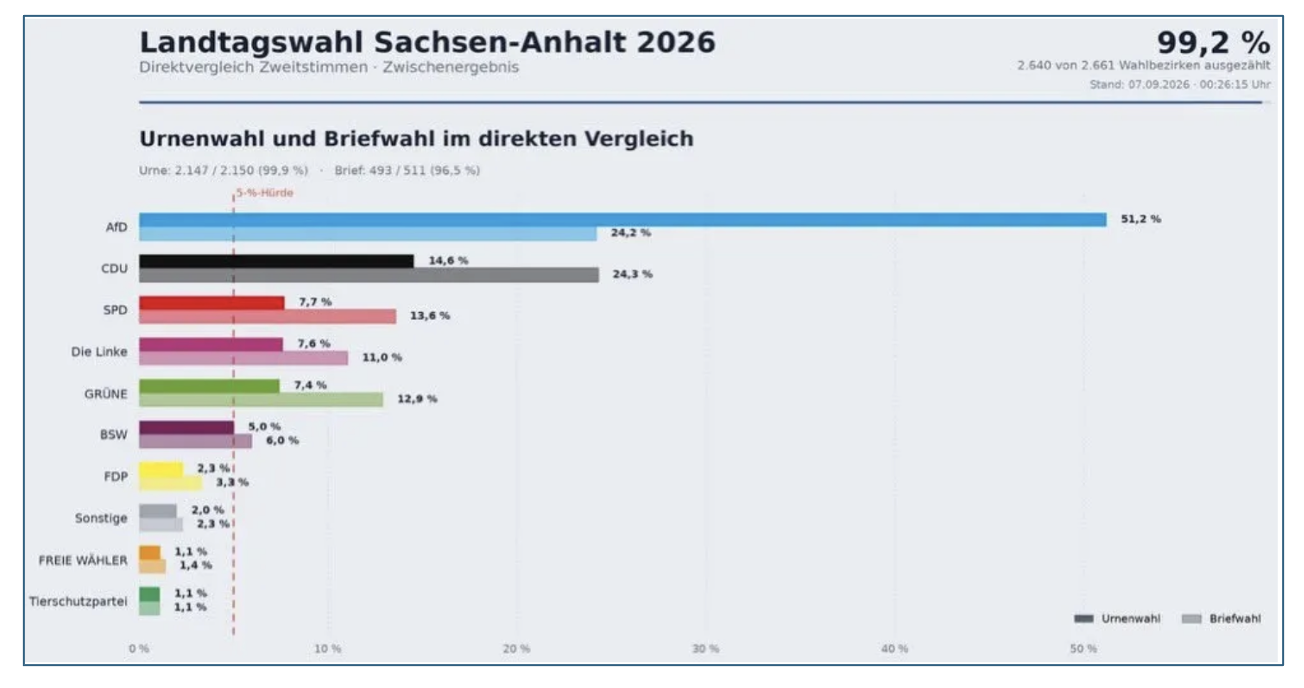
What the German mainstream calls the “firewall” has held. Despite winning an impressive 43.8% of the vote in regional elections in Saxony-Anhalt, the opposition AfD, or “Alternative for Germany”, party has fallen three seats short of the absolute majority in the regional parliament that would have ensured that the party could form a government under its prime minister candidate, Ulrich Siegmund. But critical German observers are pointing to a massive anomaly in the voting data that raises the obvious question: How exactly did the “firewall” hold? A startling discrepancy between the mail-in and in-person votes may hold the answer. Here is a graph published by the X-account Datenfuzzi comparing the results of in-person voting to the results of voting by mail-in ballot. The first, darker line represents the in-person voting results; the second, lighter line represents the results of voting by mail-in ballot. As you can see, the AfD received over 50% of the votes cast at the polling stations (51.2%), but less than half that percentage of the votes cast by mail-in ballot. All the main establishment parties, by contrast, performed significantly better in the mail-in ballots than in the in-person vote. So too did the post-Communist “Left” party (Die Linke).
Canada At An Inflection Point with the US and Europe
Friends without benefits: Why the EU should offer Canada more than casual defense ties European Council on Foreign Relations
European leaders losing sleep over Trump’s economic and territorial threats should spare a thought for their Canadian counterparts. Both the EU and Canada face a similar conundrum: how to de-risk their relationship with an increasingly predatory United States, which exposes them to security threats from Russia and poses a new threat of its own. It is against this backdrop that Carney will attend commission president Ursula von der Leyen’s State of the European Union Speech in Strasbourg on September 16th. A summit will follow in October. The timing could scarcely be better for Europe and Canada to make common cause. But if European leaders want to shift the relationship into a new gear, they will have to revise their usual approach to how the EU treats third countries, particularly in defense and security, where both sides’ dependence on the US runs deepest.
The Fallout of the U.S.–Canada Trade War Won’t Be Limited to North America Carnegie Endowment for International Peace
President Donald Trump further escalated the U.S.–Canada trade war, banning the import of some Canadian goods, in response to Canada’s retaliatory tariffs that took effect the same day. It is difficult to view Trump’s actions against Canada as anything other than unnecessary, avoidable, short-sighted, and harmful to both economies. Crucially, these moves deepen widespread concerns about the Trump administration’s trade policy—not only across North America, but with other key partners, including in the Asia Pacific. Indeed, the administration’s confrontational approach risks weakening the North American production platform that supports U.S. competitiveness. The dispute also forfeits a chance to build a coherent trade framework that advances long-term U.S. economic and strategic interests by aligning partners around shared goals rather than relying on coercion. Moreover, by focusing on bilateral relationships, the United States is missing a chance to shape global trade through commitments backed by a meaningful coalition of partners. Finally, a trade war with Canada—and with other U.S. allies and partners—wastes time and diverts attention away from real and urgent strategic challenges the United States cannot afford to neglect.
Fed up with the U.S., Canada is aggressively seeking new trading partners Washington Post
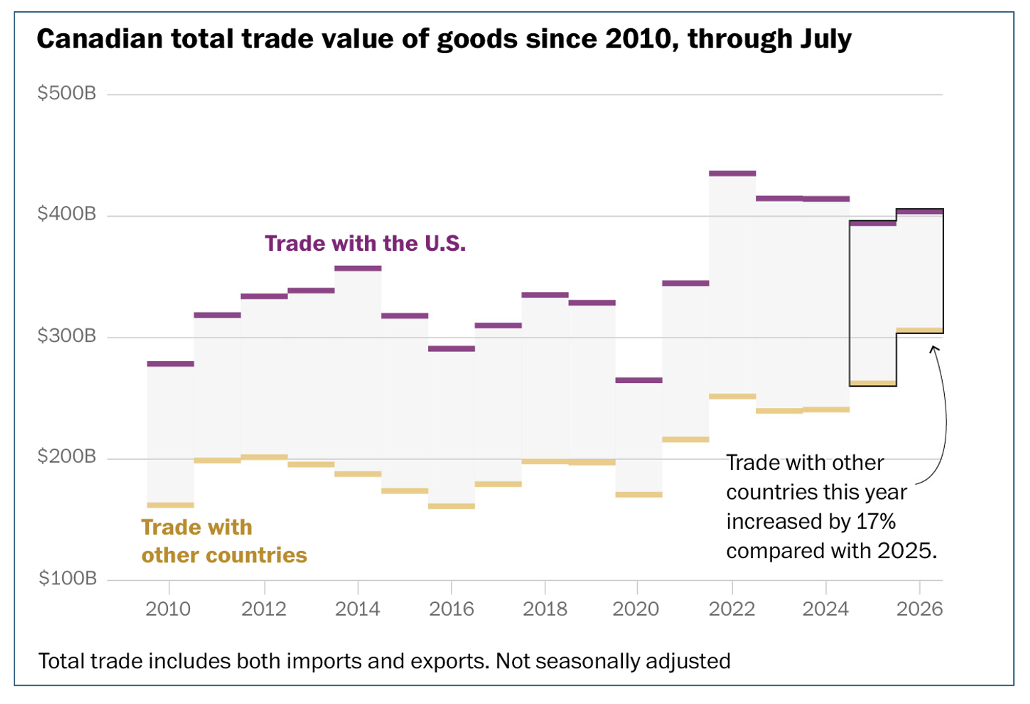
Canada is aggressively courting new trading partners as relations with the United States grow increasingly tense, in a move that could deliver economic consequences for U.S. businesses and consumers. Canada has an ambitious goal to double its exports to countries beyond the U.S. by 2035, a target that has become more urgent in the face of hefty new tariffs — from both sides — taking effect. President Donald Trump imposed 50 percent levies on a long list of Canadian products this summer and has needled Canadians by suggesting the country should become the 51st U.S. state.