

Recommended Weekend Read
What Impact Will Trump’s Latest Tariffs Have on 60 Targeted Countries? Cuba On the Brink, How DARPA Intends to Build Nuclear Reactors the Size of AA Batteries, and Inside Ukraine’s Kill Zone
July 31 - August 2, 2026
Below are a number of reports and articles we read this past week and found particularly interesting. Hopefully, you will find them of interest and useful as well. Have a great weekend.
Assessing the Impact of the Latest US Tariffs
The State of U.S. Tariffs July 24, 2026 John Iselin/Yale University Budget Lab
As of July 24th, the average statutory tariff rate stands at 11.1% after falling by about 0.3pp when Section 122 tariffs expired and were replaced with new tariffs under Section 301. Under current law, which includes several scheduled tariff increases in the coming months, this figure is set to be 11.8% by the end of this year. The Yale Budget Lab estimates the ultimate consumer price impact of current-law tariff policy to be about 0.7%. They also estimate household costs due to tariffs total about $1,100 annually under current law. Over the next ten years, the Lab estimates that current-law tariffs will raise about $1.9 trillion. These numbers are somewhat lower, though, after considering the negative impact of tariffs on GDP.
Global Trade Alert’s panopticon on Section 301 forced labor final findings Hinrich Foundation
Global Trade Alert repackaged the USTR’s 24 July final finding on its Section 301 probe on forced labor practices in 60 economies into 60 economy-specific PDFs as a handy trade research tool. New US Section 301 tariffs of 10% or 12.5% took effect on 60 economies for alleged forced-labor practices, with limited exemptions. The Global Trade Alert breaks down how the tariffs were levied based on each economy’s forced-labor import ban regime. USTR’s 431-page notice covers three parts: findings, tariff-schedule Annex I, and 15 exemption lists (Annex II) covering specific products and economies.
The Big Exceptions to the American Manufacturing Jobs Decline Jiaxin (Jason) He Agglomerations
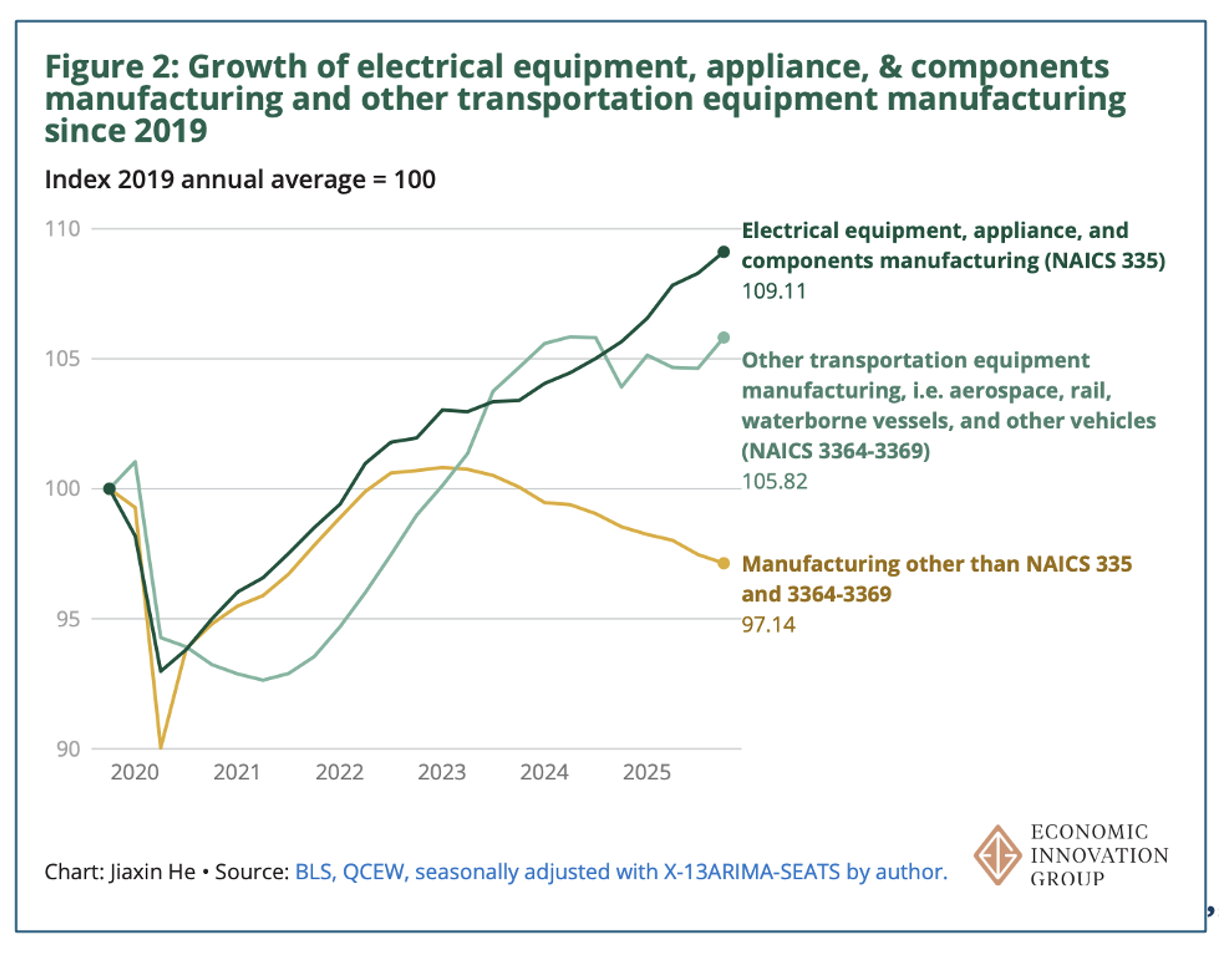
The Trump Administration’s hope that its tariff policy would increase manufacturing jobs has failed to materialize. Even after a modest uptick in the last three months, the manufacturing sector lost 53,000 jobs in the year through June. It has now shed 300,000 jobs since its post-pandemic peak of 12.9 million in the second quarter of 2023. The short version of what we found is that nearly every manufacturing subsector has lost jobs since the post-COVID peak roughly three years ago. But this study also discovered a few intriguing exceptions, and each of them tells a useful story about recent trends in the U.S. economy. Jobs in two other subsectors - electrical components and transportation equipment - not only have grown since the peak but also have continued their growth throughout 2025. As of the end of last year, electrical components manufacturing employed 9.1 percent more workers than in 2019, while transportation equipment employed 5.8 percent.
Cuba
Cuba: The Capital of 21st Century Communism US State Department
The US State Department, in a new report which ratchets up US-Cuba tensions to a new level, strongly accuses Cuba of waging “a sustained campaign of subversion against the United States. It is a campaign that has infiltrated the highest reaches of the U.S. government, recruited and cultivated generations of American activists, backed an unprecedented wave of left-wing terrorism on American soil, and carried out one of the most durable and damaging foreign intelligence penetrations in American history.” The report goes on to charge, “The Cuban campaign against America is unique. It is irregular and covert – even at the peak of its military power, Havana never possessed the capacity to defeat the United States in a conventional armed conflict. Instead, the Cubans perfected a new model for a long war of attrition, organized around espionage, infiltration, sabotage, proxy networks, and a revolutionary infrastructure designed to turn America against itself. In contrast to every other aspect of Cuba’s failed state, this model has yielded remarkable success.”
Does Cuba Really Have Iranian Drones? Foreign Policy
U.S. President Donald Trump recently said the United States is “looking into” whether Cuba is stockpiling Iranian drones and suggested that Washington could act if that’s the case. National security and Latin America experts told FP that it’s probable that Cuba has such drones, but they also emphasized that it’s extraordinarily unlikely that Havana is planning on taking offensive actions against the United States. The experts also believe that the recent alarm raised over drones in Cuba is part of a broader effort by the Trump administration to establish a pretext for U.S. military action against the island as it works toward the goal of collapsing the government in Havana.
The collapse of Cuba’s state-run economy is years in the making The Atlantic Council
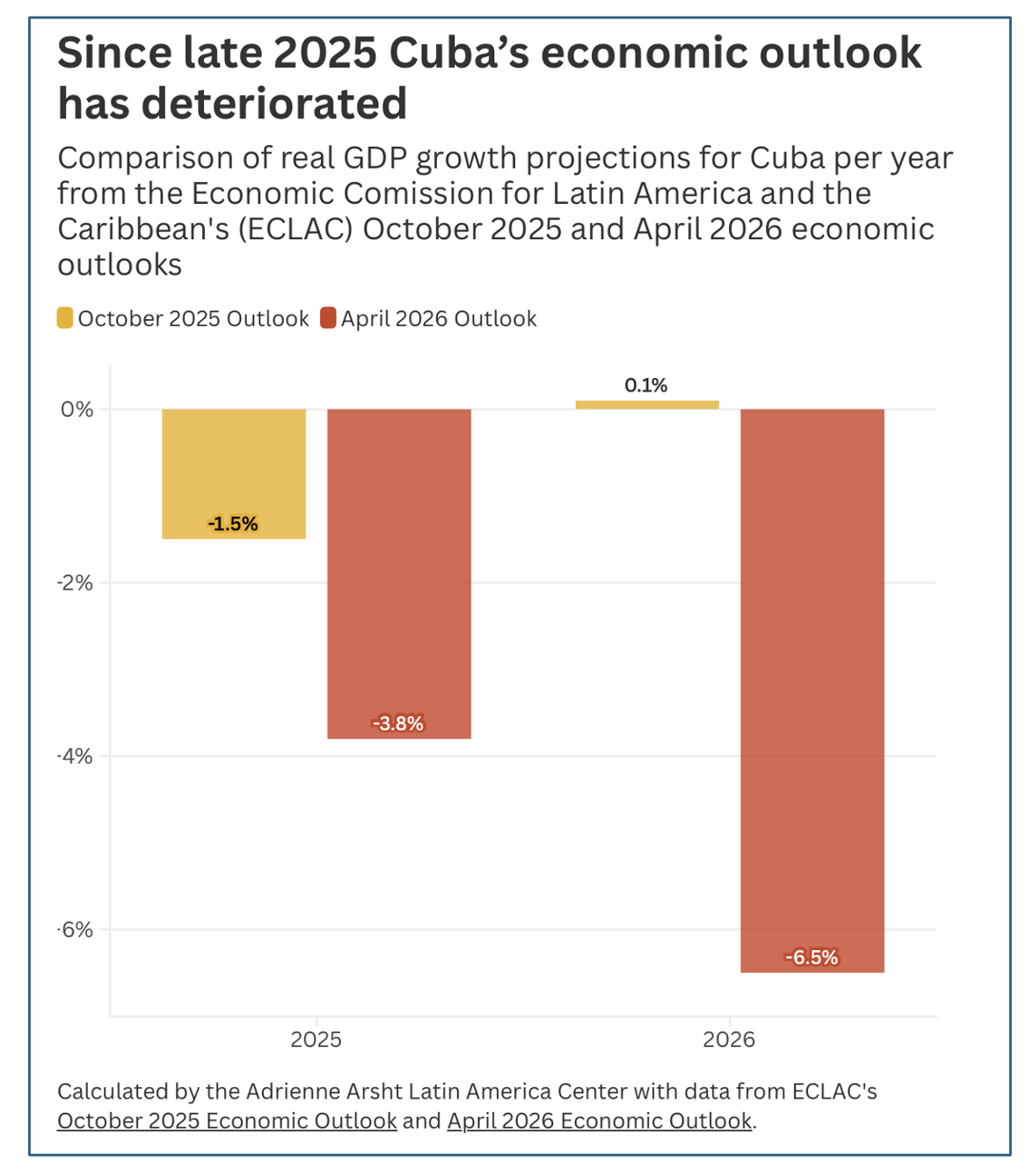
In April, the United Nations Economic Commission for Latin America and the Caribbean (ECLAC) projected that the island’s economy would shrink by 6.5 percent in 2026. This projection is significantly worse than the October 2025 projection of practically zero growth. The pressure is mounting, but the economy’s collapse precedes the recent pressure campaign. Another projection, from the Economist Intelligence Unit, further downgraded the outlook to a 7.2 percent drop in total output for this year. To look at only this data gives an incomplete picture. To begin with, even though ECLAC conducts its own independent assessment, its projections are based on official statistics from the Cuban government, presenting a credibility issue. But even more important, the two-year window is too narrow a snapshot of the Cuban economy’s problems.
Can Cuba Outlast Marco Rubio? Lee Schlenker/Quincy Institute for Responsible Statecraft
Shortly after four members of Congress returned from a fact-finding visit to Havana early last week, Secretary of State Marco Rubio announced a tranche of new sanctions against Cuba’s tourism, energy, trade and security sectors, the latest move in a months-long maximum pressure campaign intended to overthrow the island’s government by year’s end. Nonetheless, all signs indicate that progress in bilateral talks made back in March — when the U.S. “allowed” a Russian fuel tanker to dock in Havana, providing momentary relief for Cuba’s economy — has largely stalled, and other unconventional backchannels have petered out.
Big Strides in Energy Innovation and Drone Warfare
How DARPA plans to get nuclear power in the size of a ‘AA battery’ Breaking Defense
The biggest roadblocks to having transportable nuclear power, according to DARPA program manager Tabitha Dodson, come down to heat and weight. “There’s an enormous amount of energy inside a nuclear reaction, whether it’s fission or radioisotope,” Dodson told Breaking Defense. “[But] there is a lot of heavy and non-transportable hardware that deals with heat management for both fission and RTG [radioisotope thermal generators] systems. That heat management piece is always what drags down all of the dreams of transportable nuclear power.” As a way to bypass that roadblock, DARPA funded seven competing teams as part of its Rads to Watts program to refine a range of approaches to radiovoltaics. The objective of the multi-million-dollar program (full figures weren’t disclosed) is a new kind of miniature power cell that can run anything from satellites in space to tactical radios to pacemakers, tough enough to work for years or decades without recharging and in extreme environments that freeze or try traditional power systems.
Inside Ukraine’s Kill Zone Reuters Graphics
This fascinating, in-depth video/motion report by Reuters is the most detailed reconstruction yet of the new breed of battlefront. It will take you into the kill zone via a “fly-over” that starts 15 km inside Russian-held territory before heading to the contact line between the two sides and then 15 km further into Ukrainian-held land. The war, well into its fifth year, has become the first major conflict to be dominated by unmanned aerial vehicles, with thousands of the cheap but deadly machines filling the skies. Ukraine and invader Russia are constantly advancing the new technology, which is transforming modern warfare. Both sides have had to abandon age-old tactics of gathering troops, vehicles and artillery in a relatively compressed area along the front lines. Such visible targets are easy prey for drones.
Killer Drones: Ready or Not, Here They Come American Enterprise Institute
Lethal autonomy is arriving, regardless of preference or treaty. Shrinking populations and accelerating technology are pushing every military toward increasingly autonomous machines in the kill chain; the live question is whether the US or its adversaries set the bounds. Proliferated precision sensing and strike capabilities create two coupled operational problems: Concentrated forces are now fatally targetable, and the dispersal that addresses this problem depends on dataflows that are themselves an attack surface. Both problems demand uncrewed mass and bounded autonomy to attain scales of force that crewed forces alone cannot reach. The principal barrier is institutional, not technological. The color-of-money structure, Planning, Programming, Budgeting, and Execution cadence, milestone-style test and evaluation approach, and platform-centric sustainment cannot develop capabilities that must iterate continuously—and service cultures resist capabilities that threaten dominant communities.